
Inside Andy Burnham's charm offensive
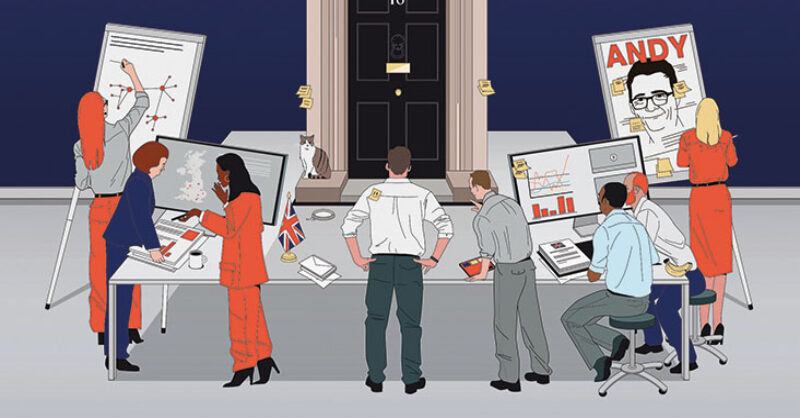
Who is providing the ideas for the Andy Burnham machine? The answer might shock you. After years of political briefings about advisers and strategists described as the “powers behind the throne” of prime ministers, the brain guiding the incoming regime is a Cambridge-educated northerner with decades of experience: a guy called Andy Burnham.
Watching his speech at the People’s History Museum in Manchester on 29 June, a senior colleague didn’t need to ask anyone to know that Burnham had written every word himself (which he had, the weekend before, at his home in Lancashire). The ideas, the observations, the final flourish. It was all him. This is what he believes.
For the next three weeks, a Labour leadership contest will play out in which there is only one contender. You could call this period the interregnum, the strange limbo between prime ministers, Keir Starmer’s farewell tour, the unofficial beginning of Burnham’s premiership. Burnham’s team, however, calls it “the campaign”. Labour’s next prime minister sees this moment as his one brief, precious window to articulate his project, and get support for it from across the party. This is Burnham’s moment to secure a Labour mandate. Once he is in No 10, the project will be agreed and his party will be expected to pull together to deliver it.
The clue was there in his speech: “The political direction I set is not up for negotiation,” he said, almost as an aside. He is preparing to lead the Labour Party in a way it hasn’t been led for years. This is a man who knows what he wants to do with power, who writes his own speeches, who is defining the purpose of the next decade of Labour government. “Speak now or forever hold your peace,” is the subtext. He is telling the party – and the country – how he intends to lead it. These three weeks are the time in which the Andy Burnham project will be agreed and ratified.
At every stage, Burnham has prepared for all scenarios, but the most likely one – even a few weeks ago – seemed to be that he would find himself fighting a leadership contest, possibly against Wes Streeting, or even Starmer. Burnham and his team prepared for that, and though he may stand unopposed, he has a campaign group operating as if it was a competitive race. The former transport secretary Louise Haigh, as chair, holds a daily morning call and an “evening wrap” with campaign staff, with all of the teams you would expect in a formal contest – spanning strategic communications, policy, digital and so on.
Jacinda Ardern’s election-winning campaign director, Hayden Munro, has been drafted in to coordinate the coming weeks, bringing expertise from New Zealand politics and, perhaps just as importantly, a lack of expertise in the petty grievances of UK Labour politics. “He doesn’t know who was rude to who 20 years ago – and that is definitely a strength,” one campaign insider jokes. He is deputy campaign director, serving as “air-traffic control” between the different teams.
Burnham has set a clear intention internally that he wants a positive, collaborative and supportive culture – which Munro has told colleagues reminds him of Ardern’s approach. Externally, too, Burnham, like Ardern, has made a conscious decision to eschew “the political point-scoring that the public is sick of”, as the same campaign insider puts it. Burnham didn’t publish attack leaflets about Reform during the Makerfield by-election – there were no negative flyers or dodgy bar charts – and he only referred to Nigel Farage obliquely on doorsteps, worrying about the “divisiveness” of the “alternative”. He mentioned the Conservatives only once during his speech in Manchester – and that was in the context of something positive that they had done.
If the purpose of a leadership campaign is to set out what you want to do and secure a mandate for those ideas from within your party, that logic still applies to how Burnham sees the next three weeks. “Andy wants to spend this period of time laying out what the project is – the values, the ideas underpinning it,” one senior campaign figure says. If the problem under Starmer was that he never set a clear, unified direction for all of his cabinet ministers to follow, Burnham is intent on doing the opposite. He is determined to establish a blueprint for his premiership so that there is no doubt about where he is going.
Speaking to those working on the Burnham campaign and preparation for government in recent weeks, they have all said a version of the same thing: the direction is coming from the top. Miatta Fahnbulleh, the Peckham MP and former think-tanker, who is leading policy preparation for Burnham, has engaged with his thinking about how Westminster is failing and what can be done differently. Head North, Burnham’s 2024 book, co-written with the Liverpool mayor Steve Rotheram, set out this blueprint for changing politics – and for devolution in particular.
“He’s thought about many of these issues for the last decade,” Fahnbulleh says. “He’s written about a lot of these issues in his book. He’s been prosecuting the same arguments over and over again about the change the country needs and how that change is delivered by putting power in the hands of the communities that know how to deliver change for their place best.” Her job – and the job of the campaign’s policy team – is to come up with the policy proposals that sit beneath the vision established by the boss, which he can discuss during the campaign and can then be taken into access talks with the civil service and plugged into the Whitehall machine. It is then up to civil servants and the relevant secretary of state to finesse or change the exact policies to deliver the Burnham vision.
That recent speech in Manchester meant a great deal to Burnham. He saw it as the moment he set out the defining architecture of his premiership, spelling out his plan for a fundamental change in how the country is governed: a huge devolution of power closer to local communities, a culture change in Westminster and Whitehall, and policies to underpin a ten-year mission to improve living standards. Devolution is not the natural inclination of many in the Labour Party, whose instinct is often to seize the levers of power from the centre and drive change from there, such as with the Labour-founded National Health Service. But place-based politics, with change driven from the ground up, is what Burnham believes in – and has believed in for a long time. Now it is what the Labour Party has to believe in too.
Burnham declined to take questions after his speech, wanting his words to take precedence over inevitable questions about his choices for chancellor and other senior roles. In a sense, he gave his own answer to that question: whoever the chancellor will be, they will be working to deliver the Burnham vision and not their own. Starmer might have outsourced his political thinking to Morgan McSweeney, his economics to Rachel Reeves, his health policy to Streeting, and so on, but Burnham is dictating the direction himself. “I had no doubt watching that speech that the person driving the economic rewiring of the state will be Andy,” one senior Labour figure commented afterwards.
He has set the tone in terms of an ambitious devolution agenda, and also in terms of policy priorities: reform of utilities, to bring down the cost of essentials over a ten-year period, reindustrialisation, and regional regeneration. We don’t know who will hold the posts yet, but we already know that, along with the great offices of state, the housing secretary, business secretary, energy secretary and environment secretary will be important figures in the Burnham government. We also already know what their defining missions will be.
If outlining his intentions is one priority for the Burnham “campaign” in this three-week period, the other is securing the backing of as much of the Labour Party as possible: a mission that isn’t yet finished, however inevitable a Burnham premiership now appears. The race is on to secure the backing of as close to the entirety of the Parliamentary Labour Party (PLP) and affiliate groups as possible, so that the mandate feels “unanimous”, as one figure involved in securing nominations puts it. And until Labour leadership nominations close in mid-July, it isn’t guaranteed that Labour MPs who want a contest won’t manage to organise behind an alternative candidate.
Burnham rushed back to Westminster after his Manchester speech for meetings with Labour MPs. In the whirlwind of returning to Westminster and preparing for power, this is how he is spending much of his time: meeting colleagues he didn’t yet know, or who did not intend to back him, discussing his vision with them, and finding the reception more positive than he might have expected. Whether Burnham is genuinely converting them with his project or they are simply jumping on the train before it leaves the station, “everyone is an ally of Andy Burnham now”, another insider jokes.
Campaign staff say to expect an amusing array of figures, including serving cabinet ministers who perhaps were not always as keen on Burnham as they are now, giving him their support when Labour leadership nominations open on 9 July. Nominations must be made in person, and crowds of Labour MPs are expected to gather outside the room before it opens – “like the John Lewis sale” as one insider jokes – to sign the nomination papers as close to the top of the list as possible, a symbolic gesture of being close to the new leader.
Burnham left Westminster ten years ago because he didn’t think it was working. He has returned and told colleagues it now feels “doubly so”. He is shocked by the divisiveness and toxicity he is encountering in his meetings with new colleagues. He said as much in his speech, remarking that he was “worried about what I found on my return last week. It is a more fragmented, disjointed place than the one I left and, frankly, unhappier.” Insisting on a positive, collaborative culture, engaging with Labour MPs who have felt neglected, using the talents of the entirety of the PLP, Burnham is determined to change the culture, rather than letting it change him. Allies say Westminster is underestimating how committed he is to that. Even the famously adversarial Prime Minister’s Questions could be in line for a change under the Burnham regime.
Yet culture change is hard, especially in a Labour Party that has become entrenched in its divisions and ways. Since Burnham returned, the party has already descended into a ferocious briefing war around Ed Miliband, his likely chancellor. Inside Burnham’s campaign team, there are divisions around the role of Josh Simons, who was forced to resign over the Labour Together scandal and then stood down as an MP to allow Burnham to run in Makerfield. Simons is seen as smart and energetic, but he is nevertheless ruffling feathers with his working style, which one campaign insider has compared to that of McSweeney (with whom Simons used to be close). “We can’t have a return to the boys’ club,” one worried campaign insider says.
Burnham will spend the next few weeks expanding on the argument he outlined in Manchester, believing he has to tell his story again and again for it to stick. And behind the scenes, his conversations with his divided but hopeful colleagues continue. They are so far enjoying being led. Whether he can keep them behind him as he makes defining personnel decisions will be the next question.