
It's Possible to 3D Print an Entire Outfit Now. 'Should You?' Is Another Question
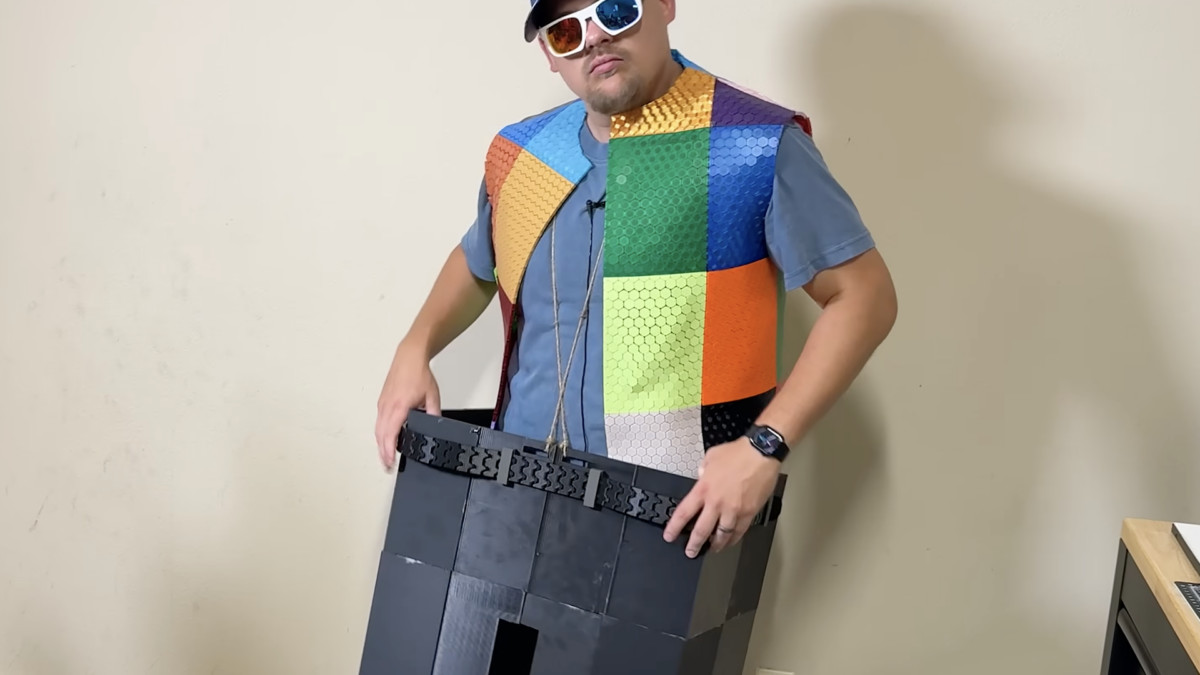
YouTuber Matthew Trahan has carved out something of a niche for himself as the guy who 3D prints everything. In previous videos, he’s 3D printed various musical instruments, a bunch of stuff for his bedroom, and, um, himself. His latest video finds him moving into the world of fashion to “[take] on Gucci and Louis Vuitton” by seizing the means of production and 3D printing an entire outfit. Does this point to a cost-effective future for DIY fashion??
Trahan’s checklist for this project includes a shirt, a pair of shorts, a pair of shoes, a pair of socks, a belt, a hat, a wallet, a bag, a tie, and some glasses. That’s a lot to get through, and, well, let’s just say that various degrees of success are achieved. You can probably tell from the video thumbnail that this isn’t an entirely serious enterprise:
Here’s the thing, though—while Trahan’s video is ultimately goofy and fun, some of the stuff he prints is actually kind of cool. The shoe design that he uses, for instance, looks like a Nike fever dream, in a good way:
If you like them, or anything else in the video, all the patterns are available online.
Trahan’s technicolor vest, meanwhile, clearly isn’t super practical, and the less said about the shorts, the better. The problem here isn’t so much the medium as the fact that—as he himself admits readily—Trahan has no idea how to make clothing patterns, and it’s interesting to think about how the hexagonal pattern he uses could be put to good use by an actual designer. Project Runway was exploring the idea of incorporating 3D printing into fashion as far back as 2015, and the technology has progressed in leaps and bounds in the decade since Tim Gunn’s band of aspiring designers struggled with the fairly rudimentary devices they were given.
In that episode, the contestants struggled to incorporate what the printers of the time had to offer. The stiff, brittle nature of the filament meant that its output was confined to tacked-on accents and design elements, rather than the actual garments themselves. Fast forward to 2026 and Trahan, who is, with all due respect, a dude in shorts, is making actual clothes. Sort of. What a time to be alive.
But anyway, let’s get down to perhaps the most interesting question here: how much did this entire exercise actually cost?
The answer depends greatly on how—and to what extent—you factor in the cost of the equipment used. As far as actual materials go, the outfit is pretty cheap—it costs about $100 in filament. But obviously, that filament is no use without a printer to use it. Trahan uses several different machines in his video, but ends up needing a Prusa Core 1L to print his shorts. These retail for $1,999, which suddenly moves this project from “a bit of fun” to “well, there goes the rent money.”
There’s also the question of time (and, accordingly, power costs.) At the start of his video, Trahan says that he “just spent 33 hours modeling [and] 560 hours printing.” The value you place on your time is ultimately up to you, but 560 hours of printing is a lot of printing. Surely that’s going to do terrible things to Trahan’s electricity bill? Well, helpfully, there’s a site that estimates power consumption and costs for a whole bunch of 3D printers. Less helpfully, its database doesn’t yet include the Core 1L, but it does include the Core 1—the 1L’s smaller sibling—and another, slightly older Prusa model (the XL) that has roughly the same volume as the 1L. The site puts the US average energy cost at $0.16 per kilowatt hour, and using that figure, it estimates the cost of a 24-hour print for the Core 1 at $0.46 and the XL at $0.69.
If we split the difference, we end up at $0.57 for a 24-hour print. This puts the cost of 560 hours at a whopping $13.30, which is not that much, really. A couple of caveats: the most up-to-date figures from the EIA, which are for April 2026, put the US average slightly higher, at just under $0.19 per kWh, and the actual cost can vary pretty dramatically from state to state. Californians, for instance, pay an average of just under $0.38 per kWh, but if you move across the border into Oregon, you’ll pay only $0.16.
Nevertheless, the deciding factors here are a) the cost of the printer and b) your ability to cook up clothing designs that aren’t those shorts. If you already happen to have both a high-end 3D printer sitting around and a vision for some sort of avant-garde fashion piece, knock yourself out. If you only have the latter, though, you’re probably still going to need to learn to use a sewing machine. Sorry. And if you just need a cheap t-shirt, well, there’s always Uniqlo.
Eric Migicovsky, leader of the revived Pebble, is making smartwatches for himself. You're just along for the ride.
Stay cool and enjoy the long, sunny days ahead with these gadgets to upgrade your life this summer and beyond.
Researchers at MIT successfully printed a working motor in a just few hours.
DHS and Vance sent childish GIFs suggesting they might do it.