
Japan's 'ninja tech' to give India's warships greater stealth - all about the UNICORN masts - The Times of India
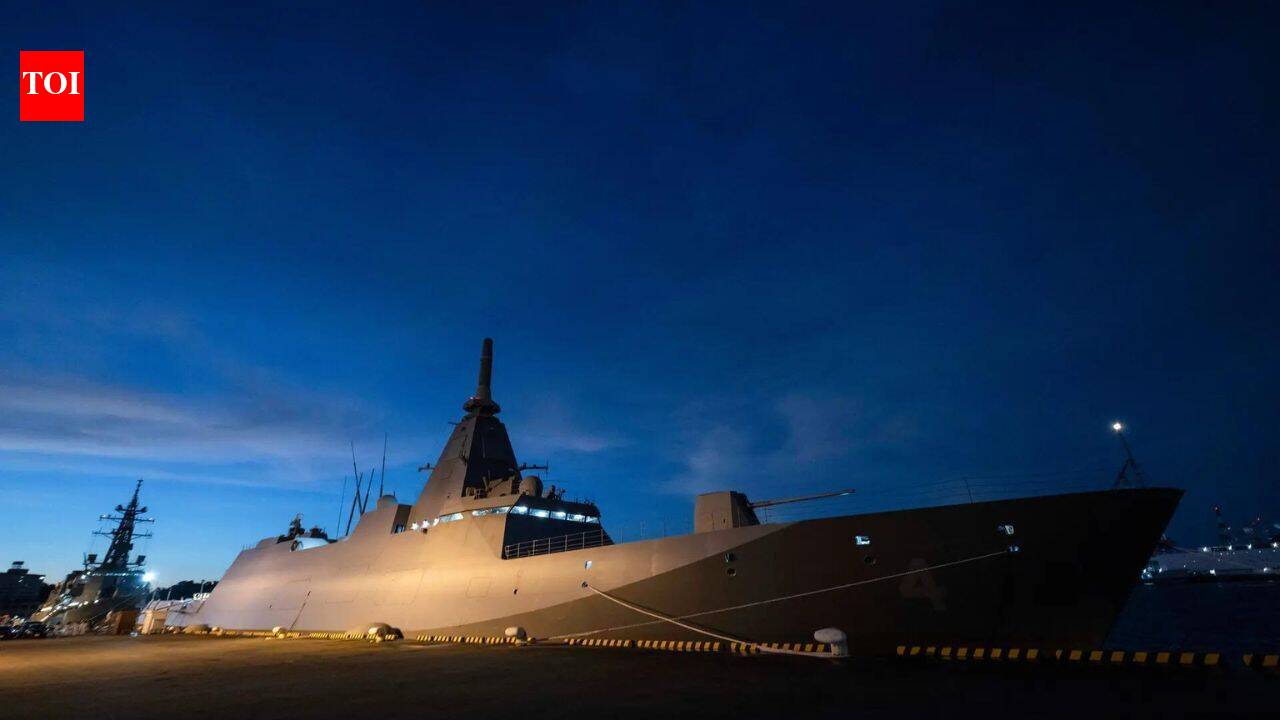
India and Japan have announced their first-ever defence co-development project, the Naval Radio Antenna 'UNICORN' (Unified Complex Radio Antenna / NORA-50 integration mast), with Prime Minister Narendra Modi describing it as a "new chapter" in the defence technology partnership between the two nations.Speaking alongside Japanese Prime Minister Sanae Takaichi in New Delhi, PM Modi said the project would "open a new chapter" and that the two countries would "jointly develop defence technologies that strengthen regional peace, maritime security, and the rules-based order."What is UNICORNUnlike conventional warship masts that bristle with dozens of exposed antennas, UNICORN consolidates them into a single radar dome (radome), sharply reducing the ship's radar cross-section.
The system houses antennas for tactical data link, TACAN (Tactical Air Navigation System), communications, Identification Friend or Foe (IFF), and Electronic Support Measures (ESM) for radar and communication interception. By stacking these elements and enclosing them in a low-RCS radome, the mast itself, historically one of the brightest radar returns on any warshiP, becomes much harder for an adversary to detect and classify.UNICORN was jointly developed by three Japanese companies, NEC Corporation (lead contractor), Sampa Kogyo K.K., and The Yokohama Rubber Co, Ltd, and is currently fitted on the JMSDF's Mogami-class stealth frigates (FFM), of which Japan has built 12 units with an upgraded batch of 12 more on order.
India-Japan UNICORN dealThe co-production will be executed by Bharat Electronics Limited (BEL) in India, with Japan providing advanced design expertise and India handling integration and co-production, aligning with PM Modi's 'Make in India' initiative. The agreement follows a Memorandum of Implementation signed in November 2024 at the Embassy of India in Tokyo for the co-development of UNICORN masts for fitment onboard Indian Navy ships.
The original political go-ahead came at the second India–Japan 2+2 Ministerial Meeting in Tokyo in September 2022.This makes India the second Asian nation to receive Japanese defence technology, after the Philippines received air-surveillance radars under a November 2023 contract, Japan's first defence equipment export since the Second World War.
Both transfers flow from Tokyo's April 2014 overhaul of the "Three Principles on Transfer of Defense Equipment and Technology", which replaced the near-total ban on arms exports that had been in force since 1967.Stealth factorUNICORN's stealth dividend matters most in the contested waters of the East and South China Seas, where China's PLA-Navy and coast-guard ISR networks rely heavily on radar fingerprinting of individual warships.
The Mogami-class already achieves a radar cross-section estimated at two orders of magnitude smaller than a conventionally designed frigate of the same size; UNICORN removes one of the last big "sparkler" returns, the antenna farm, and denies China the per-ship signal pattern it has spent years cataloguing.The Japanese PM, on a three-day official visit to India, said: "Today, both India and Japan are among the world's largest economies.
A free, prosperous, and rules-based Indo-Pacific is our shared priority. As the region's largest democratic and market economies, we have undertaken several significant initiatives today. Together, these will pave the way for peace, stability, and progress across the entire region." The wording is the standard Indo-Pacific vocabulary that Tokyo and Washington use to describe the strategic pushback against Beijing, and UNICORN is the first concrete piece of hardware under it.