
Keir Starmer’s closest Cabinet ally backs Andy Burnham
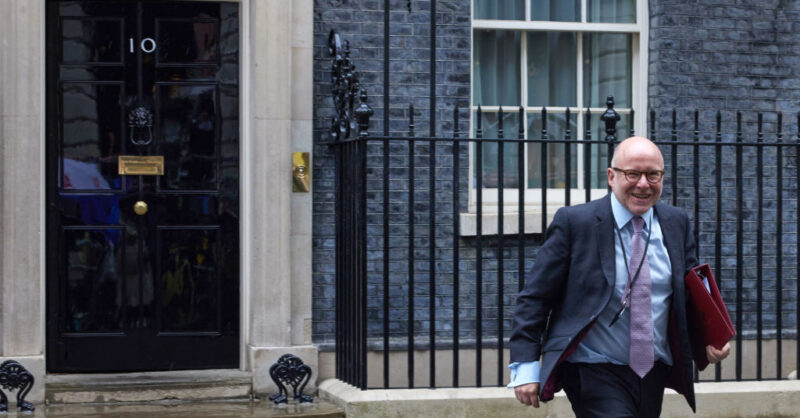
One of Keir Starmer’s closest allies has given his blessing to an Andy Burnham government as Labour prepares for a peaceful transition of power.
Richard Hermer, the Attorney General, said in a speech on Tuesday that Starmer should be positively remembered for making Britain “once again a partner that could be relied upon” while also expressing hope for what his successor would do.
Referencing a likely Burnham premiership, he said: “I have no doubt that Andy will build on this, true to his progressive values, in the years ahead, taking that progressive argument from Manchester to Madras, to Madrid and to Mexico City.”
Hermer and Starmer are old friends and colleagues who have known each other for 30 years. They met as progressive young lawyers and worked together at Doughty Street Chambers on matters of international law. Hermer was elevated to the House of Lords by Starmer following the 2024 general election so that he could serve as Attorney General.
In that role he has attracted criticism from the right over his stated commitment to fulfilling the UK’s obligations under international law. Hermer is not widely expected to carry on in post when Starmer leaves office. He was one of the key Starmer allies in the cabinet who stuck with the Prime Minister until the bitter end. Earlier this month he told the BBC that Starmer could survive a leadership challenge.
When asked if he would like to keep the job under Burnham, he said that politics was better when it was about more than individual personalities. Laying down a gauntlet to his successor as Attorney General, he said: “This government, and every Labour government, should believe in the moral principles which lie at the heart of the postwar international order including the rule of law and the protection of fundamental human rights.
“The simple idea that rules, not raw power, should govern relations between states, and should apply with equal force to the powerful. And that human rights are universal and grounded in the idea of the equal worth of humanity – every person, no matter who they are or where they are, deserves those rights, and the inherent dignity that underpins them.”
What was once a cross-party commitment to such principles has frayed in recent years. The rising salience of small boat crossings, among other controversies, has led right-wing politicians to challenge the notion of unconditional rights. Both Reform and the Conservatives now advocate Britain leaving the European Convention of Human Rights, largely because of the legal protections that it grants to asylum seekers.
In his speech, Hermer also warned that the UK faced a range of threats that would be best met by a firmer commitment to the international legal system. “We must be clear in stating that multilateralism and the rules-based order is manifestly in the UK’s national, economic and security interests,” he argued.
He set out his guiding principles for a progressive government and said Labour must marry hard power with progressive values. He argued that Starmer succeeded in this area and that he believes Burnham will do the same.
It’s a pleasure to be with you this afternoon.
Time is short, so I want to dive straight in.
I want to talk about the dangerous world Britain now faces.
And, more importantly, how a progressive UK government should respond.
Building on my reflections on my last two years as Attorney General where – because of the heightened dangers we face – a considerable amount of my focus has been on national security, foreign relations and defence.
And my belief that our national interests are served not simply through our strength, vital as that is, but our values, reflected in our leadership role in both defending the international rules-based order, and ensuring it evolves to meet the emerging challenges of our ever more dangerous world.
Make no mistake: the global challenges we face as a nation are more profound today than they have ever been.
We face the threats posed by international armed conflicts in Ukraine and the Middle East whose effects are felt – not only in the appalling loss of life and suffering locally – but globally, whether in the cost of living in this country, or in countless lives in food insecure nations dependent on access to fertilisers.
We also see bloody non-international conflicts such as in the killing fields of Sudan – indeed conflict now blights the planet at a level not witnessed since the end of the Second World War.
Of course, it might be argued that there is nothing particularly remarkable about this – sadly an era of armed conflicts is hardly unique in human history, indeed only its absence would be.
I believe this would be misplaced for at least two reasons.
Firstly, it underestimates the magnitude of the threat to this country posed by these conflicts, in particular by Putin’s Russia, whose acts of aggression are a generational challenge, not simply to the brave people of Ukraine but to peace across Europe.
Secondly, and perhaps more profoundly, defining threats to our security solely through the prism of the battlefield would be a strategic error, because it fails to take into account the range of profound new threats to this country and democracies generally.
Climate change, large-scale human migration patterns, pandemics, rapidly advancing technology in the form of AI, and the extraordinary reach of social media present huge threats to so many aspects of our security – national, economic and personal.
Each of these not only a threat in themselves but also capable of reacting with each other to intensify the risks that they pose – a malign synergy.
Allied to these challenges, and indeed in part a product of them, has been the rise of nationalist authoritarian populism and those populists who trade on the fertile ground of the uncertainties of our age – providing easy answers to contemporary problems but using the age-old tactics of stoking division, aggravating racial tensions, of using misinformation to undermine public trust in institutions and advance their own interests – a response itself that weakens the state and poses profound threats to the security of democracy itself.
What should the response of progressives be to this increasingly dangerous world – how do we navigate these unprecedented challenges and demonstrate to people that there is hope, that there are principles that guide us to a better future and that the lure of the populists should be emphatically rejected?
Today I want to suggest some broad principles which should guide the progressive response, drawing on the experiences it has been the privilege of my life to acquire during the last two years as part of this government.
The first principle is that a progressive response to our dangerous world must be underpinned, unapologetically, by hard power.
Progressives do not always feel comfortable talking about hard power.
We prefer to speak about soft power: the influence the UK can wield in the world by exemplifying values like justice; fairness; rights and compassion.
Those things matter enormously. They are the lodestars of our collective politics.
But in government you learn that in a dangerous world, soft power is not enough.
Military power matters. Economic power matters. Technological power matters.
Without such hard power, our principles become aspirations rather than achievements, and our values ring hollow if we cannot defend them.
We should not forget that the whole post ’45 framework, this unique gift to humanity of international protections of rights, unprecedented in human history, only exists because men and women were prepared to sacrifice their lives for those values and the state ensured they had the military means to secure victory.
Labour must never forget that it is the party of Nye Bevan.
Bevan wanted to see the world rid of nuclear weapons, but in his famous speech to Conference in 1957, he opposed unilateral disarmament because he would not “send a British Foreign Secretary… naked into the conference chamber”.
That is why ensuring that this country is in a position to not only defend itself, but stand with partners to defend our values is so critical.
It is why Labour has already committed to the largest sustained increase in defence spending since the Cold War, and why today’s (30 June) Defence Investment Plan announcement shows we are facing up to the changing nature of warfare.
But the second lesson of the last two years for any progressive UK government is that might, of itself, is not right.
As a governing philosophy, “Might is Right” has had its moment in the sun.
Promoted by so-called “realist” commentators and supported by certain sections of the press, the argument was that the rules-based order and international law belonged to a different, gentler age that had now passed into history.
But no one can credibly make that case now that we’ve had some real-time examples of strongman foreign policy.
Russia thought it could take Ukraine in a matter of days. But four years in, thanks to the strength and ingenuity of the Ukrainians and the steadfast support of their allies, Ukraine still stands.
Is anyone really arguing now that Russia is in a better position, economically, militarily, diplomatically now, than it was five years ago?
Or that Ukraine would be in a stronger position today if its allies had followed Putin’s lead and abandoned their commitment to international law, which requires respect for the sovereign equality and territorial integrity of states?
Is anyone really arguing now that the conflict in the Middle East has benefitted any of the major players involved?
Even leaving aside the death and destruction it has wreaked upon helpless populations, has the conflict made the world any safer?
Conversely, international law provides a sage guide, helping states navigate how to respond in the face of requests for assistance in wars of choice, and supporting a clear-eyed assessment of the national interest.
My third point is that we must be clear in stating that multilateralism and the rules-based order is manifestly in the UK’s national, economic and security interests.
Shared rules make Britain more prosperous, allowing us to trade with confidence.
They make us more just, by underpinning protections for our citizens.
And they make us more secure by enabling cooperation with allies.
The post-World War Two order we helped build coincided with a period of the greatest economic and social advancements in the history of humanity.
Multilateralism doesn’t just serve the planet; it is directly and overwhelmingly in Britain’s national interest.
Not least because in our interconnected world, the dividing line between domestic and international policy has almost disappeared.
Conflicts thousands of miles away affect the weekly shopping bill.
A blocked shipping lane affects inflation.
Instability affects energy prices; supply chains; investment; jobs and economic growth.
That is why the UK’s role in the world matters to families in every British town and city.
It is why engagement abroad is inseparable from security and prosperity at home.
When a Prime Minister spends time working to stabilise an international crisis, that is not a distraction from the cost of living.
Voters increasingly appreciate this connection. My case for a progressive response to our dangerous world is therefore not just a high-minded argument about policy and power. It is also about electoral politics.
It is clear that voters, particularly progressive ones, are looking for parties which articulate a clear values-based vision on international affairs.
A recent report by UCL Policy Lab found that the government’s resolute stance under pressure from the US administration, our strong support for Ukraine and our firm approach to not becoming embroiled in the war on Iran were all seen as positives, for which the PM rightly received credit from the public.
This evidence of UK public support for a principled approach to international affairs echoes the findings of polling by the Rockefeller Foundation in a number of countries, which also found high levels of support for international collaboration, provided it produced tangible benefits for people’s everyday lives.
My fourth and final guiding principle for a progressive government is that we do not believe in the rules-based order only because it is in Britain’s national interest to do so.
We also believe in it because we are internationalists, and because we believe in the moral purpose that lies behind those laws and frameworks.
The values that underpin the founding documents of the postwar settlement – the UN Charter and the Universal Declaration of Human Rights – are progressive values that British governments of all political persuasions have, until recently, unequivocally supported.
This government, and every Labour government, should believe in the moral principles which lie at the heart of the postwar international order, including the rule of law and the protection of fundamental human rights.
The simple idea that rules, not raw power, should govern relations between states, and should apply with equal force to the powerful.
And that human rights are universal and grounded in the idea of the equal worth of humanity – every person, no matter who they are or where they are, deserves those rights, and the inherent dignity that underpins them.
A truly progressive response combines hard power and values.
So building on these four principles, my argument is that progressives must therefore reject the false choice between defending liberal values and exercising power.
The rules-based international order exists because the alternative has been tried.
The task for progressives is not to choose between values and power.
Because power without values is not strength.
It is domination. It is arbitrary. It is ultimately destructive.
Strength without purpose becomes cruelty.
But equally values without hard power, in this increasingly dangerous world are illusory.
The lesson of the last two years for progressives is that only a combination of hard power and commitment to the values underpinning the rules based international order can protect people against the feelings of insecurity and precarity that they experience in our ever more dangerous world.
So, the starting point for any progressive government should be that not only is the rules-based order not redundant, it has never been needed more.
The challenges we face are no longer limited by territorial borders.
To tackle the climate crisis, the impact of social media and artificial intelligence, to prepare for the next pandemic – these all require international cooperation, under a shared and explicitly normative framework.
They all require trust and collaboration. Partnerships and alliances. Underpinned by shared and agreed rules.
That does not mean key tenets of that order cannot be updated for today’s world.
Indeed, many of the great global challenges of today require innovative responses from states, including in some cases new international agreements.
They also require a reimagining of global cooperation, not least meaningful and substantive, rather than tokenistic, engagement with the Global South.
Because international law, international frameworks are not and should not be set in stone.
But the values and principles that underpin the post-war international order should be our guide in these troubled times.
Keir Starmer recognised this – we should reflect with gratitude the role he has played in once again putting this country back centre stage in global affairs.
He took over when our international standing was at a particularly low ebb – weakened by Brexit, undermined by brazen breaches of international law.
Our reputation for global leadership on the international rule of law shattered by the destructive approach of the previous Conservative Government.
Keir recognised that our interests were served not only by the projection of power, but of international cooperation – making this country a venue to which world leaders came in moments of crisis and with which new economic partnerships were formed and trade deals struck.
Because we are once again a partner that could be relied upon.
Once again, we are able to reap the benefits of global leadership and I have no doubt that Andy will build on this, true to his progressive values, in the years ahead.
Taking that progressive argument from Manchester to Madras, to Madrid and to Mexico City.
Because it serves the interests and values of all of us.
He will recognise that we have a unique role as the United Kingdom.
To be able to truly bring people, countries and organisations together, as a good faith player.
To show in our words and deeds, our belief in the post-World War Two settlement, that has brought peace, prosperity and strength to us and our allies.
Because, when combined with the hard power we will continue to build, that is our superpower.