
Mammoth Structure Found in Deep Space Challenges Our Understanding of The Universe
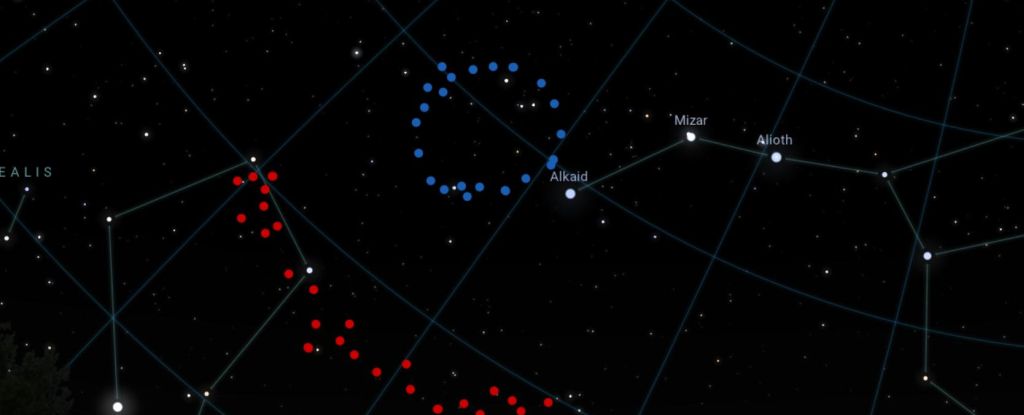
A massive structure detected in the distant Universe is defying our understanding of how the Universe evolved.
In 2024, astronomers found a giant, almost perfect ring of galaxies, some 1.3 billion light-years in diameter.
Yes, you read that right. BILLION light-years.
It doesn't match any known structure or formation mechanism.
The discovery, led by astronomer Alexia Lopez of the University of Central Lancashire, was presented at the 243rd meeting of the American Astronomical Society in 2024, and was published in the Journal of Cosmology and Astroparticle Physics.
The signal was picked up in light that has traveled for 6.9 billion years to reach us.
The existence of 'The Big Ring', as the structure has been named, could mean that we need to amend the standard model of cosmology.
It's the second giant structure discovered by Lopez and her colleagues. The first, called the Giant Arc, is actually in the same part of the sky, at the same distance away. When the arc's discovery was announced in 2021, it puzzled astronomers. The Big Ring only deepens the mystery.
"Neither of these two ultra-large structures is easy to explain in our current understanding of the universe," Lopez said in January 2024.
"And their ultra-large sizes, distinctive shapes, and cosmological proximity must surely be telling us something important – but what exactly?"
The most immediate link seems to be with something called a Baryon Acoustic Oscillation (BAO). These are giant, circular arrangements of galaxies found all throughout space. They're actually spheres, the fossils of acoustic waves that propagated through the early Universe, and then froze when space became so diffuse acoustic waves could no longer travel.
The Big Ring is not a BAO. BAOs are all a fixed size of around 1 billion light-years in diameter. And thorough inspection of the Big Ring shows that it is more like a corkscrew shape that is aligned in such a way that it looks like a ring.
Which leaves the very unanswered question: What the heck is it? And what does it mean for the Cosmological Principle, which states that, in all directions, any given patch of space should look pretty much the same as all other patches of space?
"We expect matter to be evenly distributed everywhere in space when we view the universe on a large scale, so there should be no noticeable irregularities above a certain size," Lopez explained.
"Cosmologists calculate the current theoretical size limit of structures to be 1.2 billion light-years, yet both of these structures are much larger – the Giant Arc is almost three times bigger and the Big Ring's circumference is comparable to the Giant Arc's length."
But the size is just one of the problems. The other is what it means for cosmology, the study of the evolution of the Universe. The current model is the one that currently fits the best with what we observe, but there are some features that are challenging to explain under its framework.
There are other models that have been put forward to address these features. Under one such model, Roger Penrose's conformal cyclic cosmology, in which the Universe goes through endless Big Bang expansion cycles, ring structures are expected – although it's worth noting that conformal cyclic cosmology has significant problems of its own.
Another possibility is that the structures are a type of topological defect in the fabric of space-time known as cosmic strings. These are thought to be like proton-wide wrinkles that emerged in the early Universe as space-time stretched, then froze into place.
We've not found much physical evidence of cosmic strings, but the theoretical evidence is pretty promising.
At the moment, nobody knows for sure what the Big Ring and the Giant Arc signify. They could just be chance arrangements of galaxies twirling across the sky, although the likelihood of that seems pretty small.
The best hope would be to find more such arrangements of galaxies, scattered throughout the Universe, hiding in plain sight.
"From current cosmological theories we didn't think structures on this scale were possible," Lopez said.
"We could expect maybe one exceedingly large structure in all our observable Universe. Yet, the Big Ring and the Giant Arc are two huge structures and are even cosmological neighbors, which is extraordinarily fascinating."
The findings are reported in the Journal of Cosmology and Astroparticle Physics.