
Map of wild horse herds in US as Trump admin cracks down on mustangs
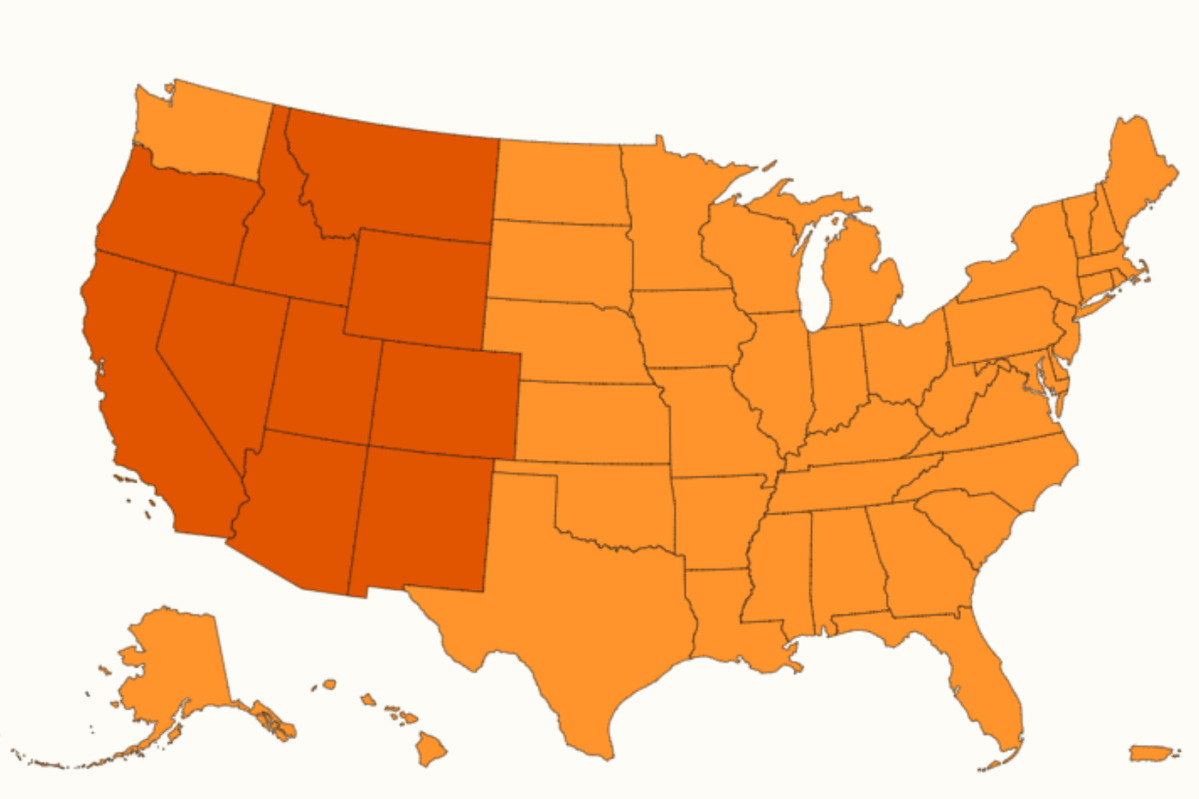
A map shows where America’s federally managed wild horses are found, with Nevada home to by far the largest population, as the Donald Trump administration has moved to shift how the animals are managed.
The Bureau of Land Management (BLM) estimates there are more than 60,000 wild horses across 10 Western states, with Nevada accounting for more than half of the total.
The numbers come into focus as federal sales of protected wild horses, once a rare occurrence, have increased under the Trump administration, fueling concerns among animal-welfare groups that some could ultimately enter slaughter channels after being sold through a government program.
Newsweek contacted the BLM via email on Friday for comment.
Nevada had an estimated 37,426 wild horses, more than five times the number recorded in the next-largest state, Wyoming, which had 7,165.
Oregon had the third-largest population, with 5,994 horses, followed by Utah with 4,611 and California with 3,534.
Smaller populations were recorded in Colorado, with 1,669 horses, Idaho with 564, Arizona with 268, Montana with 195 and New Mexico with 97.
The map shows the stark concentration of horses across the West, with Nevada standing out from the other states.
The BLM manages wild horses and burros on designated public lands across the West. Its population estimates are used to determine how many animals the agency considers can be supported by available habitat.
The agency manages wild horses and burros on 25.5 million acres of public land across 10 Western states under the Wild Free-Roaming Horses and Burros Act. Its stated objective is to maintain “healthy herds on healthy public lands.”
Congress declared in the 1971 law that wild horses and burros were “living symbols of the historic and pioneer spirit of the West” and should be protected from capture, branding, harassment or death. The same law directs the Interior Department to manage them as part of the public-land system and maintain what it calls a “thriving natural ecological balance.”
The BLM has long faced a difficult balancing act over wild horses. The agency says populations can grow rapidly in the absence of natural predators and can exceed what public rangelands can sustainably support.
The result has been periodic roundups and removals of horses from public lands, followed by efforts to place them through adoption and other programs.
Those policies have attracted criticism from animal-welfare groups, which argue that removals can be traumatic for the animals and that the government should pursue alternatives to large-scale roundups.
The Trump administration’s approach has renewed that debate, particularly around what happens to horses after they are removed from the range.
Animal-welfare groups say the government has focused too heavily on roundups, long-term holding facilities and sales rather than aggressively expanding fertility-control efforts designed to reduce future population growth.
Patricia Miller, executive director of American Wild Horse Conservation, previously told Newsweek: "This year while removing 14,000 horses there are no plans to go back and manage with fertility control as they are supposed to. That will create another rinse and repeat round up situation in the future."
Sales of wild horses also surged after Trump returned to office. BLM sold about 3,700 horses in 2025, more than double the previous year’s total, according to bureau records first cited by The New York Times.
Sold horses lose the statutory protections retained by adopted horses, although initial buyers must agree not to slaughter them or knowingly sell them to someone intending to do so. Critics argue that restriction can be circumvented when a horse is resold to an intermediary not bound by the agreement.
"We have been following the increase in Sale Authority usage over the last 12 months and saw the correlation between need to move horses out of long term holding with plan to round up 14,000 more," she said Thursday.
Miller said records her organization obtained through Freedom of Information Act requests helped reveal how extensively the program was being used.
"We saw not only a large increase, but also the alarming part of large group sales going to buyers that were not vetted," she said
In an earlier statement to Newsweek, the Department of the Interior said the BLM "does not sell or send wild horses or burros to slaughter" and that allegations of violations of federal law or sales agreements are reviewed and referred to law enforcement when appropriate.
The department also said protecting wild horses and burros is a long-standing federal responsibility under the Wild Free-Roaming Horses and Burros Act of 1971, while Congress directed the BLM in 2004 to make certain excess animals available for sale subject to safeguards barring commercial processing.
Wild horse management was mentioned in Project 2025, the conservative policy blueprint developed ahead of President Donald Trump’s return to the White House.
This includes proposals aimed at addressing what it describes as growing populations and the costs of managing.
"The BLM’s multi-pronged approach in its 2020 Report to Congress included expanded adoptions and sales of horses gathered from overpopulated herds; increased gathers and increased capacity for off-range holding facilities and pastures; more effective use of fertility control efforts; and improved research, in concert with the academic and veterinary communities, to identify more effective contraceptive techniques and strategies.
"All of that will not be enough to solve the problem, however. Congress must enact laws permitting the BLM to dispose humanely of these animals," reads the passage.
The existence of a Project 2025 recommendation in the policy blueprint does not by itself establish that the administration has adopted it.