
Map shows states with highest and lowest rates of violent crime in America
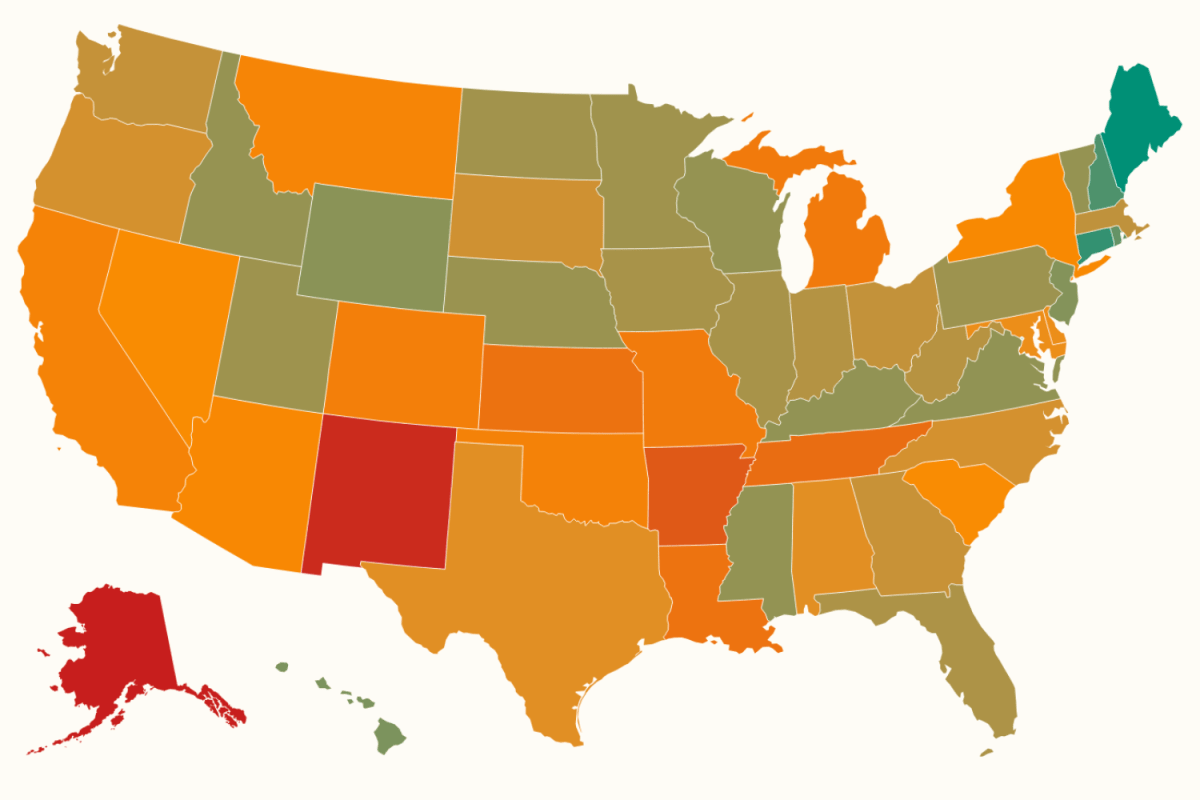
The national violent crime rate saw its largest year-to-year decline in almost 90 years, the FBI said in a recent report, which also showed Alaska as the state with the highest violent crime rate in the country and Maine with the lowest.
Data the agency released this month found that nationwide, violent crime—which covers murder and nonnegligent manslaughter, rape, robbery, and aggravated assault—fell 9.3 percent between 2024 and 2025, dropping to 327.6 offenses per 100,000 people. The murder rate, meanwhile, fell 18.1 percent to 4.1 per 100,000 residents, tying 1955 and 1956 for the lowest level on record.
Still, a Newsweek analysis of FBI agency-level data aggregated by state shows that despite the nationwide decline, violent crime rates vary sharply across the country.
The figures were released as part of the FBI's annual Reported Crimes in the Nation publication, which compiles data submitted by more than 17,000 law enforcement agencies covering roughly 96 percent of the U.S. population.
According to the analysis, Alaska recorded the highest violent crime rate in the nation, with 659.6 violent crimes per 100,000 residents. New Mexico ranked second with 638.4 per 100,000, followed by Arkansas with 525.8 and Tennessee with 469.5.
Kansas rounded out the top five with 453.4 violent crimes per 100,000 residents. Louisiana, Michigan, Missouri, Colorado and Oklahoma also recorded rates above 400 per 100,000.
Several of the states with the highest rates had relatively small populations compared with the country's largest states, highlighting the difference between total crime counts and crime rates.
California, the most populous state, reported the largest volume of violent crimes, with 157,828 offenses, followed by Texas with 103,827 and New York with 69,274. Because those states have much larger populations, their crime rates still ranked lower than several smaller states.
California's violent crime rate stood at 402.6 per 100,000 residents, compared with 331.3 in Texas and 383.4 in New York.
North Carolina recorded 32,749 violent crimes during the reporting period, while Florida reported 42,034 and Ohio reported 30,516, placing them among the states with the largest numbers of reported violent offenses.
At the other end of the scale, Maine recorded the nation's lowest violent crime rate with 88.3 offenses per 100,000 residents. Connecticut was second with 104.5, followed by New Hampshire with 124.9.
Rhode Island ranked fourth lowest with 146.4 per 100,000 residents, while Hawaii reported a rate of 175.0. New Jersey, Wyoming, Virginia, Kentucky and Mississippi also ranked among the 10 states with the lowest violent crime rates.
The gap between the highest- and lowest-ranking states was substantial. Alaska's violent crime rate was more than seven times higher than Maine's rate during the same reporting period.
The FBI's latest figures build on a broader decrease in violent crime that has been underway since the spike seen during and immediately after the COVID-19 pandemic.
The bureau reported an estimated 1.12 million violent crimes nationwide in 2025, down 9.3 percent from the previous year and roughly 12.6 percent lower than in 2016.
The FBI also reported declines across each of the major violent crime categories measured nationally. Murder and nonnegligent manslaughter fell 18.1 percent year over year, robbery declined 18.5 percent, rape decreased 7.6 percent and aggravated assault fell 7.2 percent.
"The 2025 murder rate is tied with 1955 and 1956 for the lowest rate since FBI estimations began in 1936, and we are celebrating the largest year-to-year decrease in violent crime rates and murder and nonnegligent manslaughter rates," said FBI Director Kash Patel in a statement.
Lawrence Sherman, a professor of criminology at the University of Cambridge, told Newsweek that one explanation for the decline may be the growing use of "evidence-based policing" (EBP), an approach that uses crime data and research to help direct police resources.
Sherman said decades of research have found that a large share of crime is concentrated in a relatively small number of places, victims and offenders, allowing police departments to focus prevention efforts where crime is most likely to occur.
"Ever since a National Institute of Justice grant supported my team's discovery that most crime occurred in a tiny fraction of Minneapolis, the concept of crime concentration has been found repeatedly across places, victims and offenders," Sherman said.
He said the approach has contributed to an increased police presence in locations where crime is most likely to occur and has helped agencies prioritize the most dangerous offenders and the victims most at risk of harm.
Sherman added that the growth of evidence-based policing has been supported by expanded police training, the widespread computerization of police records and a greater focus among police leaders on crime prevention.
"No one has measured how rapidly the changes in policing occurred, but EBP is as plausible a reason as any for explaining the great crime drop," he said.
According to the FBI, aggravated assault remained the most common violent offense category, accounting for almost three-quarters of violent crimes reported nationwide in 2025. Robbery represented about 15 percent of violent crime offenses, rape about 11 percent and murder about 1 percent.
Contact Newsweek editors on this story: Rebecca Flood and Shakeema Edwards.