
Map shows Trump's DC makeover as he sets next renovation date
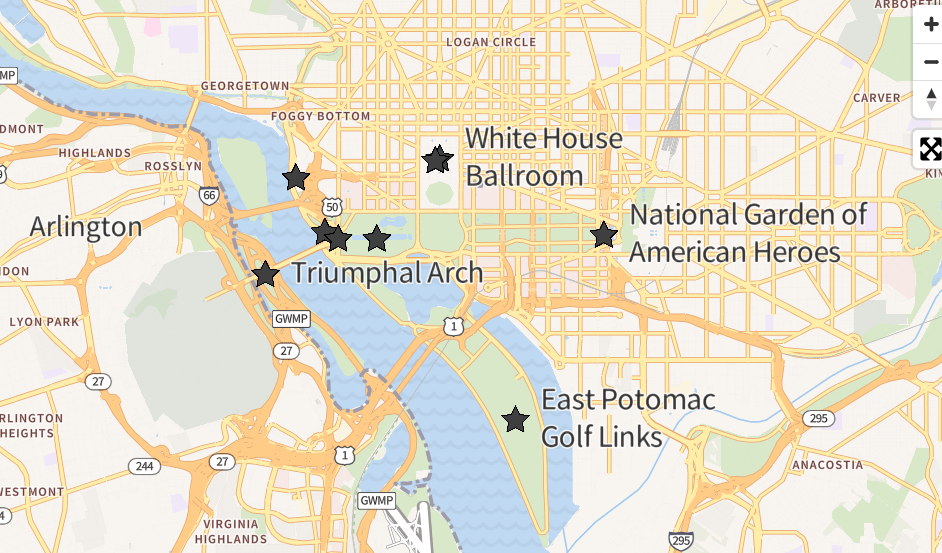
President Donald Trump has set September 1 as the start date for renovations at East Potomac Golf Links—a historic, century-old public course and the latest project in an increasingly broad effort to make over some of Washington's most visible public spaces.
Trump toured the course on Sunday with Interior Secretary Doug Burgum and golf architect Tom Fazio, later writing on Truth Social that the federal government would rebuild the "old and run down" course into one of the "greatest golf courses anywhere in the world." The president said the course could one day host major tournaments, such as the U.S. Open, Ryder Cup or PGA Championship.
The wider Trump-led overhaul of the capital includes changes at the White House, the National Mall, the Lincoln Memorial area and the Kennedy Center. However, the projects have also drawn a wave of legal challenges—most notably the White House ballroom, the "Independence" or Triumphal Arch and the resurfacing of the Lincoln Memorial Reflecting Pool.
Lawsuits against the projects have alleged, among other things, that the administration bypassed congressional authority, historic preservation rules, environmental review requirements or public-planning processes.
Trump's date announcement for work at the East Potomac Golf Links comes after a nonprofit organization and two Washington residents sued the administration in an effort to block the project.
The century-old public course also faced a monthslong fight between Trump officials and the National Links Trust over who has control over D.C.'s public golf courses.
However, a deal was reached in May to allow the organization to continue overseeing the East Potomac Golf Links until federal officials overhaul it.
One of the most controversial projects happening in the District of Columbia is Trump's planned $400 million White House ballroom, a roughly 90,000-square-foot development happening at the site of the demolished East Wing.
The demolition of part of the 1902 East Wing sparked outcry last year from preservationists. The National Trust for Historic Preservation has filed a lawsuit, arguing that a president cannot alter the White House so drastically without congressional approval.
On March 31, a federal judge barred further work, ruling that Congress must authorize Trump's ballroom project—a temporary injunction that the administration is appealing. Two days later, the National Capital Planning Commission, chaired by a Trump ally, voted 8-1 to give final approval to the ballroom's design.
Trump has also pushed plans for a triumphal arch, also known as the "Independence Arch," which would be situated between the Lincoln Memorial and Arlington National Cemetery.
The U.S. Commission of Fine Arts has given preliminary approval of the arch, although the project still faces legal hurdles. A group of Vietnam War veterans has sued to block the arch from being built.
While Trump has touted the new monument as a feature of the country's 250th anniversary celebrations, the plaintiffs argue that its placement would disrupt sight lines meant to represent the United States' unity following the Civil War.
The National Garden of American Heroes would place statues paying tribute to 250 "historically significant" Americans in West Potomac Park.
However, a coalition of preservation and cultural groups filed a lawsuit this month to block the project, arguing that it violates restrictions on new commemorative works on the National Mall without congressional approval.
Trump's renovation of the Lincoln Memorial Reflecting Pool included more than $14 million in work aimed at repainting the basin a darker blue and improving water quality ahead of the nation's 250th anniversary celebrations. However, within days of the pool being refilled, algae rapidly spread across the surface, turning the water green.
The Cultural Landscape Foundation has filed a lawsuit to halt the project, arguing that the administration unlawfully altered a protected historic feature of the National Mall. Trump has blamed "vandals" for damage, and the administration has moved to dismiss the lawsuit.
Trump announced plans for a new promenade near the Lincoln Memorial in June. The bridge would serve as a pedestrian path over the two roads that encircle the monument to the Civil War president.
Another one of Trump's projects is renovating the Arts of Peace statues, located in West Potomac Park. Since their first restoration in the 1970s, the gold coating on the four large bronze horses has faded, and federal government data shows that Trump is spending about $5 million to have the statues re-coated in gold leaf.
Earlier this year, Trump announced a two-year closure of the Kennedy Center for construction and renovation. The announcement came less than two months after the center's board voted to add Trump's name to the historic institution, which serves as a "living memorial" to former President John F. Kennedy.
In May, a federal judge ruled that Trump's name had been illegally added to the Kennedy Center and blocked the renovation plans.
Last year, the Trump administration paved over the grass of the White House Rose Garden, a $1.9 million renovation paid for by private donations. Trump had previously said the grass was not suitable for press conferences, but that "gorgeous stone" would be better.
Contact Newsweek editors on this story: Tobias Meyjes and Shakeema Edwards.