
Mars orbiter watches Perseverance rover cross the marathon finish line | Space photo of the day for June 29, 2026
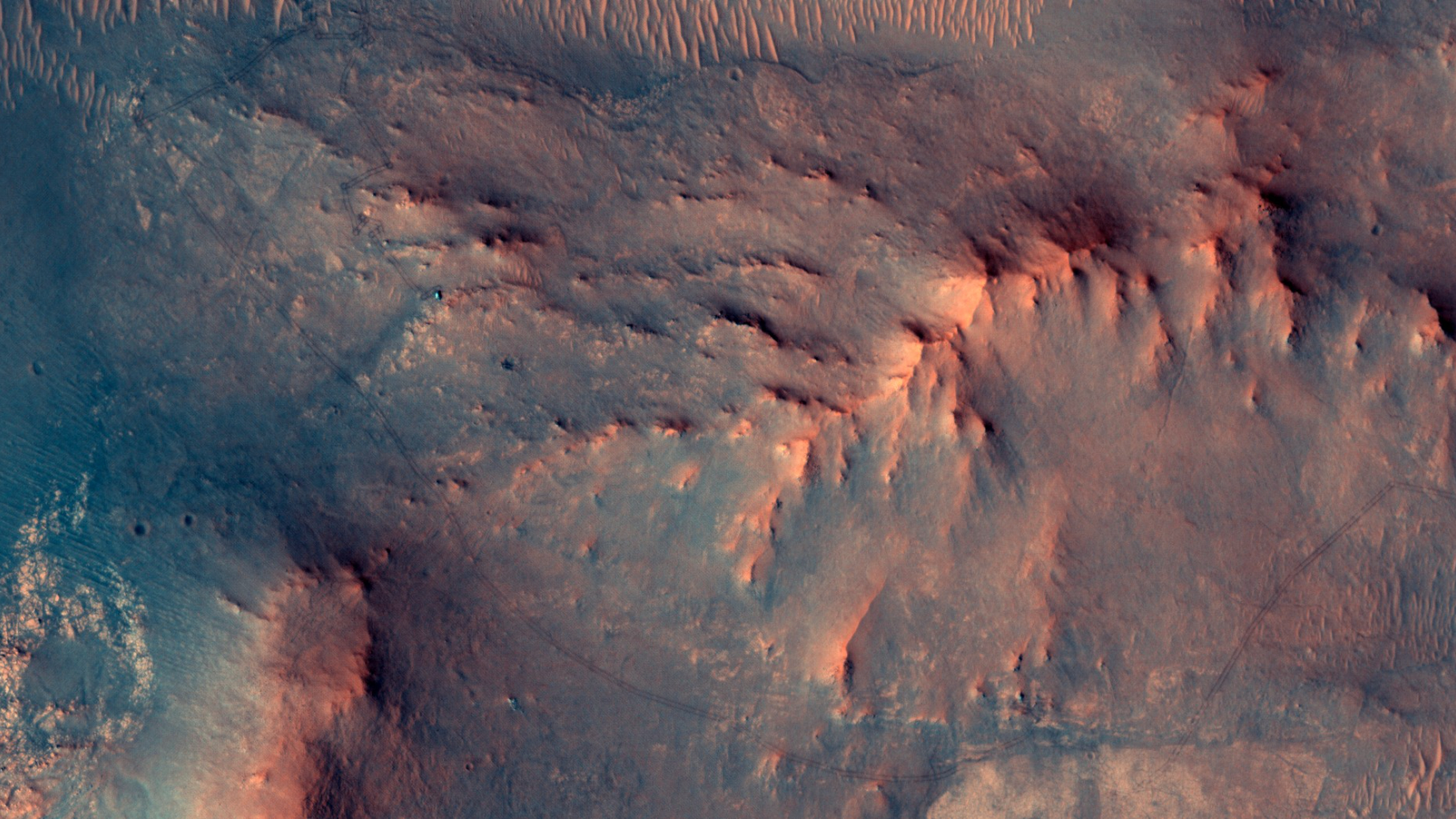
A spacecraft orbiting Mars watched as its "friend," the Perseverance rover, finished its first marathon on the Martian surface. There weren't any medals handed out, and there wasn't any competition, but we're proud either way.
On June 14, 2026, NASA's Perseverance Mars rover completed the equivalent of a marathon, having driven 26.2 miles (42.2 kilometers). After landing in the ancient lakebed Jezero Crater in 2021, the rover has been hard at work exploring, sampling, and collecting information to help scientists put the pieces of Mars' history together.
NASA's Opportunity rover also managed to reach a marathon distance on Mars, though it took over 11 years to make it that far. Perseverance managed to make it to this marathon milestone in just 5 years and 4 months, and the rover is still going strong.
But Perseverance isn't making history alone; it has the Mars Reconnaissance Orbiter (MRO) watching from orbit. In this image captured on June 13 by MRO, we can see Perseverance in the home stretch of its marathon, rolling toward that finish line in a region of Jezero Crater called "Arbot."
While the rover is barely a speck from this orbital distance, this additional vantage point allows researchers a different perspective on the robotic explorer. With the speed at which the rover completed this marathon, and how well it continues to explore on Mars, who knows, maybe Perseverance will be the first to manage an ultramarathon on the Red Planet.
While crossing the marathon finish line on Mars is an exciting milestone, Perseverance has done so much more than just travel this impressive distance.
In the past 5 years, and over 26.2 miles, Perseverance has accomplished quite a lot. The rover has captured an incredible wealth of imagery, data, and even samples of Martian material.
Last year, observations made with the rover revealed the most-compelling possible biosignature found yet on the planet. And more recently, the rover found even more evidence of possible past life in a similar location.
Please logout and then login again, you will then be prompted to enter your display name.
Chelsea Gohd served as a Senior Writer for Space.com from 2018 to 2022 before returning in 2026, covering everything from climate change to planetary science and human spaceflight in both articles and on-camera in videos. With a M.S. in Biology, Chelsea has written and worked for institutions including NASA JPL, the American Museum of Natural History, Scientific American, Discover Magazine Blog, Astronomy Magazine, and Live Science. When not writing, editing or filming something space-y, Gohd is writing music and performing as Foxanne, even launching a song to space in 2021 with Inspiration4. You can follow her online @chelsea.gohd and @foxanne.music