
Mars' Potato-Shaped Moon May Have Gotten Its Youthful Look From a Single Impact
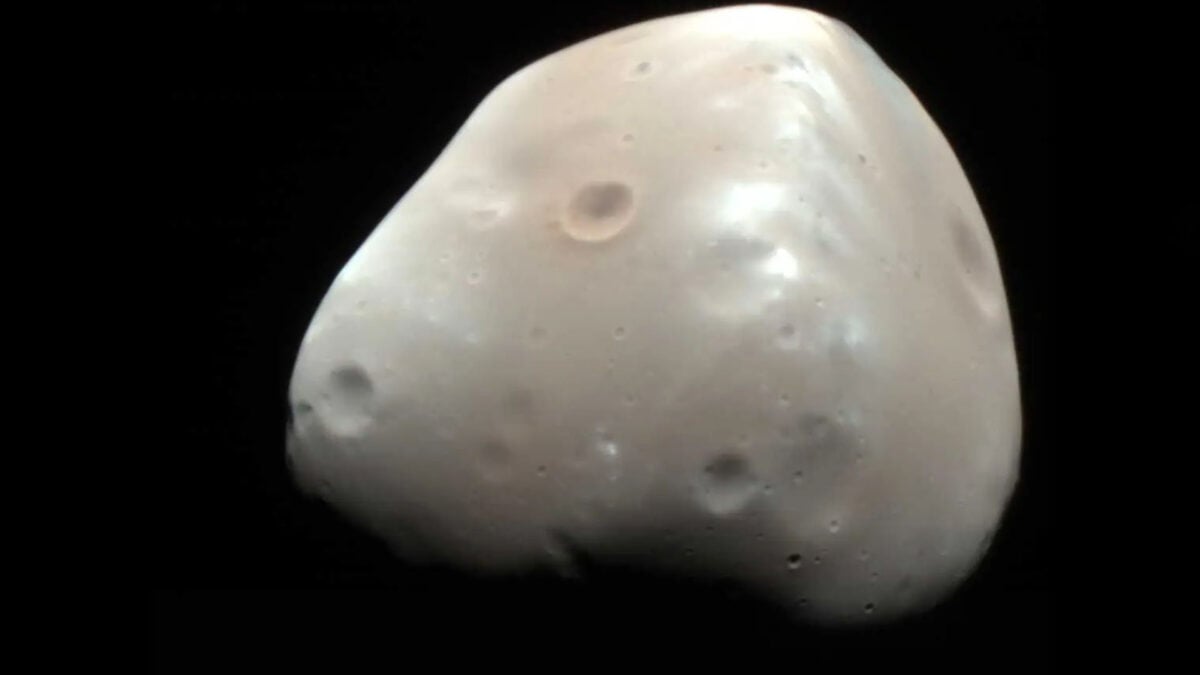
Decades ago, a NASA spacecraft swooped past Mars’ smaller moon, Deimos, revealing a smooth, dust-strewn world covered in a thick layer of regolith. Since then, scientists have wondered how the Martian moon got its youthful look compared to its larger counterpart, Phobos. Now, a recent flyby of Deimos may have traced the cause to a violent collision during its early past.
Using images gathered by the European Space Agency’s (ESA) Hera mission, a new study suggests that a single asteroid strike may have dramatically reshaped Mars’ outer moon. The findings, published in Nature Astronomy, show how the impact could have tossed large amounts of material across Deimos’ surface, giving it its surprisingly smooth appearance.
The results imply that Deimos is a rubble pile, similar to asteroids, that may have formed from material kicked up from Mars by surface impacts, according to the researchers behind the study.
Deimos is the smaller of Mars’ two moons, orbiting Mars every 30 hours. Measuring at 9 by 7 by 6.8 miles in size (15 by 12 by 11 kilometers), its tiny body is lumpy and heavily cratered.
In 1977, NASA’s Viking 2 orbiter pulled off a historic flyby of Deimos, capturing high-resolution images of the moon’s surface. Deimos turned out to have a much smoother, dustier surface than the other Martian moon, Phobos. The flyby also revealed a 6-mile-wide (10-kilometer) basin around its southern pole.
In March 2025, ESA’s Hera mission performed a flyby of Mars, coming as close as 3,106 miles (5,000 kilometers) to the planet. During the brief rendezvous, Hera caught a glimpse of the tidally-locked Deimos.
The team of researchers combined the flyby images with an impact code called Smoothed Particle Hydrodynamics to model a hypothetical impact and its aftermath. “Our Bern Smoothed Particle Hydrodynamics, SPH, impact code works by recreating bodies of interest into millions of adhering particles whose interplay is governed by various programmable variables, including gravity levels, material strength and cohesion,” Sabina Raducan, a researcher at the University of Bern and one of the chairs of the Impact Physics Working Group for the Hera science team, as well as lead author of the new study, said in a statement.
“We created a detailed shape model of Deimos out of SPH particles, having filled in the southern depression to leave it ready for the impactor to strike. Then we ran about a hundred simulations – each one taking about a week at a time to complete – to experiment with various impactor masses and angles of approach,” Raducan added.
Out of the hundred scenarios, the best fit turned out to be a slanting, 45-degree impact from a relatively small, 1,049-feet-wide (320-meter) asteroid that struck Deimos at high speeds. The catastrophic impact did not completely destroy the moon, instead it created a broad depression at its south pole.
The violent collision also threw large amounts of material across the moon’s surface, and much of the debris fell back to form a global blanket of loose regolith that covered much of Deimos. Beneath this layer of dust, the outlines of the moon’s ancient craters remained visible.
“We began this simulation campaign before Hera’s Mars flyby, but with the hope that Hera’s observations would help constrain the results even more,” Raducan,said. “This indeed turned out to be the case, as the side of the moon imaged by Hera turned out to show additional buried craters.”
The presence of the pre-impact craters suggests that Deimos is rather fragile in nature. If a similar asteroid impact would have struck a more solid body, it would have created shock waves that would have disrupted or erased older features.
“This simulation therefore implies that Deimos is a rubble-pile body, akin to many asteroids,” said Michael Kueppers, ESA’s Hera project scientist. “This does not necessarily mean the moon is in fact a captured asteroid – it might well have formed out of material kicked up from Mars by surface impacts – but more that it may have formed in a similar way and therefore shares comparable properties.”
The 1.27 billion-year-old rock bridges a huge gap in the Red Planet's history.
The Red Planet may have once been habitable, with a thicker atmosphere and surface liquid water.
Astronomers found evidence that solar storms and dust storms magnify heat synergistically on Mars, by as much as 90 degrees Fahrenheit (50 degrees Celsius).
Nysa has a strange, three-lobed structure with two prominent valleys wrapped around it.
The rover has never found so many in one place before.