
McKinsey's Kelsey Robinson on the current marketing AI paradox
At Cannes Lions, where the global marketing industry gathers each year to explore what's next, one topic unsurprisingly dominated the conversation: artificial intelligence.
AI is already widely used across marketing teams - but according to strategy and management consulting firm McKinsey's latest research, that doesn't mean organisations are truly ready for it.
Behind the excitement sits a more complicated reality: anxiety about jobs, uncertainty about how to adapt, and a gap between using AI and actually seeing value from it.
McKinsey's report published during Cannes Lions, titled From anxiety to advantage: A marketing organisation that thrives with AI, draws on a survey of more than 500 marketers alongside interviews with senior leaders.
It shows a clear disconnect - most marketers are using AI regularly and are excited about its potential, but many are also worried about what it means for their roles.
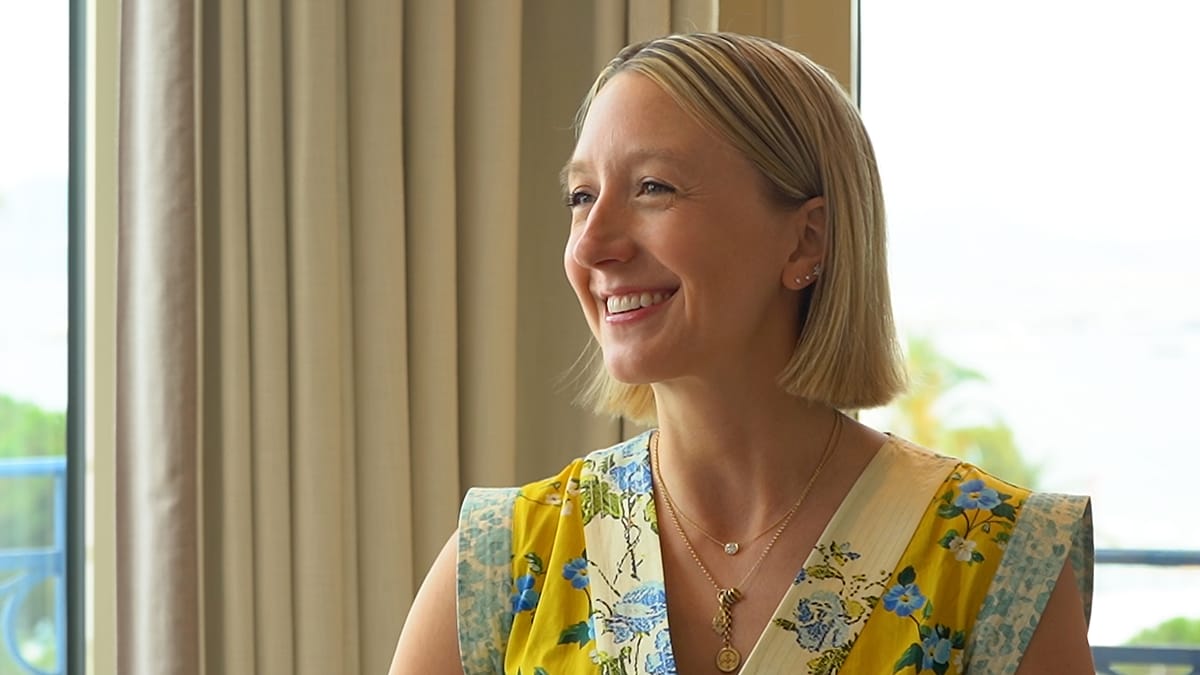
In this interview with Euronews Culture at Cannes Lions, McKinsey Senior Partner Kelsey Robinson discusses these findings and what they mean for CMOs navigating the shift to AI-driven marketing.
Kelsey Robinson: So we did two different articles that launched on Monday, actually, for Cannes really. One was overall research where we talked about the new five capabilities for marketing - like what should those be, what do those look like.
And one piece of research where, with Kellogg and Google, we actually went to talk to, I think, a thousand different marketers across the world, from CMOs all the way down, to understand what is actually happening with AI, how do you feel about it, and what are the barriers to progress.
I think it has a decent amount of anxiety in it, and that is a lot of what we were trying to unpack and understand. So I’d say maybe two main insights.
One: lots of companies are using AI. 88% of companies are using AI. When we ask marketers, over 60% of them are saying that they’re using it multiple times a week. But then less than 10% of those companies say they’ve actually really seen value capture from it. And so there’s this disconnect between usage and the aspiration, and real business impact.
The second main insight was there’s a lot of anxiety, and we need to move from anxiety to advantage - that’s how I like to say it. So if you go and talk to the marketing teams, they are really excited about AI, right? So 86% of them are like, this is great, I’m excited about using AI within my job in marketing. That could be anyone from a copywriter to the CMO to a media optimisation analyst.
So 86% are excited, but 57% are super anxious. Okay, well what does it mean then? If you talk to the CMO, 96% of them are excited, 71% are anxious. And what was most shocking to me is 80% of them were actually worried about their job.
Yeah, I think we might have expected maybe certain roles to feel more anxiety. And what we saw was that was widespread.
So there was some variance, but largely every role within the marketing function had some meaningful level of anxiety. Some people might say, “Is copywriting something that feels like it will be replaced sooner?” They were just as anxious as folks who were thinking on the creative breakthrough ideation.
So I think I was surprised by the lack of variation by role. And then also, to have the head leader, a CMO, I didn’t expect their personal anxiety and fear to actually be higher than some of the folks on their teams.
So a few things. First, you really have to have a narrative that isn’t just about efficiency. And I think we see this in all the companies we talk to, is that AI came in, not even just to marketing, but to technology, to engineering, and other functions, and there was a very big focus on productivity and efficiency, which reads as “we are saving money, we are cutting,” which I think is a reality and actually a benefit of AI.
I think leading companies realise they can’t just focus the narrative on an AI transformation that leads to cost cutting. You have to have a growth aspiration, and it should unlock growth.
If we think about personalisation - we’ve talked about this for 15 years - we are at a point where we can really realise that in a new way. That should drive growth, real growth, revenue uplift. But a lot of companies are still very focused on this as an efficiency play.
And then I don’t think it’s surprising why the org isn’t fully behind it, because they want to be a part of growth, they want to be a part of rewriting that next chapter of marketing, not just “how can I cut costs?”
So I think that’s one thing - leaders focusing on growth, not just efficiency, but both.
I’d say the second thing we see leading organisations doing is they are not waiting for perfect data. A big conversation since last year - I remember last year in Cannes - was “our data is not good enough, we really need to shore up the foundation before we can make progress with AI.” Sure, but there is actually value to be captured now.
So leading organisations are kind of taking two speeds. They are figuring out where they can actually show value - maybe in customer support, maybe in some version of personalisation - and then continuing to make progress on their data foundation and rewire workflows, which is another key thing that leaders are doing.
In the research, we profile the fintech player Chime, and I think their story is one of the best ones out there. Their CMO is really focused on this as a staged organisational transformation, versus just rolling out some technology.
So phase one is giving teams enterprise tools they need to make their day-to-day lives more effective. “Kelsey, you as a marketer, here are a bunch of tools. This hopefully makes your day better, lets you save time, lets you be more impactful."
So stage one is what I’d call normalisation - normalising what it means to use AI.
Stage two is actually transforming some of the core jobs. So where can you see value - taking something like media optimisation or customer support and really working those specific jobs and driving value through those. In the case of that company, they actually saw real value. A ten-week campaign cycle down to four, return on ad spend up by almost 20%. And that is both efficiency and growth. They were able to talk about it as a growth driver and no longer needed to think these things are all trade-offs.
And then the third phase, which I think most companies are not quite there yet, is how do you reimagine whole workflows from front to end. In Chime’s case, they call it “go-to-market AI factories” - how do you take agents, humans and workflows and reimagine how all that work gets done. But that last part is an intimidating place to start. So we’re seeing this phased transformation approach being really successful.
Yeah, I don’t really think that’s an option - to not do it.
I think there will be a cohort of leading companies, and you’re seeing a few break away. But again, we think it’s maybe somewhere between 5 and 10% that are really figuring out how to drive value and re-architect the function. So I think if you don’t do it, someone else will.
There’s this quote I’ve heard many people use: “It might not be AI that takes your job, but it might be someone who’s just better at using AI.” So I think that is the spirit - if everyone shifts from anxiety to advantage and embraces these capabilities, then they’ll be great.