
Mike Rogers team asked AIPAC not to run ads against El-Sayed: Report
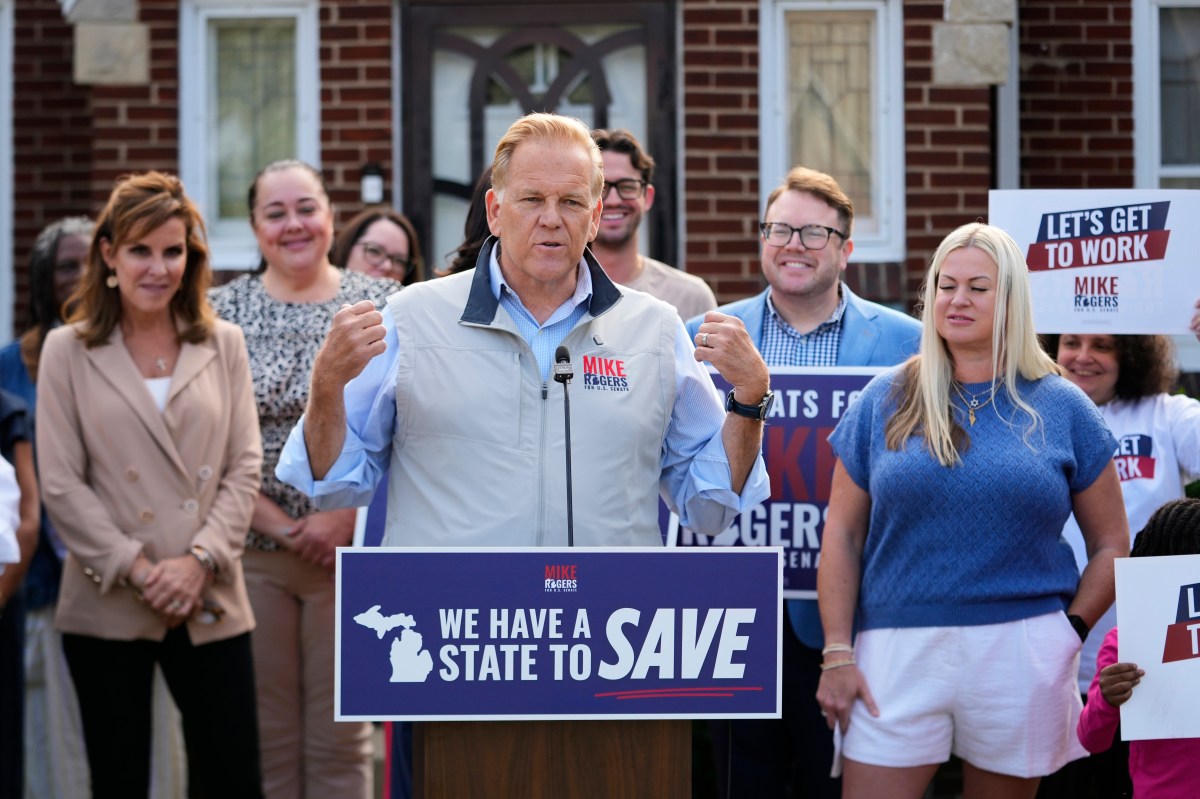
Republican Senate nominee Mike Rogers' campaign has urged the American Israel Public Affairs Committee (AIPAC) not to run advertisements against Democratic rival Abdul El-Sayed, according to an Axios report on Saturday.
AIPAC and its affiliated political action committees are influential players in congressional and statewide races, spending millions of dollars to support candidates, while drawing criticism from some Democrats and progressive candidates.
Democratic primary voters this cycle have defied one of Washington's most influential political organizations in several primary races, delivering a series of victories to candidates running against rivals backed by AIPAC and its affiliated organizations, as was the case in Michigan’s Democratic primary.
El-Sayed, a progressive Democrat who has been critical of Israel's handling of the war in Gaza, won the primary against Representative Haley Stevens earlier this month, in a race that saw around $30 million from AIPAC and affiliated groups such as United Democracy Project (UDP).
Rogers, a strong supporter of Israel and who has been endorsed by President Donald Trump, will face El-Sayed in November in a closely watched race that could help determine control of the Senate.
Newsweek has reached out to AIPAC and both Rogers’ and El-Sayed’s campaigns for comment via email on Saturday.
Rogers' campaign urged AIPAC not to intervene in the race on his behalf, Axios reported. The outlet said Rogers spoke with AIPAC chair Michael Tuchin last week, shortly after which the organization decided not to move forward with a prepared advertisement targeting El-Sayed. The move reportedly angered AIPAC officials, who said they were prepared to spend millions more in the race to ensure El-Sayed is not elected.
The decision highlights the political sensitivities surrounding AIPAC's involvement in political races, even as the group and its affiliated organizations continue to spend heavily on behalf of favored candidates. Rogers, a former congressman, has been a strong supporter of Israel, making his reported decision to push away direct AIPAC support notable.
In the Michigan Democratic Senate primary, UDP had spent nearly $15 million, with roughly two-thirds of the money backing Stevens and the remainder aimed at defeating El-Sayed.
Rogers’ team believes that the AIPAC-backed ads against El-Sayed backfired in the primary, per Axios.
El-Sayed has described Israel’s military actions in Gaza as genocide, allegations Israel has repeatedly denied. He has also called for the end of unconditional U.S. military aid to the country. El-Sayed has criticized AIPAC's political spending and has campaigned on rejecting corporate PAC money.
After his primary win, El-Sayed addressed accusations of antisemitism, saying in part, "To my Jewish American sisters and brothers ... I want you to know that my commitment to your safety, my commitment to Jewish safety, is the same commitment that I have to the safety of my own daughters."
The outlet reported that talks between Rogers and AIPAC have since halted.
"I welcome any and all support from the pro-Israel community and I'm proud to have their involvement," Rogers told Axios.
Meanwhile, AIPAC spokesperson Deryn Sousa told the outlet: "We appreciate [former] Rep. Mike Rogers' welcoming of pro-Israel support. Our members are highly motivated to be involved in this race, and we will be looking at every option to make the case that El-Sayed's policies are bad for Michigan and bad for America."
From Michigan and Minnesota Senate primaries to congressional races in New York, Illinois and California, several Democratic nominees prevailed in their races despite millions of AIPAC-affiliated spending aimed at boosting their opponents.
The primary victories come amid an ongoing debate within the Democratic Party over its direction, with progressives pushing for a more left-leaning agenda while some moderates argue that such candidates could be less competitive in swing districts and statewide races.
Some analysts say AIPAC's role is drawing greater scrutiny in Democratic primaries where debate over U.S. policy toward Israel has exposed divisions within the party, than it will in general elections that are often driven by a broader set of issues between Republican and Democratic candidates.
Ahead of the Democratic primary, Doug Gordon, a Democratic strategist at Upshift Strategies said an El-Sayed victory would be interpreted as a setback for AIPAC.
"There is no question that an El-Sayed victory would be a huge defeat for AIPAC and another sign of how toxic their brand has become within Democratic politics," Gordon told Newsweek at the time.
Earlier in July, Senator Bernie Sanders, a Vermont independent who endorsed El-Sayed, described the Democratic primary as not a race "between Abdul and Haley Stevens. It is Abdul vs. AIPAC."
Jim Kessler, Third Way's executive vice president for policy, previously told Newsweek that the state's demographic plays an important role in relation to AIPAC spending in the state. "It is important to remember that no state has a higher percentage of Arab-American residents in the U.S. than Michigan," Kessler said, noting that "the Jewish population is less than half that of the Arab-American population there."
The race has drawn national attention as El-Sayed and Rogers go head-to-head to fill the open Senate seat following Democrat Gary Peters' decision to retire. Democrats have held the seat for decades, but Michigan has long defied easy political labels, often producing razor-thin elections and unexpected outcomes.
Several forecasters such as The Cook Political Report and Sabato’s Crystal Ball rate the race as a "toss-up."
In the 2016 presidential election, Democratic primary voters backed independent Vermont Senator Bernie Sanders over former Secretary of State Hillary Clinton. Trump later carried the state in the general election by a razor-thin margin. Since then, Michigan has alternated between Democratic and Republican presidential support, cementing its battleground status.
Many of the races have been close. Trump won the state in 2024 with 49.7 percent to Vice President Kamala Harris’ 48.3 percent. In 2020, President Joe Biden won the state over Trump, 50.6 percent to 47.8 percent. Trump narrowly secured the state in his first campaign in 2016, beating Clinton by 0.23 percent, or about 10,700 votes.
Democrats face a difficult map this year, needing to gain four seats while defending their own. The party has pointed to voter concerns over the economy, the ongoing Iran war and Trump’s slipping approval rating as potential opportunities to make inroads and flip the Senate. Republicans currently have a 53-47 majority in the Senate.
The race has remained highly competitive in public polling, with most surveys showing Rogers and El-Sayed running within a few percentage points of each other and often any lead is within the margin of error.
An AARP poll released on Thursday found El-Sayed leading Rogers by a single point, 48 percent to 47 percent. It surveyed 877 likely voters from August 9 to 11, with a margin of error of plus or minus 3.3 percentage points. It was conducted by Fabrizio Ward and Impact Research.
A TechnoMetrica Institute of Policy and Politics (TIPP) survey of 1,528 registered voters in Michigan, conducted for the League of American Workers, found El-Sayed ahead with 45 percent of the vote to Rogers' 42 percent.
On favorability, 39 percent of voters viewed El-Sayed favorably, while 44 percent held an unfavorable opinion and 17 percent said they had no opinion or were unsure. Rogers posted similar ratings, with 37 percent of voters viewing him favorably, 42 percent unfavorably and 21 percent saying they had no opinion or were unsure. The poll was conducted August 6-10 and had a margin of error of plus or minus 2.6 percentage points.
A recent Fox News poll of 1,006 registered Michigan voters found Rogers ahead at 51 percent to 47 percent, with 2 percent undecided. The August 6-10 poll had a margin of error of plus or minus 3 percentage points.
Another recent poll, Susquehanna Polling and Research, which has been rated by Real Clear Politics as one of the most accurate pollsters, found El-Sayed leading 46 percent to 39 percent. The poll of 800 likely voters was conducted August 11-17 and had a margin of error of plus or minus 3.46 percentage points.
Prediction markets currently give El-Sayed an edge. As of Saturday, Kalshi gave the Democrat a 61 percent chance of winning compared to 39 percent for Rogers, while Polymarket put El-Sayed's odds at 64 percent and Rogers' at 37 percent.
The U.S. is a close ally of Israel, providing billions in military aid and diplomatic support for years. Public opinion in the U.S., however, has shifted since the aftermath of Hamas’ October 7, 2023, attack on Israel, in terms of diplomatic and military aid. Following the attack, which killed about 1,200 people and resulted in 250 hostages being taken, Israel responded with an intense military campaign in Gaza, killing over 73,000 Palestinians and triggering mass displacement. More recently, Israel and the U.S. launched coordinated strikes on Iran in late February.
Recent polling shows that America has become much more divided over U.S. support for Israel, which has historically held significant support.
A June AP-NORC poll found that 58 percent of Democrats said the U.S. is too supportive of Israel, up from 45 percent in January 2024, while 60 percent of Republicans said the current level of U.S. support is "about right." Overall, 31 percent of U.S. adults said they believe Israel's military actions in Gaza constitute genocide, while 49 percent said they did not know enough to say and 20 percent felt they did not constitute genocide.
The survey also found Democrats have become increasingly supportive of Palestinians while support for Israel has declined within the party. Sixty-two percent said the U.S. is not supportive enough of Palestinians, up from 49 percent in January 2024. The survey of 3,040 adults was conducted from June 11 to June 17, with a margin of error of plus or minus 2.8 percentage points.
A smaller subset of the AP-NORC poll looked into Jewish Americans' views. Among the bloc, polling found that Israeli Prime Minister Benjamin Netanyahu's favorability among Jewish adults is 32 percent compared to a 59 percent unfavorable rating.
The poll also shows that 38 percent of respondents think the United States is too supportive of Israelis versus 24 percent who feel the U.S. is too supportive of Palestinians. When asked if they think Israel has committed genocide against Palestinians, 30 percent of Jewish adults say yes, compared to 49 percent who say no, while 21 percent say they don't know enough to answer. The study included 1,022 Jewish adults, with a 5 percent margin of error.
A Pew Research survey of 12,574 Americans conducted from May 4 to May 17 found that Americans' view of the Israeli government has significantly worsened since 2022, when 65 percent of Republicans had a favorable view compared to 35 percent of Democrats. The latest survey found 51 percent of Republicans and 16 percent of Democrats feeling as such.
A May Reuters/Ipsos poll found Israel's favorability rating among Democrats had fallen from 59 percent in 2018, to 22 percent.
Contact Newsweek editors for this story: Steve Mollman and Anthony Murray.