
NASA Swift telescope rescue: a daring orbital first
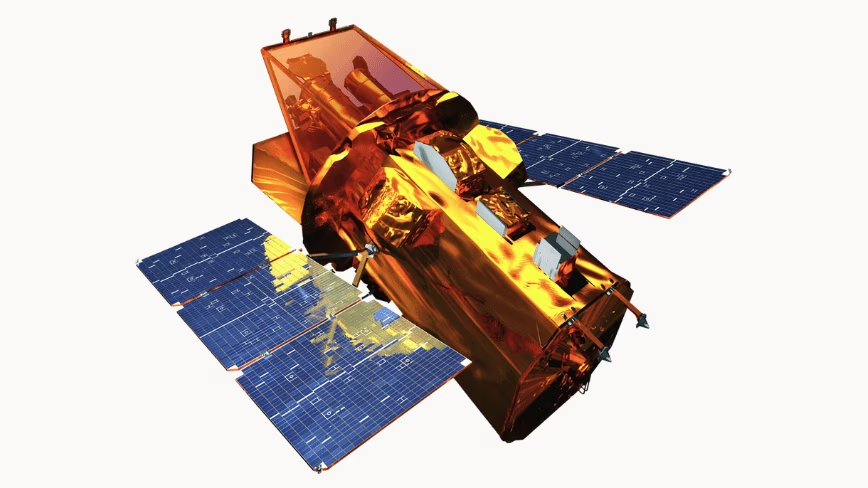
Swift has watched the sky since 2004, catching some of the universe’s biggest explosions. Now it is sinking, and time is short. NASA is paying Katalyst Space Technologies about $30mn to save it, the Associated Press reported. Liftoff could come as early as Tuesday.
The plan sounds simple and is anything but. Reach a satellite nobody designed for capture, grab it, and lift it higher.
Every satellite in low orbit fights a slow drag from the thin air up there. The Sun makes it worse. Intense solar activity has puffed up the atmosphere, and the extra drag now pulls Swift down faster than NASA expected.
The telescope now orbits at about 360km. Left alone, it would drop below 300km by October, past the point where a rescue could still work. After that comes re-entry and a fiery end for a working observatory. NASA has already switched off Swift’s instruments to slow the fall, and science observations stopped in February.
A workspace designed for growth, collaboration, and endless networking opportunities in the heart of tech.
That would be a real loss. Swift ranks among the fastest eyes on the sky, swinging within minutes onto gamma-ray bursts, the brief, violent flares that mark dying stars and colliding neutron stars. “If we let Swift reenter, we would lose that telescope,” NASA science chief Nicky Fox told the AP. “We don’t currently have the budget to build another one to replace that.”
Katalyst’s answer is Link, an autonomous spacecraft about the size of a small fridge with a 12-metre solar wingspan. It carries three arms, each tipped with two pinching grippers. It rides up on an air-launched Pegasus rocket, dropped from a plane over the Marshall Islands in the Pacific.
From there it has to chase down its target. NASA expects Link to take about a month to reach the 1.4-tonne observatory and grab it, then a further couple of months to raise the orbit from roughly 360km to about 600km. If it works, Swift could be back at work by September.
The catch is the hard part. Swift has no docking port and no grip points, because nobody designed it for servicing. Astronauts once fixed Hubble by hand, but that took the space shuttle and a crew. This time a robot works alone.
The speed of it is striking. NASA signed the contract only last September with two instructions: hurry, and do not make things worse. Nine months later, Katalyst is ready to fly.
It is also a first for the US. China nudged a dead satellite into a higher graveyard orbit in 2022, but catching a working telescope that was never built to be caught is a harder job. “No one thought it was going to be possible,” said Shawn Domagal-Goldman, NASA’s astrophysics director.
That matters far beyond Swift. A young industry wants to service, refuel and move satellites in orbit rather than let them die. A real rescue, on a real deadline, is the proof such firms have been waiting for.
The maths is part of the appeal. Thirty million dollars is a fraction of the cost of building and launching a fresh space telescope. If a tug can add years to a healthy instrument, the case for saving hardware over scrapping it gets stronger.
Hubble could be next. Katalyst says a bigger robot, due to fly next year, could reach satellites far higher up and give the ageing Hubble its own boost around 2028. Further out, the firm imagines fleets of orbital robots fixing, fuelling and even building in space.
There is a tidier future hiding in this too. Today most spacecraft simply fall and burn when they reach the end of their lives. A working tug fleet could lift the valuable ones, deorbit the dead ones on purpose, and start to clear the junk crowding low orbit.
For now, all of that rests on one launch and one delicate grab. NASA and Katalyst will know within months whether Swift keeps watching the cosmos or becomes a cautionary tale. The countdown has already started.
Get the most important tech news in your inbox each week.