
new york times misrepresents public executions in iran as extremely rare
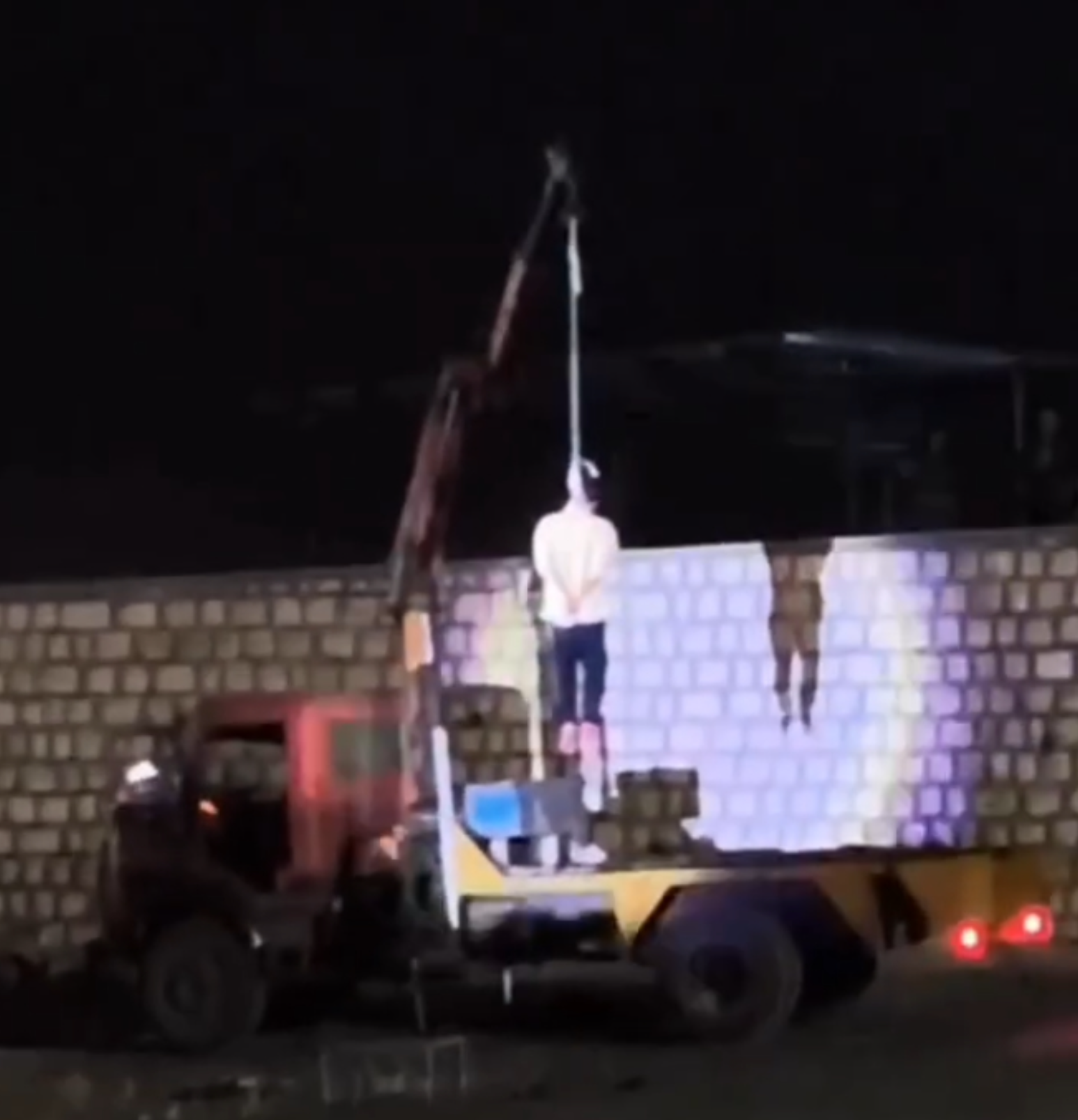
The New York Times recently published an article claiming that public executions are "extremely rare" in Iran. However, this statement has been disputed by various sources, including the Associated Press and the watchdog group Iran Human Rights. According to Iran Human Rights, there were 459 public executions in Iran between 2008 and 2025, with many of these executions featuring large audiences, including children.
United Against Nuclear Iran has also reported that Iran "regularly carries out executions in public," with some of these executions being particularly brutal, such as public hangings from construction cranes. Furthermore, President Trump has stated that between 30,000 and 52,000 pro-democracy protesters were murdered by the Iranian regime this year, many of whom were shot in the forehead.
The New York Times article, written by Leily Nikounazar and Sanjana Varghese, has been criticized for its inaccurate representation of public executions in Iran. Nikounazar, a graduate of Tehran's Faculty of News, and Varghese, who has freelanced for Al Jazeera and worked at Airwars, funded by anti-Israel nonprofits, did not immediately respond to queries about whether they planned a correction.
The use of the adverb "extremely" in the article has been particularly contentious, with some arguing that it pushes the envelope and makes the Times' coverage seem extremely slanted. While the Times might have gotten away with calling public executions "unusual" or "rare," the use of "extremely rare" is seen as an exaggeration.
It is possible that the Times Iran team is attempting to ingratiate itself with the Iranian government in hopes of obtaining permission to cover the eventual funeral of Mojtaba Khamenei. The Times has previously covered the funeral of Ali Khamenei with a team of journalists, and it is possible that they are seeking to repeat this experience.
In the past, the New York Times has been more accurate in its reporting on public executions in Iran. In 2012, the Times reported that "executions are very public events in Iran," with authorities setting up building cranes at the scene of the crime or in the central square of the city. The article also noted that families of the victim and the convicted often attend these executions, and that crowds may try to influence the decision of the Islamic judge.
The 2012 article was accompanied by a slideshow of pictures of hangings, preceded by a disclaimer warning of graphic images. However, the Times' more recent article has been criticized for its lack of accuracy and its attempts to downplay the frequency and brutality of public executions in Iran.
According to the annual report by Iran Human Rights on the death penalty in Iran, the number of public executions increased dramatically after 2010, reaching an annual average of 50 to 60 between 2011-2015. In 2025, the report noted that 11 executions were carried out in public spaces, where children were amongst the spectators, a practice intended to spread fear and reinforce the state's policy of intimidation.
The report also noted that among the crimes punishable by the death penalty under Iran's Islamic law are incest, rape, adultery, consensual gay sex, apostasy, insulting the prophet, and tafkhiz, or intercrural sex where the "active party" is non-Muslim and the "passive party" is Muslim. Approved execution methods include hanging, firing squads, crucifixion, and stoning.
The New York Times' inaccurate reporting on public executions in Iran has been seen as a significant error, and one that undermines the credibility of the newspaper. It is essential for news organizations to strive for accuracy and fairness in their reporting, particularly when it comes to sensitive and controversial topics such as capital punishment.