
Nigel Farage's aura loss
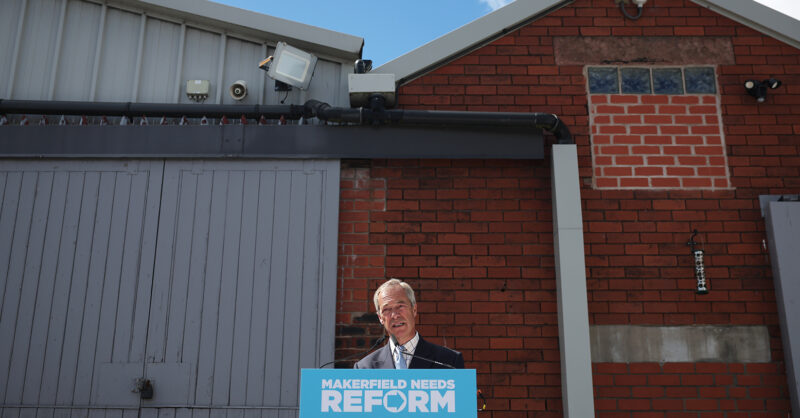
It’s the £5m question: is Nigel Farage losing momentum? The Reform UK leader has had a tricky run of by-election disappointments. There was Andy Burnham’s win in Makerfield, where Reform had cleaned up in council elections just weeks before, and the Conservatives’ win in Aberdeen South, which reminded the political class that Kemi Badenoch still has something to offer right-leaning voters.
After failing to gain Gorton and Denton in February, and before that Caerphilly in the Senedd in October, the most recent results have added to the thesis that Reform’s local election success is failing to translate at a national level, where tactical voters block its candidates. Since the start of this year, the party has drifted down to 25 per cent in the polls – still ahead but several points off the share it needs for a majority.
Questions about the £5m “gift” Farage received from the Thailand-based crypto billionaire Christopher Harborne persist. The original story, that the money was to fund his private security, soon morphed into the claim that it was an unconditional gift, to “reward” his campaign for Brexit. This was after Farage had insisted it “wasn’t political in any sense at all”. He has also tried to blame the revelation on a Russian hack (in reality, he revealed the story himself to the Telegraph, after the Guardian’s City editor got the scoop and asked him about it before publishing).
The gift was made in early 2024, before Farage had announced his return to British politics. In June that year, having previously ruled out running again, he said he would stand as an MP, explaining that he had changed his mind. Parliament’s standards watchdog is investigating whether he broke Commons rules by accepting the payment and not declaring it. MPs must register financial interests going back 12 months before their election.
In interview after interview, the Reform leader – the great communicator – appears rattled, struggles to give a plausible explanation, and makes jarring asides. “I don’t think it’s any of your business, frankly… Will you give your salary to charity?” he said to the Today programme’s Nick Robinson when asked if he’d pay the money back. Jolly needling from Ed Balls and Ranvir Singh on the Good Morning Britain sofa elicited the hiss: “You care, but no one cares.” When LBC’s harrumpher-in-chief Nick Ferrari asked how he was spending it, Farage bragged, “I can spend it on Ferraris if I want… I can put it on the horses.” He even made the mistake of lumping Talk TV’s Julia Hartley-Brewer in with the “London media class”. Appalled, she dug in and asked why he hadn’t shared the security receipts. No straight answer.
After this story broke, I received exclusive polling by Survation for the campaign group 38 Degrees that revealed 68 per cent of Britons were concerned the money gave Harborne “inappropriate influence” over Farage’s political decisions. This included 50 per cent of Reform voters. But the party went on to win big in council elections in May, and when I spent the day talking to residents of Clacton – Farage’s constituency – it didn’t come up once.
Instead, his reputation appeared to be waning in other ways. Locals joked that he was never in town, didn’t believe much would change under him, and many said they wouldn’t vote. “He’s the same as the rest,” said one bus driver who was a floating voter. “Both Starmer and Farage, I don’t see the point.” One woman who had voted Reform at the general election in 2024 was now leaning towards Restore because “Farage seems quite anti-women; just little comments he makes”.
It’s also a worry for Reformers that Farage, long perceptive about how far he could push the boundaries of acceptable debate and where to draw the line, is losing that common touch. His party’s policy to rescind indefinite leave to remain from people already permanently settled here didn’t chime with a Britain still committed to fair play. His call for “pure, cold rage” ahead of the Southampton riots associated Reform with street thuggery – something Farage has always tried to avoid by denouncing Tommy Robinson. And his insistence that the party “should be unapologetic” about the Makerfield Reform candidate Robert Kenyon’s sexist online comments was ill-judged. Even his old ally and former spin doctor Gawain Towler wrote about this attitude “alienating” women.
If the reason behind the wobble is Restore, a far-right alternative nibbling at Reform’s vote, then that is also misjudged. Rupert Lowe’s splinter party could be useful for Farage – as extremists he can define himself against. He could benefit from the “radical flank effect”, a phenomenon whereby a niche or unpopular radical movement raises the salience of an issue (in this case, immigration) which then boosts more mainstream advocates. This happened during Just Stop Oil’s M25 blockades: they were hugely offputting to the public, but in that time the milder Friends of the Earth saw a bump in support.
Reform knows it can only win by persuading middle-ground voters that it isn’t too extreme or strange. “When Nadhim Zahawi defected, we had people calling up saying they’d never forgive us,” one senior Reform source told me, of anti-vaxxers reacting to the party’s recruitment of the ex-Tory minister behind the Covid vaccine roll-out. “But there are always going to be those people. We should ignore them.” To keep momentum, Nigel Farage needs the ones who were banging pots and pans every week during lockdown. He needs middle Britain.