
Old-School Lessons from a Special French Rural Education Program
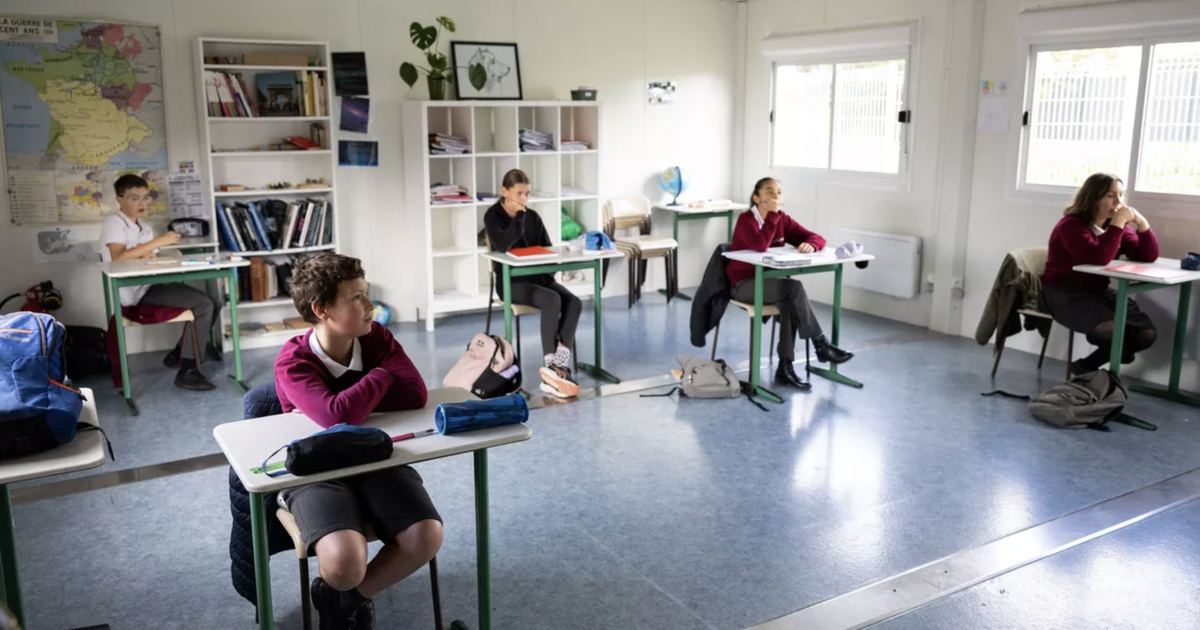
To signal the end of recess and ask her students to line up, Marie de Seroux gently rings a small hand bell before heading to the 7th-grade classroom for a lesson on chromosomes, carrying a stack of freshly copied handouts. Facing her are just five students.
“It’s quite a change from my previous positions: I can get the class to be quiet much more quickly,” she quips.
The newest addition to the Excellence Ruralités network founded by Hervé Catala and Jean-Baptiste Nouailhac, the independent Vauban middle school has welcomed ten 6th- and 7th-grade students since last September in the town of Étang-sur-Arroux, in Saône-et-Loire, population 1,800.
Its promise? “Small class sizes, personalized support, and adapted teaching methods” in an area where educational options are limited, especially for children with special needs.
“Here, nearly all of the children have learning difficulties, accompanied by a serious lack of self-confidence, although we are open to all students,” says Marie de Seroux, the school’s director. “Our goal is to welcome and provide an education to children who have nowhere else to go—not the other way around. We are not trying to empty public-school classrooms.”
The secret to the school’s success? Bringing traditional methods back into fashion.
Here, all children wear uniforms. The school provides four white polo shirts, two burgundy sweaters, and either a gray skirt or gray trousers for €120. Parents must purchase the shoes themselves, which must be dark-colored and unbranded.
On Monday mornings, the week begins with a flag-raising ceremony accompanied by La Marseillaise. Every day, classes start at 8 a.m. and end at 4:30 p.m., after an hour of supervised study led by a teacher.
“The organization is simpler for parents and children because the schedule is always the same. This also allows us to walk all students who arrive by train to and from the Étang station every day,” explains Dorian Maillot, a mathematics teacher.
Another guiding principle for the teaching staff is that teachers are also “educators.”
In the playground, the preteens still play tag and kick-the-can. Students readily mix together and are rarely alone.
“I put on my sneakers and join them!” says Dorian Maillot before heading off to play soccer with two students.
“At first they beat me, but eventually I regained the upper hand,” the teacher laughs.
At lunchtime, students and teachers share the same table. These moments of camaraderie are important for the children.
“There’s a really family atmosphere here. We all play together without judging each other, unlike a normal public middle school where everyone stays in their own corner gossiping,” says Anastasia, a 7th-grade student, brushing a lock of dark hair behind her ear.
Every Friday afternoon, students put away their notebooks and take part in a fun workshop led by a teacher. Sewing, cooking, furniture restoration, gardening, mechanics...
“Today we’re making clafoutis cake!” announces Louis, a 6th-grade student, as he pits cherries brought by Anastasia.
On the other side of the garden, Loan carefully screws together boards salvaged from a pallet to build a compost bin.
“It’s my favorite moment of the week. I love manual work and spending time outdoors,” he says with a smile.
The method has already proven successful elsewhere in France.
The first Excellence Ruralités school, called Cours Clovis, opened in 2017 in La Fère, in the Aisne department. Housed in a former Lidl supermarket, it now educates students from first grade through ninth grade. The location was carefully chosen: at the time, this town of 3,000 residents had a school dropout rate of 37%.
In 2022, Cours Aliénor d’Aquitaine opened in the former village school of Esse (population 500), in the Charente department, near Confolens, France’s smallest sub-prefecture.
Cours Vauban, meanwhile, has found its home in a field, where five portable modular buildings have been modestly outfitted.
“We decorate as best we can, putting up maps of France and student projects to brighten the walls,” says French teacher Aline Bouheret with a smile.
The projector’s power cable is taped to the ceiling with strips of brown tape. Chairs and desks are secondhand, while the dishes and kitchenette equipment—students bring their own lunches to school—have been found, donated, or given by parents.
Two additional modular units will be installed this summer to house future 8th- and 9th-grade classes, scheduled to open at the start of the 2026 and 2027 school years.
Because the independent private school receives no state funding, tuition fees are calculated according to family income and range from just €30 to €90 per month.
On average, these fees are closer to those of state-contracted private schools, whereas independent private schooling generally costs between €400 and €800 per month.
“That was a wonderful surprise and confirmed our decision to enroll our son,” says François Lallemand, a civil engineering professional and father of Étienne, a 7th-grade student diagnosed with ADHD.
Excellence Ruralités operates thanks to sponsorships and private donations—from organizations including L’Oréal, the Fonds du Bien Commun, owned by conservative billionaire Pierre-Édouard Stérin, and Hellio—which account for “90% of our funding,” explains Jean-Baptiste Nouailhac.
Despite what its director general describes as a “social mission,” the network has been under criticism for several months.
First because of Stérin’s financial involvement, making him a frequent target of the left-wing media.
On April 15, Mediapart published an article headlined, “Excellence Ruralités, the traditionalist education flourishing where public schools are struggling,” asserting that the educational project, “largely financed by the far-right billionaire Pierre-Édouard Stérin, seeks to wage an ideological battle in regions where the national education system is faltering.”
A month later, Libération also criticized Excellence Ruralités in an opinion piece titled, “Let’s Not Leave Rural Schools to Pierre-Édouard Stérin’s Far Right.”
In addition, inspection reports from the Ministry of Education have identified pedagogical shortcomings and deficiencies in hygiene, safety, and student monitoring, particularly at Cours Aliénor d’Aquitaine.
The Bordeaux education authority referred the matter to the prefect to consider a possible administrative closure.
Philippe Sauer, the school’s director, says corrective measures have been taken. “Come see what our schools look like, and you’ll see that our students feel good there. We have addressed every deficiency raised during inspections in 2023, 2025, and last May,” he says.
Cours Vauban, the network’s newest school, has also not escaped criticism.
“Some people are convinced we came here to politicize children and provide an ultra-Catholic education, which is false. We are a secular school,” says Marie de Seroux.
For Pierre-François Chanu, the network’s educational director, the methods used are “neither ideological” nor “old-fashioned.”
“We use the phonics method to teach reading, as was done in the past. In mathematics, on the other hand, we prefer the Shanghai method, which dates from the 2000s,” he explains.
Nevertheless, Excellence Ruralités continues to enjoy the support of its teachers and students’ parents.
“Our team remains united. We know why we chose this school,” says Paul Prédignac, who has taught history and geography in Esse since the start of the last school year.
The same sentiment is shared by Candice Debock, whose three children have attended Cours Clovis for the past five years.
“This school has given us the opportunity to provide a better education for our children, who have multiple learning disorders,” she says. “Since enrolling, they have been transformed.”
And the results appear to support that claim: last summer, Excellence Ruralités highlighted its students’ performance on the national middle-school exam, with average scores of 14.1 out of 20 at Cours Clovis and 12.4 out of 20 at Cours Aliénor d’Aquitaine.
In the coming years, the network intends to expand enrollment at its existing schools. At the same time, it is actively working toward obtaining state association contracts for its schools.