
OpenAI has reportedly offered Washington a 5% stake worth $42.6bn
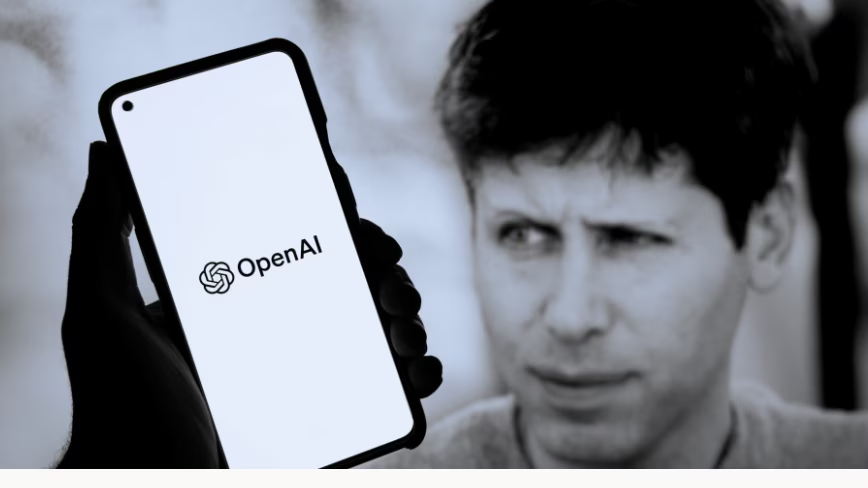
OpenAI has proposed handing the US government a 5% equity stake in the company, according to the Financial Times, as the White House and Silicon Valley’s best-funded startup edge closer to a deal that has been under discussion for more than a year.
At OpenAI’s $852bn valuation, struck in its record-breaking March funding round, a 5% holding would be worth roughly $42.6bn.
Two people familiar with the talks told the FT that chief executive Sam Altman has argued giving the public a financial interest in OpenAI is the best way to share the upside of artificial intelligence.
That framing tracks with OpenAI’s own public statements since early this year, when Altman first floated the idea of a government stake directly to the Trump administration.
A workspace designed for growth, collaboration, and endless networking opportunities in the heart of tech.
The structure being discussed reportedly involves a so-called public wealth fund, a vehicle OpenAI first sketched out in an April policy paper that proposed pooling equity donations from AI companies and distributing the resulting economic benefit to citizens.
Under that framework, OpenAI would donate shares rather than sell them, which would avoid a direct cash outlay from the government and sidestep, at least on paper, questions about how a private company transfers equity to the federal government in the first place.
The FT’s report, says the proposed arrangement envisions other US AI companies ceding similar stakes through the same vehicle. Anthropic, Google and Meta were named as potentially participating, though it remains unclear whether any of them would actually agree to OpenAI’s terms, and none has commented publicly on the proposal.
The politics around the idea are messier than the mechanics. Senator Bernie Sanders has pushed a competing and considerably more aggressive plan, the American AI Sovereign Wealth Fund Act, which would impose a one-time 50% stock tax on large AI companies to seed a fund the senator’s office projects could reach $7 trillion.
Palantir’s Alex Karp has argued that OpenAI’s voluntary 5% offer will look modest next to Sanders’ proposal, and that full nationalisation of frontier AI companies is coming regardless of which version wins first.
Where the two plans agree is on the underlying premise, that a handful of AI companies are about to become extraordinarily large and that the public should hold some claim on that value before it fully accrues to private shareholders.
Where they diverge is on consent and scale. OpenAI is offering a small slice voluntarily, structured to look like a donation, while Sanders wants a mandatory transfer worth ten times as much, paid in stock rather than cash and backed by the threat of legislation rather than a company’s own initiative.
OpenAI’s ownership structure already complicates any transfer of this kind. The company completed a recapitalisation last year that split it into a nonprofit foundation and a for-profit public benefit corporation, with the foundation retaining a 26% stake and legal control over the business.
Layering a government-held 5% stake on top of that structure would require decisions about where the new shares sit, what voting rights attach to them, and whether the foundation’s existing control provisions would need renegotiating to accommodate a new, politically sensitive shareholder.
None of this resolves the practical questions that have stalled the idea for more than a year.
How a private company transfers equity to the Treasury, who administers the resulting fund, and whether Congress would even need to authorise such a vehicle are all unsettled, and OpenAI’s own restructuring into a public benefit corporation under nonprofit oversight already complicates the ownership picture considerably.
The FT’s sources gave no timeline for when, or whether, the proposal moves from talking point to signed agreement, and neither the White House nor OpenAI had confirmed the specific terms on the record at the time of the report.
Get the most important tech news in your inbox each week.