
Over 900 Arrested During South African Anti-Migrant Protests. Here's What to Know
Follow this section to personalize your feed and get instant alerts.
Follow this tag to personalize your feed and get instant alerts.
Follow this author to personalize your feed and get instant alerts.
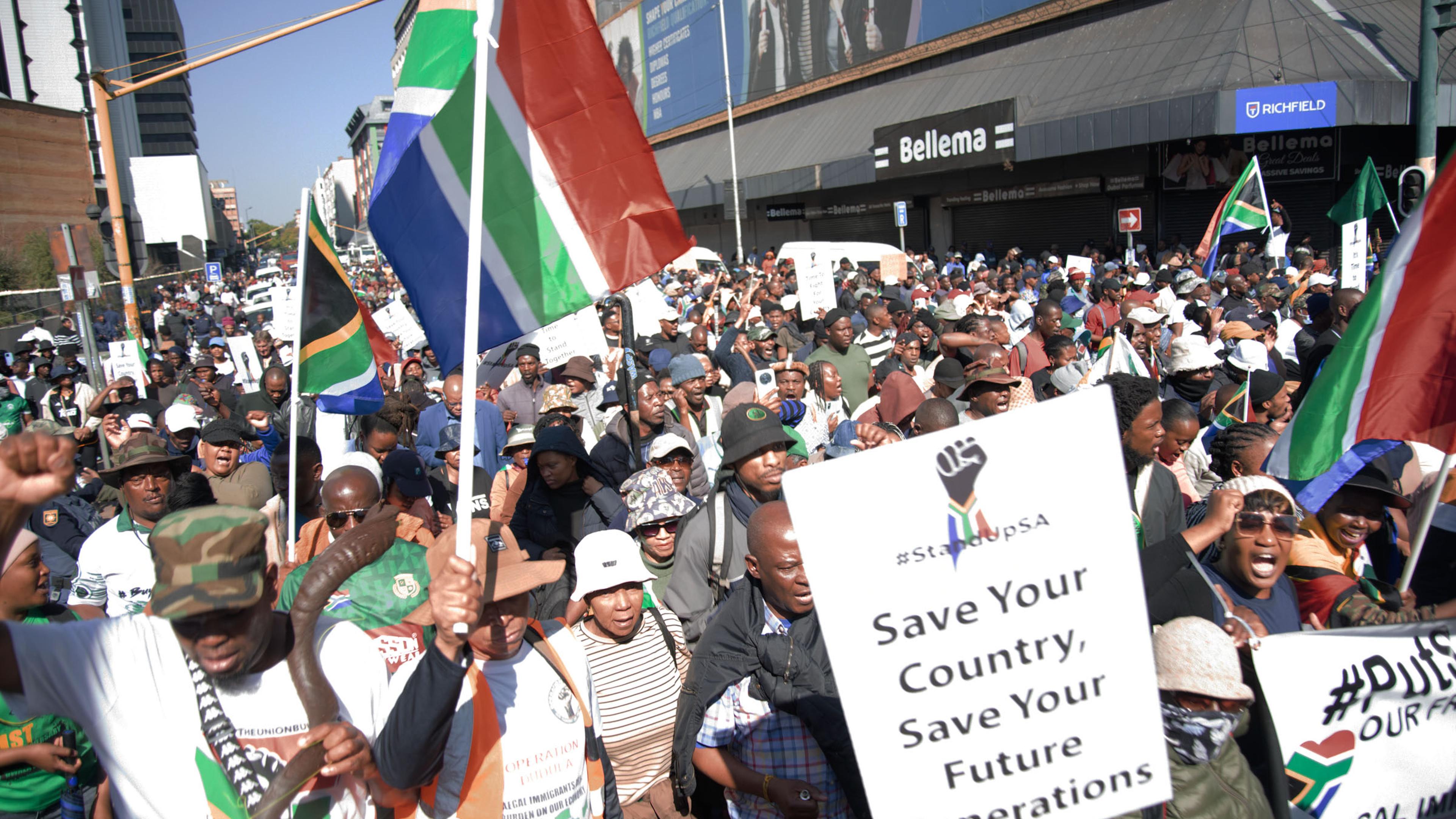
Nearly 5,000 protesters took part in a march against illegal immigration in Pretoria. The demonstrations were reportedly organized by more than 20 anti-migrant organizations and civil society groups, including the March and March movement.
Follow this author to personalize your feed and get instant alerts.
More than 900 people were arrested amid nationwide anti-migrant protests in South Africa on Tuesday that saw thousands take to the streets to mark a “deadline” by which organizers demanded undocumented immigrants must leave the country.
South African authorities said that while most of the protests were mostly peaceful, several marches descended into violence.
Tebello Mosikili, the Deputy National Commissioner of the South African Police Service (SAPS), said at a press conference on Wednesday that of the 120 marches that took place on Tuesday, 108 were peaceful and 12 led to clashes with police, including in parts of Gauteng, KwaZulu-Natal, and the Western Cape.
Tuesday’s demonstrations, which were organized in part by the March and March civic organization, were the culmination of protests beginning in April. At least five people have been killed since they started.
Thousands of people marched in the coastal city of Durban, according to local media, chanting “Abahambe!”, meaning “They must go!” in isiZulu, the most widely spoken language in the country. This phrase has become a rallying cry for activists who say that undocumented migrants and other foreigners in South Africa have taken away jobs from those who were born there.
One protestor, Simphiwe Gumede, who lives in an urban suburb of Durban, told The Washington Post that he was marching because he is “not happy about immigration” in the country.
“We feel that government leaders do not care about our plight and some officials are taking bribes to allow illegal immigrants, some of whom are peddling in drugs, others taking the few jobs available,” he said. “We are warning all those who are still keeping foreign nationals in their homes as lodgers to please take them out while it is still safe. We are on the campaign to clean this country.”
March and March founder and leader Jacinta Ngobese-Zuma was one of those who marched in Durban, and addressed protestors in the city, announcing the campaign would continue weekly until the government responds to protesters’ demands of stronger border management and enforcement against undocumented immigrants.
“For as long as they haven't left, we are marching every Thursday,” she told supporters.
According to census data, as of 2022 South Africa was home to 2.4 million foreigners—both documented and undocumented. That number represents roughly 3.9% of the country’s total population.
While the government said that the June 30 deadline set by March and March had no legal standing, and that citizens do not have the authority to enforce immigration laws, thousands of people fled their homes in South Africa in the days and weeks leading up to the date, sleeping outside, next to government offices, and in makeshift camps near the country’s border in hopes of being repatriated.
Days before Tuesday’s protests, the South African government reported that more than 9,000 Malawian nationals and about 3,000 Zimbabweans had been repatriated or deported through the Beitbridge Port of Entry over a five-day period ahead of the organization’s deadline.
Human rights groups including Amnesty International South Africa have argued that while citizens have the right to peacefully protest, migrants are being used as scapegoats for the South African government’s mismanagement of public resources and services.
“Marches in full swing across South Africa today, on the deadline given by anti-migrant group March for March, are a result of the country's failing immigration systems that leave thousands of people undocumented and living in limbo, including refugees and asylum seekers,” the group wrote on social media Tuesday.
“This together with persistent inequalities and socioeconomic exclusion rooted in the legacies of apartheid go far beyond bureaucracy, feeding public frustration and creating fertile ground for misinformation,” the statement continued. “No one should be scapegoated as a result of governmental failures.”
The group also said that while South Africa has a “strong” legal and human rights framework regarding the rights of refugees and asylum seekers, its asylum management system has failed, which has left hundreds of thousands of applicants without the proper documentation to remain in the country.
Human Rights Watch reported that in April and May, “vigilante” and “xenophobic” attacks targeting African and Asian foreign nationals in South Africa rose.
The group traces the country’s history of xenophobic attacks back to 2008, when 62 people—including 21 South Africans, 11 Mozambicans, 5 Zimbabweans and 3 Somalis—were killed in riots targeting refugees.