
Pride the musical: a rousing reminder that solidarity can triumph
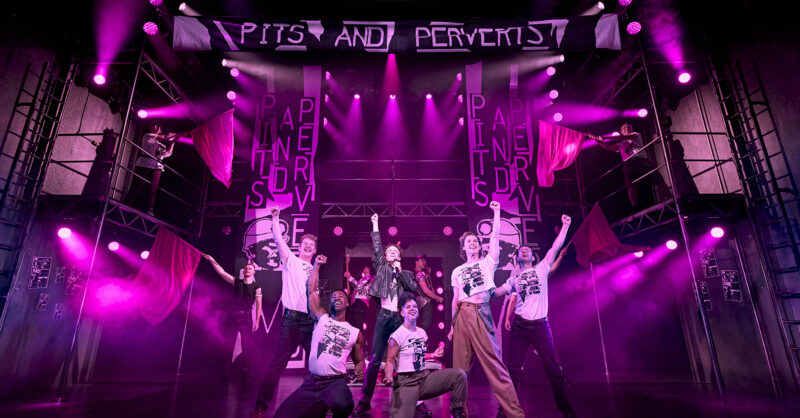
Before there was “woke”, there was “solidarity”: the idea of standing with groups you weren’t a member of because you understood that you shared a common enemy – or even simply because you considered them worthy of respect and dignity. That idea is what drove Mark Ashton, an Irish communist gay activist, to raise money at the 1984 pride march to support striking miners, on the grounds that Margaret Thatcher and the tabloids hated them as much as they did the LGBT+ community. The true story of the subsequent unlikely alliance between Ashton’s Lesbian and Gays Support the Miners (LGSM) organisation and a small Welsh mining village was told in the critically acclaimed 2014 film Pride, written by Stephen Beresford and directed by Mark Warchus.
Now Beresford and Warchus have adapted their work as new National Theatre musical. Already sold out before press night, it is a guaranteed sensation.
Musical adaptations can sometimes fall flat, relying too heavily on the audience knowing the plot and leveraging emotion from lacklustre songs. Not this one. Pride is an emotional rollercoaster – complex, witty, joyful and tragic at once – that takes no shortcuts either musically or thematically.
Christopher Nightingale’s score veers from rock-opera to Welsh chorals to classic show-biz, with some truly dazzling showstoppers. “Paint the Revolution Pink”, the soundtrack as the LGSM throw a “Pits and Perverts” fundraising concert for their mining comrades, is an instant hit, as is the rallying cry of the Valleys women as they launch themselves onto the London gay scene, one elderly Welsh grandmother proudly announcing “I think I’m into leather!”. And in terms of lyrics, nothing quite beats the coming out ballad of one of the younger gay men: “Yes I’m sure so save the sermon, I like cock and Ethel Merman.” The Welsh villagers get their moments too, with a rousing chorus of labour anthem “Bread and Roses” which had the whole auditorium in tears.
The performances are pitch-perfect. There is not a weak link the whole ensemble, but a special shoutout should go to Jhon Lumsden as the manic but indefatigable Ashton, whose electric charisma can be felt from the back row. And if his co-star Samuel Barnett (of History Boys fame), who plays the more flamboyant Jonathan, somewhat steals the show, it is only because of the exquisite dance numbers he gets to star in.
Except it’s not all sequins, disco and tap shoes. As anyone who remembers the Eighties will know, Thatcher won; the miners lost their strike. Homophobia wasn’t banished overnight, and the gay community was on the brink of calamity, as a deadly new virus was starting to wipe out a generation of young people in their prime. Is a stage show of the period really going to sugar-coat all that and pretend it has a happy ending?
No. The desperation and sense of bittersweet loss is what elevates Pride from a good musical to a great one. There is grief and despair woven into the message of hope, all the more powerful for the contrast. Does hope triumph in the end? In a way, it depends on whether you’re a miner or a homosexual. In 1985, a Labour resolution committing the party to gay and lesbian rights passed with the support of no other than the National Union of Mineworkers. Solidarity was not just an ideal. It was a triumph.
All that feels a very long way from current politics. The programme hosts reflections from a collection of politicians – including Chris Bryant, who won the seat of Rhondda in 2001 despite doubts an openly gay man could ever win over the Valleys, and Siân James, the former MP for Swansea East who finds herself depicted in the musical. Most are heartwarming odes to progress. But Lynne Featherstone, the Liberal Democrat politician who championed same-sex marriage through parliament in 2014, is more uncertain. “The atmosphere has changed,” she writes. “I don’t think it would be possible today.” The narrative now is that left-behind communities like the Welsh miners have no time or interest for progressive ambitions like LGBT rights. The left has been accused of getting distracted from its core base of hardworking families, lured astray by clueless metropolitan liberals pressing for causes real people don’t care about.
Pride isn’t just a history lesson – it’s a reminder that such cynicism is misplaced. The idea that traditional working-class communities are inherently at odds with “woke” activists agitating for social change was wrong in 1985, and it’s wrong now. Here’s to you, Mark. You were right.