
Project Kusha will cut India’s dependence on imported air shield systems like Russian S400 in future: DRDO expert - The Times of India
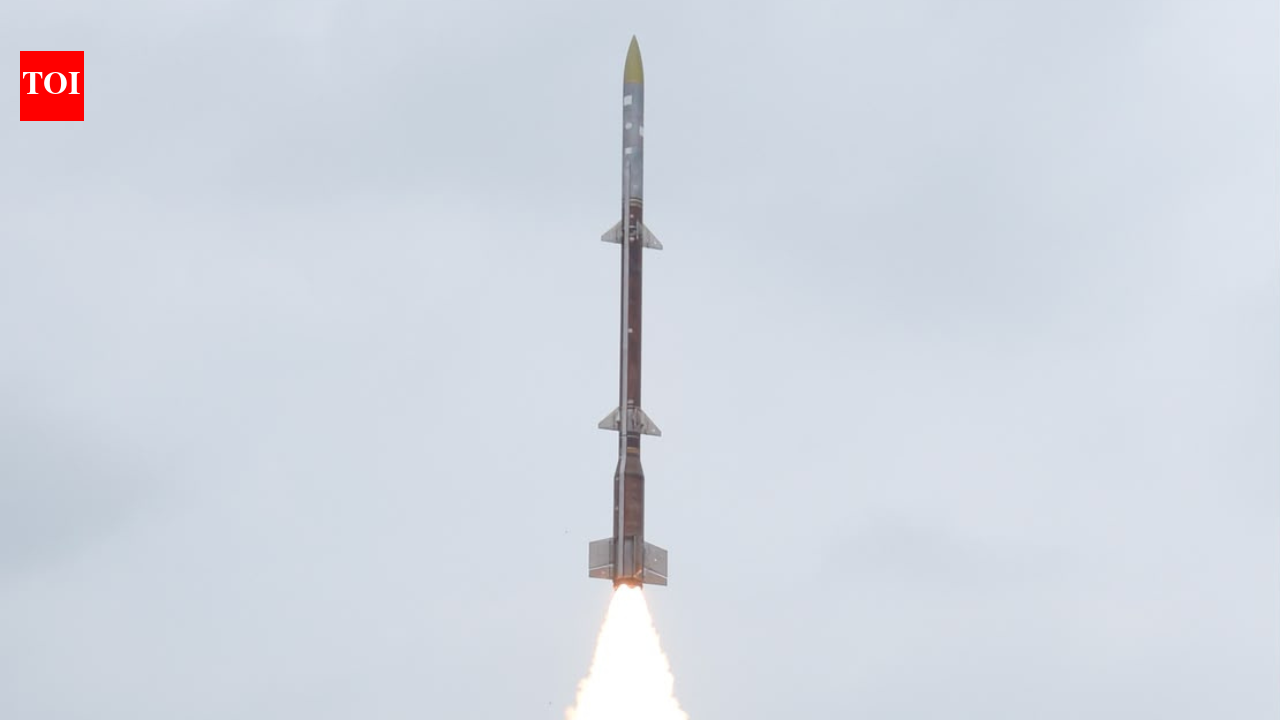
NEW DELHI: India’s successful maiden flight test of the indigenous Project Kusha on July 23 was not just any missile test but it was a giant step towards building a homegrown long-range air defence system capable of reducing dependence on imported defence shield platforms like Russian S-400 triumf in future and will help counter aerial threats from China and Pakistan.Developed by Defence Research and Development Organisation (DRDO), the Kusha project has been designed to rival the capabilities of Russia’s S-400 triumf and US’s MIM-104 Patriot missile shield as its extended range surface-to-air missile (ER-SAM) system is intended to anchor a three-tier defence architecture capable of engaging aerial threats up to 400 km away.
The July 23 test of a long-range Kusha missile was a key milestone in India’s evolving multi-layered long-range air defence architecture envisaged under Mission Sudarshan Chakra. Kusha has been designed to intercept fighter aircraft, cruise missiles, large drones, precision-guided weapons and certain classes of ballistic and hypersonic threats.Sudhir K Mishra, distinguished scientist (Retd) and DRDO chair (Emeritus), told TOI, “Project Kusha uses three distinct variants of interceptor missiles designated M1, M2, and M3 to provide a multi-layered defence shield.” M1 interceptor reaches a range of up to 150 km to tackle tactical point-defence targets like fighter jets and cruise missiles.
M2 interceptor has an extended range of 250 km to intercept stealth aircraft and high-speed threats and M3 interceptor will reach an outer range of 350 to 400 km to engage high-value assets like AWACS and refuellers.“Currently, MRSAM (IAF and Army versions) and LRSAM (for Navy), also called Barak-8 system, jointly developed by DRDO and Israel Aerospace Industries (IAI), provide protection for ranges from 70km to 150km.
Once fully developed, Kusha interceptor missiles will provide multi-layered protection from a range starting from 130 km to 400km. Right now, the Russian-S400 Triumf with a range of 400 km is being used to provide long-range air shields. Initially, Kusha will complement the S400 system in providing long-range protection and will then gradually replace S400,” Mishra said.Kusha forms the outer layer of India’s evolving multi-tier air defence architecture and will operate through the Indian Air Force’s Integrated Air Command and Control System (IACCS).
By utilising homegrown software, command networks, and target seekers, its system cuts out foreign supply chain dependencies and allows sovereign, in-country upgrades. It uses advanced Gallium Nitride (GaN)-based active electronically scanned array (AESA) radars and dual RF/IR seekers. The indigenous system is slated for full military induction and deployment between 2028 and 2030.Defence PSU Bharat Dynamics Ltd and private company Solar Industries are the chosen development-cum-production partners and are involved in the process.
Bharat Electronics is the development partner with DRDO for different types of radars and control systems.