
Putin can no longer hide the consequences of his war
For more than four years, Vladimir Putin largely succeeded in insulating the majority of Russians from the immediate consequences of his war against Ukraine. Much of the fighting and dying was concentrated among contract soldiers who were paid large signing bonuses and drawn, disproportionately, from the poorer regions, far from the major population centres in Moscow and St. Petersburg. The economy was stalling, inflation climbing, and interest rates, at one point, hit 21 per cent. But for many people the conflict, still technically known as the “special military operation,” was an abstract concept, being fought far away, that could be tuned out of their daily lives.
No longer. Bolstered by advances in its indigenous drone manufacturing capabilities, the Ukrainian military is doubling down on a campaign to bring the war home to Russia by targeting the country’s energy infrastructure with medium- and long-range drone strikes. This has the three-fold benefits of targeting the fuel supplies needed to sustain the Russian offensive, forcing the Russian military to redeploy air defences to protect domestic facilities across the country’s vast landmass, and compelling Russian civilians to confront the fear of aerial attacks that Ukrainians have been living with for years now, albeit at a fraction of the intensity.
Until recently, Putin mostly adopted a posture of public insouciance, insisting that the conflict was proceeding according to plan, Russian soldiers were relentlessly advancing, the Ukrainian defences were crumbling, etc. But the wave of recent attacks – including a massive drone strike on Moscow on 18 June, which included more than 200 drones, setting an oil refinery on fire and sending massive clouds of thick black smoke billowing into the skies above the capital – combined with the resulting shortages of fuel has finally forced the Russian president to acknowledge the fact that his war is coming home.
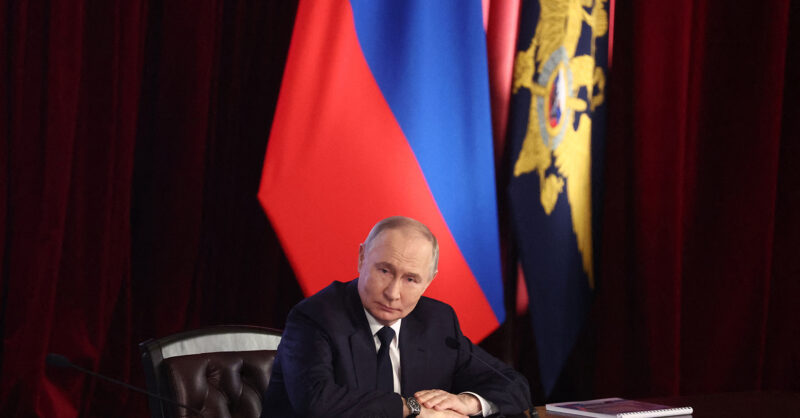
“These strikes on our infrastructure sites are creating problems, that’s obvious,” Putin said during an interview with a state television reporter on 28 June. He insisted that the damaged facilities were “being restored quite quickly, and the issues that arise are not critical.” On the same day, he was pictured chairing a meeting of energy and transport officials inside the Kremlin to discuss the “problems for car owners and businesses” and the urgent need to “stabilise the fuel market.”
According to Mediazona, an independent Russian news site, fuel rationing has already been implemented in 56 regions, with a “state of emergency” declared in Crimea, which has been occupied by Russia since 2014. “There are still queues at petrol stations, and some highly demanded fuel brands may be hard to find,” Putin told the officials in unusually candid remarks. “Of course, we are aware of the difficulties agricultural producers and farms face in summer. We need to do our best to ensure that the seasonal fuel supply schedules are strictly met for agricultural enterprises, as harvests depend on these supplies.”
In some respects, this is classic Putin. Confronted with a crisis he can no longer credibly ignore, he is attempting to present himself as the solution to the country’s problems, rather than their cause. Putin’s public image has long been predicated on the idea that he is an effective manager – the only figure strong enough to knock heads together and make the dysfunctional system operate, and negotiate the vicious rivalries between the warring factions of the elite. But the war against Ukraine is testing that proposition. Now in the fifth year of a conflict that has already lasted longer than the First World War, and the Great Patriotic War, as the Soviet involvement in World War II is known in Russia, Putin seems to have little to offer but more of the same: a never-ending conflict with no coherent path to victory beyond the hope that Ukraine eventually gives up.
During the same interview in which Putin acknowledged the “problems” Russia was now facing at home, he also said he had rejected a proposal from Kyiv to suspend their respective long-range air strikes and limit the conflict to the four regions of Ukraine where most of the fighting is currently taking place. This was merely aimed at “distracting our attention and our forces from achieving the main task at hand – final liberation of the Donbas and Novorossiya.”
Putin’s reference to “Novorossiya” suggests he now has more expansive ambitions than the objectives he outlined to US president Donald Trump during their summit in Alaska last August. Then, he is said to have offered to halt the fighting and withdraw Russian troops from other parts of Ukraine if he was given control of the Donbas. The addition of Novorossiya – a Tsarist era term that dates back to Catherine the Great – would include the partially occupied regions of Kherson and Zaporizhzhia as well as a wide swath of southern Ukraine, potentially stretching as far as the Black Sea port city of Odesa. In other words, Putin has no intention of agreeing to a compromise.
Yet the Russian leader also surely understands that this war has now entered a new phase. He no longer has the luxury of pretending that the violence can be confined to the borders of Ukraine. He will be well aware that his approval ratings have slumped to some of their lowest levels since the start of the war. The independent Levada Centre shows his approval rating at 79 per cent in May, down from 87 per cent last September. (Still high by the standards of most countries and indicative of both the lack of domestic political alternatives and polling conditions under a repressive authoritarian regime.) It is not just the danger of drone strikes and the economic consequences of the war that are fuelling this sentiment, recent moves to restrict access to the internet, including widespread outages of mobile internet service, are also driving discontent.
This does not mean Putin is now likely to back down and agree to a ceasefire on any terms. Quite the opposite. Recent history has taught Putin the unfortunate lesson that decisive military action is the best cure for dwindling public support. The two biggest spikes in his approval rating over his quarter-century in power so far came after his annexation of Crimea in 2014, and the full-scale invasion of Ukraine in 2022. Confronted, once again, with domestic challenges – even if they are of his own making – and a war that is already coming home, the danger is that he decides to escalate again, calculating that the only antidote to his perceived weakness is an unmistakable display of strength.