
Putin knows more than we realize
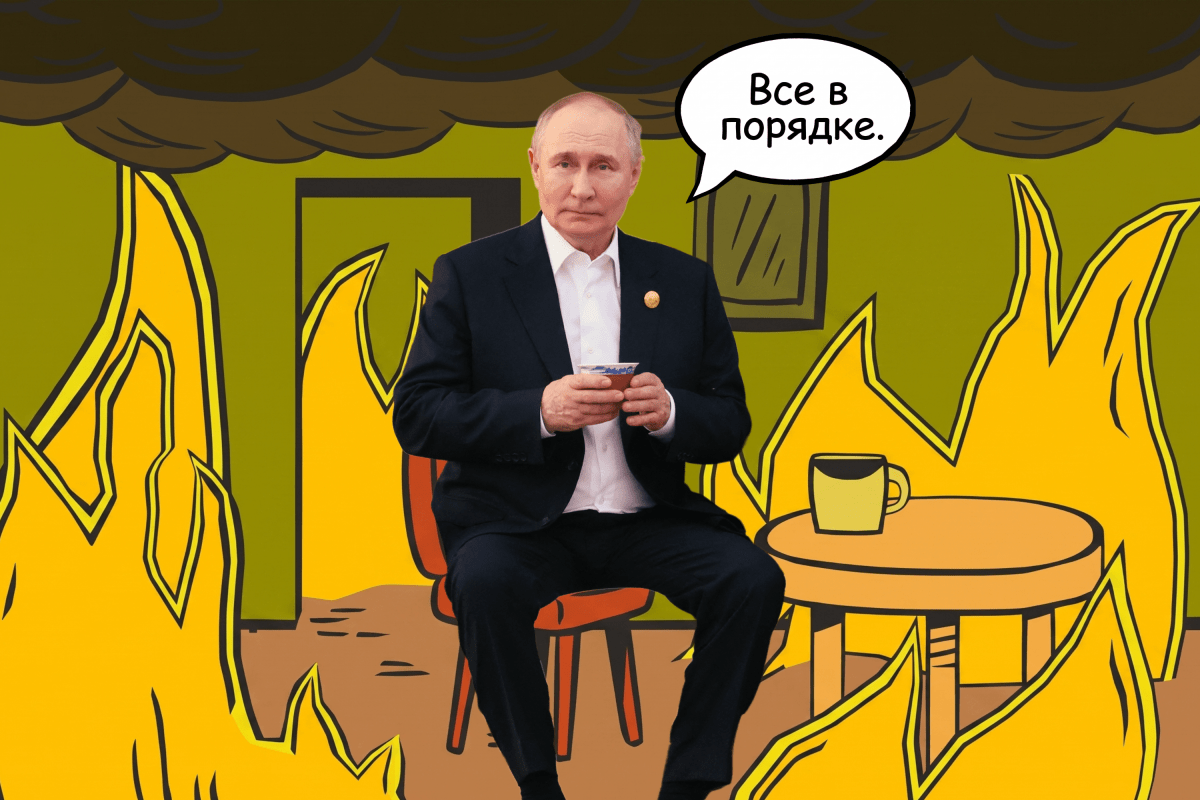
"I am almost certain we’ll come to a social crisis…under the current macroeconomic policy being pursued, the economy will stop, and society is unlikely to accept it."
These are the words of Andrei Klepach, the chief economist of Russia’s state development bank (VEB), at a Moscow meeting of top economists and scientists in May. There, he delivered a scathing report on the Kremlin’s monetary policy, predicted Moscow will be more dependent on Beijing than it ever was on Europe, and openly admitted Russia is losing the technological and economic battle to Ukraine.
And nothing happened. For three months, Klepach continued his work at VEB undisturbed—until Russian media got a hold of the contents of his report last week. By Sunday, he was gone.
A common Western assumption is that Vladimir Putin is shielded from bad news by subordinates too afraid to tell him what he doesn’t want to hear. But the Russian president was clearly aware of this dire prognosis, fielded by one of the nation’s leading economists, before the media cottoned on.
That Klepach was abruptly removed only after his findings went public means something different. Putin knows he’s running his country into the ground; with elections around the corner, he just needs to make sure the people don’t.
Andrei Klepach was hardly a fringe economist preaching Russia’s downfall. He was among Moscow’s most reputable experts, a man who’d served 10 years in Russia’s Ministry of Economic Development as a forecasting director and then deputy minister before joining VEB as chief economist in 2014.
During his glittering career, for which he was awarded the Order of Honor, he also held positions on the boards of Russia’s largest scientific and military-technical state companies, including Rosatom, the United Shipbuilding Corporation and the United Aircraft Corporation.
This made him uniquely qualified to deliver his assessment of Russia’s technological and economic future; and what an assessment it was. In his report entitled "The Russian Economy and Geopolitical Challenges," he delivered four bleak conclusions, the last of which will have set alarm bells ringing in the Kremlin.
First: Russia’s current economic model cannot sustain a long confrontation with the West.
Moscow, he argued, is trying to fight a costly war while simultaneously throttling the civilian economy with punishing interest rates and tighter budgets.
"Under the macroeconomic policy being pursued…we will not withstand the confrontation," he said. "The economy will stop, and society is unlikely to accept it."
VEB’s own forecast put Russian growth at just 0.3 percent in 2026—in line with Central Bank forecasts of between 0 percent and 1 percent growth—with investment falling 2.5 percent.
Second: Putin’s war is handing Beijing huge influence over Moscow.
Klepach openly wondered whether Russia could even remain a sovereign power, or become a country with a "non-sovereign economy, overwhelmingly dependent on China."
Its trade structure, he said, already showed an "extremely high degree of dependence" on Beijing; "in many respects higher" than Russia’s former reliance on the European Union.
"The only question is how far we will comply with various Chinese regulatory requirements and allow Chinese business to control different sectors of the Russian economy," he concluded.
Third: The war in Ukraine is killing Russia’s broader technological and economic progress—as much as the economist didn’t want to admit it.
"We are losing both the technological and the economic competition in the world," Klepach said, "not only to China and the United States, but in some respects even to Ukraine, however unpleasant that may be even for me personally."
His fourth and final key prognosis was the nail in the coffin.
Invoking perhaps the most ominous precedent available in Russian history, Klepach said a public fallout could happen as abruptly as it did in February 1917, when the 300-year Romanov dynasty collapsed amid the Russian Revolution.
"The economy will hold up, but a social crisis could emerge, and when no one particularly expects it. No one expected the February Revolution either," he noted, recalling that Lenin himself had written only months before the tsar fell that his generation might never live to see a revolution.
The VEB told Russian media in a brief statement that Klepach resigned his post at the weekend, but independent Russian publication The Bell cited two separate sources who confirmed the economist was fired by VEB’s CEO at the request of Russia’s Presidential Office.
This was hardly the first time Klepach’s forecasts spelled trouble, though. He had a long history of telling the Russian government what it didn’t want to hear; they kept him anyway, because they understood he was both a patriot and an excellent economist.
While working in the Ministry of Economic Development, he frequently clashed with the ministry’s chief and central bank deputy chairman Alexei Ulyukaev over monetary policy.
Klepach was appointed VEB chief economist in 2014, partly to get him away from Ulyukaev. The latter was banished to a strict penal colony in 2017 on corruption charges.
Had Klepach’s report remained private, he would’ve been left alone to carry out his valuable work. That bargain ended the moment his feelings were made public.
With parliamentary elections now barely a month away, Putin is desperate to insulate ordinary Russians from the mounting costs of war. There’s no doubt his United Russia party will win next month, but victory is not enough.
The Kremlin needs a fully choreographed display of national unity. That’s the foundation on which Putin’s legitimacy rests, and any threat to it must be erased.
Fuel shortages, higher prices, and exploding warehouses are costly for Putin, but they can all be explained away as evidence of Ukraine and its infernal Western backers’ futile attempts to destroy Russia.
Klepach’s report is a much greater threat. It tells the people that Russia’s future is one of economic hardship, subservience to China and indefinite decline. More importantly, it tells the people that the Kremlin understands this perfectly well, and doesn’t care.
Putin is willing to achieve his aims in Ukraine at any cost. He cannot afford for the Russian public to learn he’s willing to sacrifice all their futures.