
Remembering Alan Greenspan: the Fed Chair, Bookkeeper, and Bandleader
Follow this section to personalize your feed and get instant alerts.
Follow this tag to personalize your feed and get instant alerts.
Follow this author to personalize your feed and get instant alerts.
Bryant, the founder, chairman and CEO of Operation HOPE, is the author of Capitalism For All: Inclusive Economics and the Future-Proofing of America (Wiley).
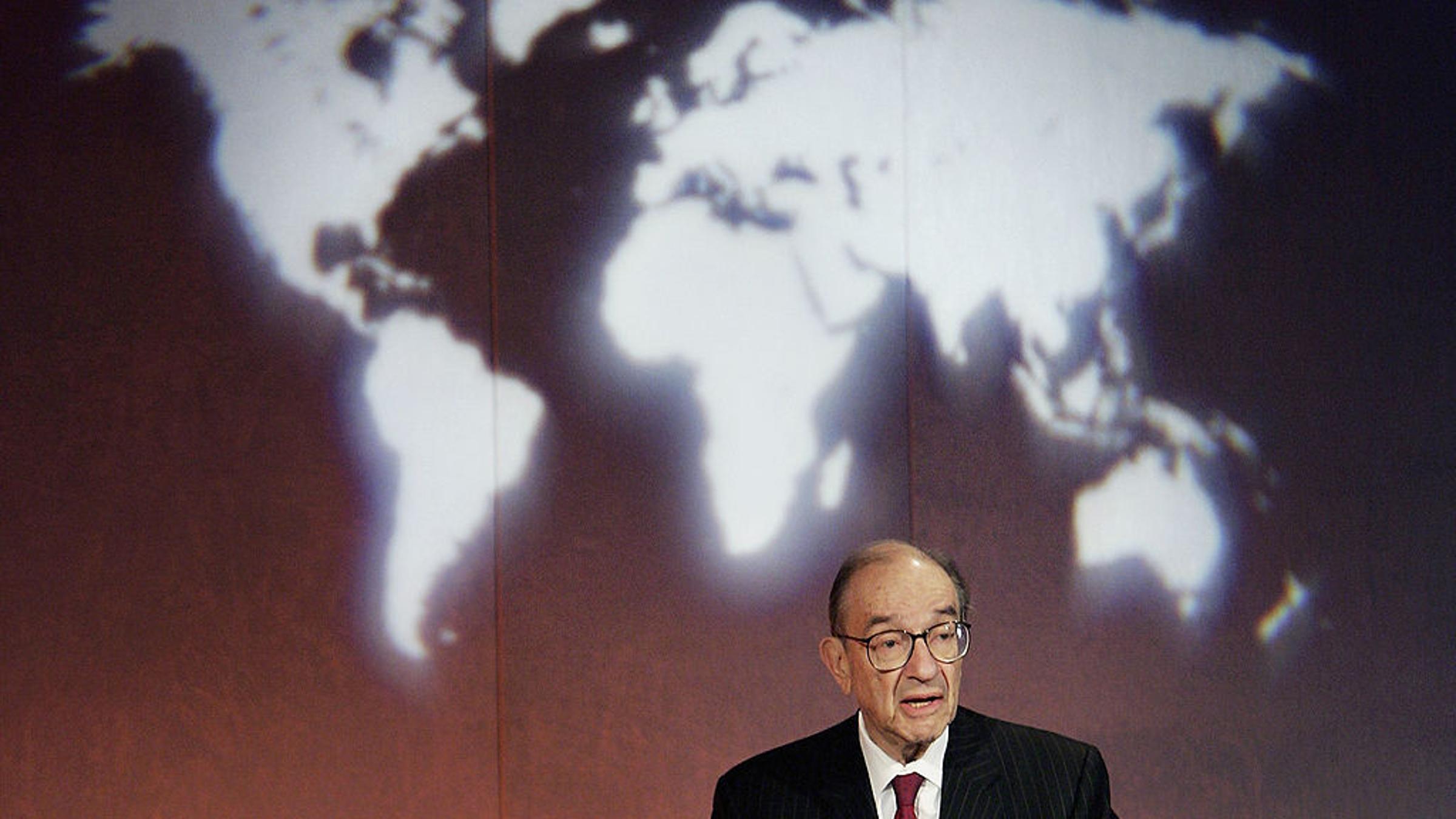
Alan Greenspan makes a keynote speech at the G7 as Chairman of the U.S. Fed in London on February 4, 2005.
Follow this author to personalize your feed and get instant alerts.
Bryant, the founder, chairman and CEO of Operation HOPE, is the author of Capitalism For All: Inclusive Economics and the Future-Proofing of America (Wiley).
Quincy Jones once told me something that I have never forgotten.
He said that when he was coming up as a young musician in New York, there was a kid in his circle who played clarinet and saxophone. A smart kid. A careful kid. A kid who could sit in any room and, within minutes, understand exactly how everything worked. He went to Juilliard. He played with the great Stan Getz—side by side, night after night, in the Henry Jerome Orchestra—and somewhere along the way, the other musicians figured something out about him that he was only beginning to figure out about himself.
He was the one you went to when the numbers didn't add up.
Between sets, while the rest of the band disappeared into the green room, this kid was doing the bookkeeping. Running the ledgers. Filing the tax returns for his bandmates. He understood money the way the others understood music—intuitively, structurally, as a system with its own logic and rhythm. And somewhere in those years of playing beside Stan Getz — one of the greatest jazz voices of the twentieth century — he made a discovery about himself that changed the course of American history.
That kid was Alan Greenspan. And today, he is gone. He was 100 years old.
Greenspan was a good musician. But his true gift was economics. So he put down the saxophone, picked up an economics textbook, and eventually became one of the world’s most powerful financial voices.
Jones, of course, went on to become one of the greatest music impresarios in history. Two young men from the same rooms, the same bandstands, the same late nights. One would go on to conduct the global economy. The other would go on to conduct the world's greatest musicians.
That was the lesson Quincy shared with me—not a story about failure, but a story about wisdom. About the courage to know your true gift. About the grace to follow it, even when the path isn't yet clear.
Now, the world is full of tributes to the maestro of monetary policy—the Oracle, the Fed Chairman who steered the American economy for nearly two decades under four presidents, the man whose briefcase and eyebrows moved bond markets. All of it is true. All of it is warranted.
But Greenspan’s life, and indeed his impact, was so much bigger than his resume. I learned this the first time I met him.
Alan Greenspan takes questions from children at the John Philip Sousa Middle School on June 5, 2003 in Washington, D.C. Mark Wilson—Getty Images
In 2003, Greenspan came to Washington to visit a school library in John Philip Sousa Middle School, a community that the American economy had largely bypassed, for an event about the importance of financial literacy. The plan, as the Fed's staff made clear to me beforehand, was precise. Formal. Controlled.
While I would typically greet people with warm hugs and chit-chat, the Chairman, I was informed, would deliver prepared remarks. There would be no improvisation. This is the Fed, they told me. This is the Fed Chairman.
To my surprise, he smiled. Not a polite smile. A real one. And in that moment, quietly, told him to put the prepared remarks down. “Speak from your heart,” I said. “These kids need to hear you, not your staff.”
He looked at me for a moment. And then he put the papers down.
What happened next is captured in these photographs, taken that morning and rarely seen since. The most powerful economic voice in America, the man who famously chose his words with surgical precision, who had elevated deliberate ambiguity to an art form, stood in front of a room full of children and spoke from his heart.
No script. No prepared text. No Fed-speak. Just a man, a room, and a conversation about money and possibility and the future.
That is your orchestra leader right there. Not the one who insists on the score as written. The one who reads the room, feels the shift in the air, and adjusts—in real time, on the spot—to what the music is actually asking for. Greenspan was a chairman who could come in with prepared remarks and still offer an unrepeatable performance.
Greenspan grasped, perhaps better than anyone, that the distance between the community economy and the global one is not fixed and that financial literacy—understanding how money works, how credit works, how wealth is built—is the civil rights issue of this generation.
In 2003, that idea was not yet mainstream. And then Alan Greenspan walked into that school library, put down his prepared remarks, and talked to children like they mattered. Because he believed they did.
When the most powerful economic voice in America shows up—not in a press release, not in a statement, but in person, in a school, speaking from his heart.
Throughout his life, Greenspan used his presence, his authority, his platform to bring other voices into tune. Telling the world that this music, too, deserved to be heard.
That is the version of Greenspan the world will miss most. The young musician who understood money better than he understood the saxophone. The bandmate who did your taxes between sets. The economist who became the Maestro—not of one instrument, not of one section, but of the largest, most complex economic orchestra in the history of the world. And the man who, 50 years after those late nights in New York, walked into a classroom, set aside his script, and told a new generation that they, too, had a part to play.
That the same qualities that make a great musician—discipline, listening, the willingness to find your true register and commit to it completely—are the same qualities that build lasting wealth. Greenspan understood that money, like music, is a language. And everyone deserves to be fluent.
Leaders like Alan Greenspan gave my work early credibility at a time when it needed it most. He didn't have to show up. He chose to. And in doing so, he did what the great ones always do—he pointed the way. Not with a policy, but with his presence. Not with a speech, but with his time. And on that particular morning, not with prepared remarks, but with something rarer: his authentic self.
That was Alan Greenspan at his best. Reading the music. Adjusting to it. Conducting something that no one had written down in advance.
His wife, Andrea Mitchell, said that he had "irrational exuberance" for baseball, jazz, and the people he loved. That made me smile. Of course he did. The jazz never really left him. It just found a different instrument.
Alan Greenspan lived one hundred years. He shaped an era. He made mistakes and said so. He moved markets and he moved a roomful of kids in a school library. He was equally serious about both. That is the man I knew. That is the man I will remember.
TIME Ideas hosts the world's leading voices, providing commentary on events in news, society, and culture. We welcome outside contributions. Opinions expressed do not necessarily reflect the views of TIME editors.