
Republicans on defense in state Donald Trump dominated three times
President Donald Trump carried Alaska by double digits in 2016, 2020 and 2024. Republicans have held both of the state's Senate seats and the governor's office for most of the past two decades.
That history is now colliding with a Senate race Republicans are struggling to put away, a 17-candidate governor's field splintering their own base, and a president whose standing in the state has slipped enough that strategists on both sides are recalculating their odds.
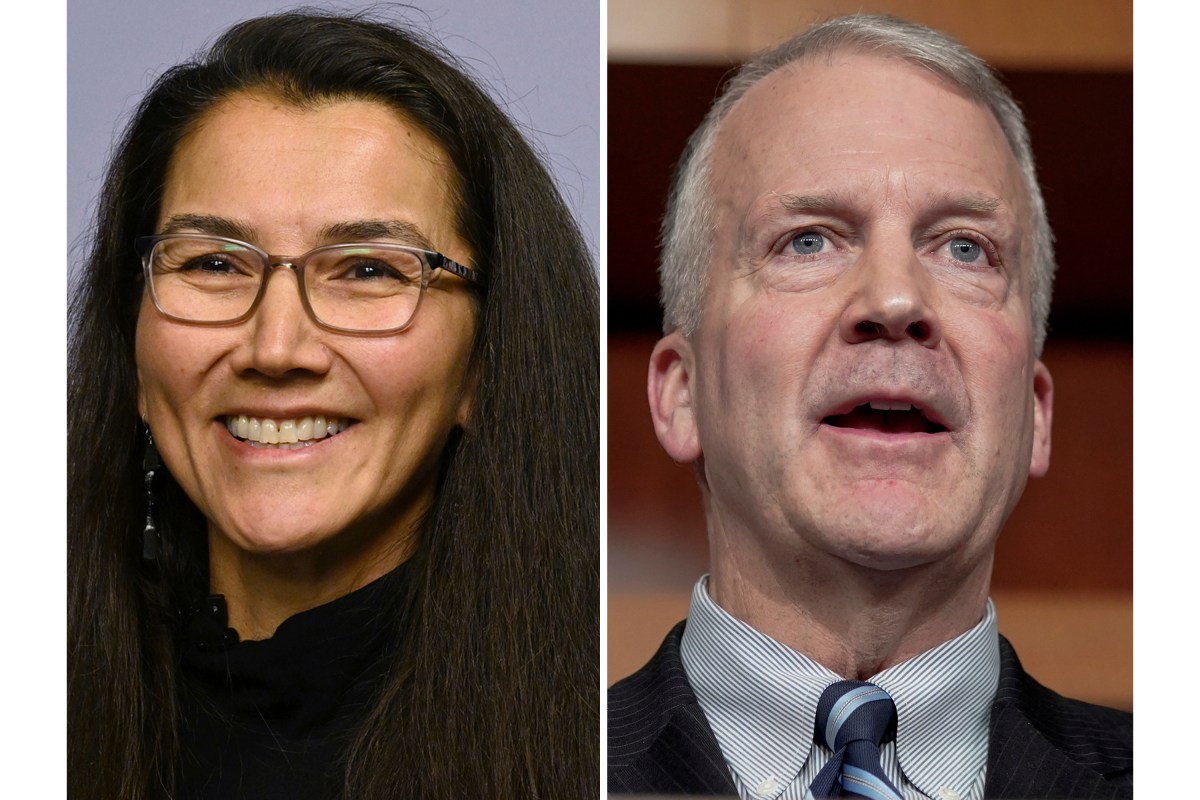
Alaska Senator Dan Sullivan, a Republican first elected in 2014, is fighting to hold his seat against Democrat Mary Peltola, the former U.S. representative trying to become the state's first Democratic senator since Mark Begich lost to Sullivan in the 2014 midterms.
Peltola is also the only Democrat to win statewide in Alaska since Begich's 2008 Senate victory, a fact both campaigns are using to make opposite arguments. Her campaign says Peltola has already proved she can win statewide, while Sullivan's argues her victory was an exception the state is unlikely to repeat.
Down the ballot, a wide-open governor's race and mounting frustration over federal spending cuts have widened the opening even further.
Brandon Boylan, a political science professor at the University of Alaska Fairbanks, called the Sullivan-Peltola race genuinely competitive, with Peltola holding a real chance of winning it outright.
"Party affiliation isn't everything" in Alaska, Boylan told Newsweek. The state consistently backs Republicans for president, he said, but has elected Democrats and independents to other offices before, pointing to Begich's single Senate term and to independent Governor Bill Walker, who served from 2014 to 2018.
Alaska Survey Research has tracked the Senate race monthly since January, and Peltola has led in every wave, typically by 2 to 7 points. Her most recent edge, in a poll of 1,371 likely voters conducted August 2-5, was 51 percent to 49 percent. Only one survey has shown Sullivan ahead: a New York Times/Siena University poll conducted June 15-29, which had him up 47 percent to 45 percent. Boylan noted that Peltola's lead has narrowed over the past several months, even as she's stayed in front.
Prediction markets show a similar picture. Polymarket recently gave Peltola a 52 percent chance of winning the seat outright. Kalshi's contracts, updated August 13, put her at 55 percent, compared with 47 percent for Sullivan.
Republicans, however, are still investing heavily in the race. The Senate Leadership Fund, a Republican-aligned super PAC, announced last week that it would spend another $2 million in Alaska, bringing its total investment against Peltola to $17 million.
Peltola's campaign, however, pointed to signs of momentum.
"Alaskans know that Mary will stand up to anyone to fix the rigged system in Washington, lower costs and put Alaska first," a spokesperson for her campaign told Newsweek. "With more than 10,000 Alaskans signed up to help Mary's campaign from every corner of the state, and Dan Sullivan's approval rating plummeting after he helped drive up the cost of gas, groceries and health care, Mary is in a strong position to retire self-serving Dan Sullivan this November."
The Democratic hopeful is also not a newcomer to statewide races. She won a special election in August 2022 to complete the late Representative Don Young's term, then won the seat outright that November before losing it to Nick Begich in 2024. Some Alaskans are frustrated with Trump over rising living costs tied in part to the war with Iran, Boylan said, while Sullivan has stood shoulder to shoulder with the president on nearly every issue.
Newsweek reached out to Sullivan's campaign for comment.
Part of what's scrambling the race is Trump himself. A new Ipsos poll sponsored by Reuters released August 17 put his national approval at 33 percent against 64 percent disapproval, a record for either of his terms.
Alaska's numbers are less severe but still soft for a state he carried by 13 points less than two years ago. A Morning Consult tracking poll put his net approval in the state at minus 5, worse than deep-red Wyoming but nowhere close to the minus-41 Morning Consult recorded in Vermont. Civiqs data through early June put his approval in Alaska at 43 percent, disapproval at 51 percent.
CNN's polling analysis found something odd sitting underneath those numbers. Alaska voters split almost evenly on Trump's job performance, yet Sullivan still held a narrow lead over Peltola in the same surveys. Republican candidates nationally were winning roughly 85 percent of Trump approvers in Alaska, nearly as high a share as in states where Trump remains broadly popular. Democrats haven't yet consolidated Trump disapprovers to the same degree.
Boylan, of the University of Alaska Fairbanks, said Trump's declining approval is not necessarily hurting candidates like Sullivan. But Republicans cannot rely only on their party or their ties to Trump, he said. They also need to focus on issues Alaskans care about, including rising living costs, federal jobs and funding, resource development and rural health care.
"While President Trump remains popular and Alaska will most likely support the Republican candidate in the 2028 presidential election, Alaskans are willing to overlook party affiliation for candidates who promise to protect federal jobs and funding. Ranked-choice voting also means candidates must build a broad cross-party coalition," Boylan said.
Those concerns are not abstract. Alaska's federal workforce took one of the biggest hits in the country in 2025, ranking third nationally in federal job losses. It shed 4.5 percent of its federal civilian workforce, or roughly 700 jobs, according to the Alaska Department of Labor and Workforce Development. Fourth-quarter losses alone topped 1,600, which state economist Karinne Wiebold said better reflects the pace of the cuts than the annual average.
"Previous administrations have cut federal employment, but what made last year’s sweeping job cuts unusual was how, and how fast, they were implemented," she wrote in a report commissioned by Alaska's Department of Labor, released August 2026.
She described the Department of Government Efficiency's approach as having a "chainsaw effect" as it moved quickly to find cuts, hitting the Department of Defense, Alaska's largest federal civilian employer, along with the Bureau of Land Management, the Forest Service and NOAA.
The cuts have already affected how voters view Republican leaders. Alaska Survey Research's quarterly tracking poll, conducted last summer as layoffs mounted and Congress passed Trump's tax and spending package, found Sullivan's approval rating fell from a net positive 8 points in January to a net negative 8 in late July, a 16-point drop in six months. Murkowski, who voted for the bill, saw an even steeper decline, from net positive 3 to net negative 47.
The drop was driven largely by moderate and progressive voters. Ivan Moore, who conducted the poll, said Alaska's shift mirrored Trump's falling numbers nationally and was hurting Republicans.
The stakes are particularly high in Alaska, where federal spending per capita is the highest in the country, Boylan said. The state's infrastructure needs, federal land management, development projects and heavy military presence all contribute to that dependence.
"Federal job and funding cuts could reduce Trump's margins for the Sullivan-Peltola [race] even if Trump remains popular on the whole," Boylan said.
Medicaid cuts have also compounded the frustration. The program covers close to 250,000 Alaskans and most of the state's children. Advocates warn the cuts would leave families without care and worsen already high rates of untreated mental health and substance abuse issues in a state that already has some of the nation's highest rates of child abuse, sexual assault, domestic violence and suicide.
None of this guarantees a Democratic win. Alaska has bucked Trump-aligned challengers before without flipping a seat.
Senator Lisa Murkowski beat back Trump-backed Kelly Tshibaka in 2022, winning reelection under the state's ranked-choice system after Trump endorsed her opponent. It was her second brush with a hard-right primary revolt. She won as a write-in candidate in 2010 after losing the Republican primary outright.
The governor's race carries its own version of the same instability, minus an incumbent to defend. Governor Mike Dunleavy is term-limited, and seventeen candidates registered for the August 18 primary, including 11 Republicans, three Democrats and three independents.
On the Republican side, several polls have shown former Anchorage Mayor Dave Bronson and Anchorage businesswoman Bernadette Wilson leading a field that also includes former Attorney General Treg Taylor, former state Senator Click Bishop and independent former Governor Bill Walker. No candidate was polling above 22 percent as of the week before the primary.
Democratic support has consolidated around two candidates, former state Senator Tom Begich and former state Representative Jonathan Kreiss-Tomkins, after state Senator Matt Claman exited the race just before the June withdrawal deadline.
With Republican votes spread thin across a crowded field, it isn't out of the question that both Begich and Kreiss-Tomkins finish in the top four, giving Alaskans two Democratic options in November. Neither has publicly committed to dropping out if both make the cut.
Alaska last elected a Democratic governor, Tony Knowles, in 1998. He left office in 2002. The state hasn't sent a Democrat to the Senate since Begich lost his seat to Sullivan in 2014. Whether either drought ends this November may come down to turnout among voters angry about federal cuts, and whether that anger translates into ranked-choice ballots the way both campaigns are betting it will.
Contact Newsweek editors on this story: Jason Lemon and Sam Wilson.