
Satellites reveal Earth has a surprising symmetry in the way it reflects light — and it might be tied to the El Niño cycle
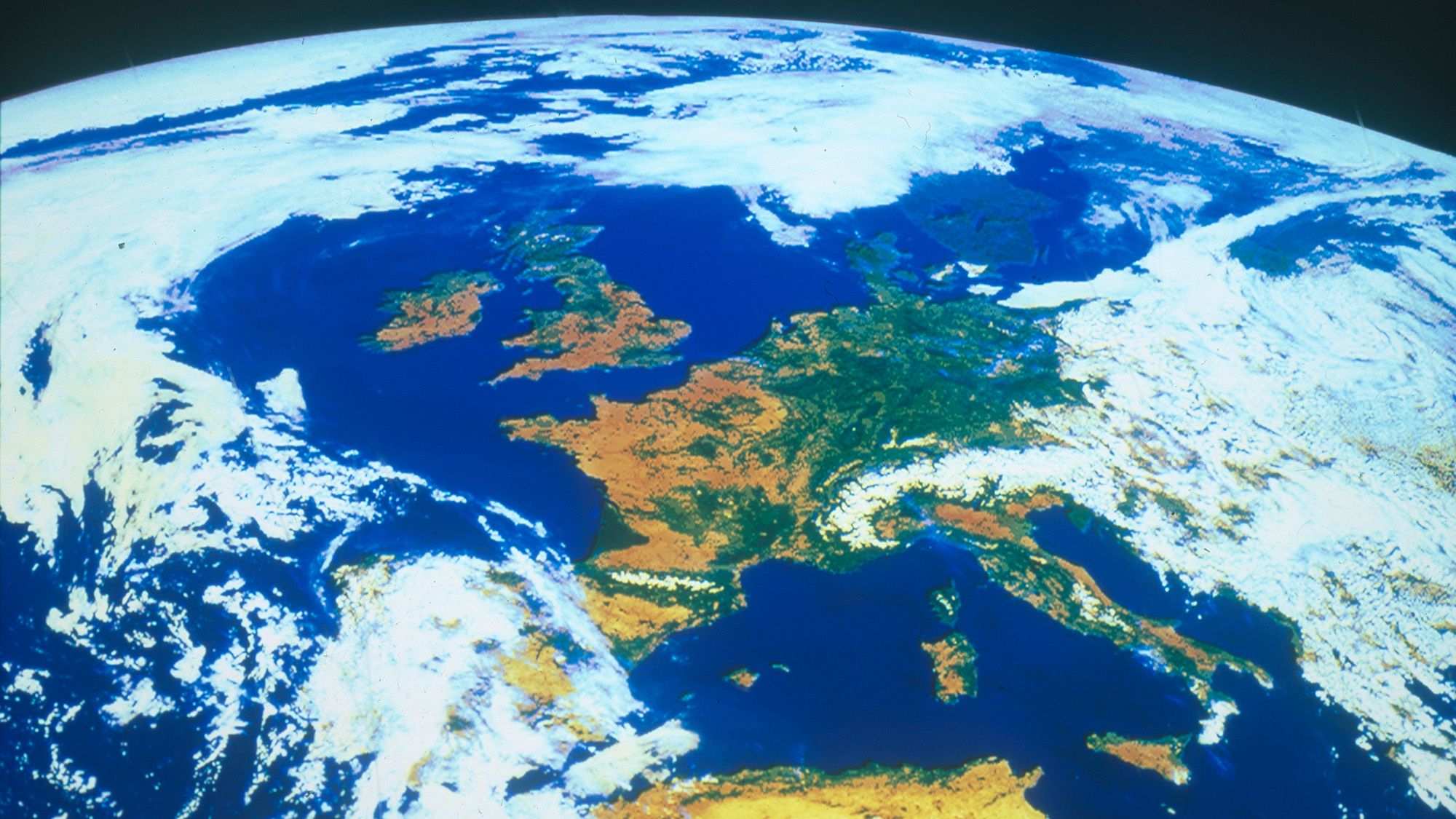
For half a century, scientists have known that Earth's Northern and Southern hemispheres have almost the exact same albedo — the amount of sunlight they reflect back to space. This is true even though the two hemispheres look very different, with the Northern Hemisphere having more land and the Southern Hemisphere having more ocean.
Now, researchers have uncovered another surprising symmetry hiding in the data: Earth's Eastern and Western halves appear to reflect the same amount of sunlight as well, they reported in a study published June 3 in the journal Nature. They found that the dividing line lies along a great circle that wraps around the whole planet. It's made up of two longitude lines: the 27 degrees east and 153 degrees west meridians, which stretch from the North to South Pole through Eastern Europe, Turkey, Central Africa, Norway and Alaska.
"Given that the Earth is approximately spherical, it is unsurprising that one can divide it into two non-overlapping hemispheres that reflect equal amounts of sunlight," the authors write in the paper. But what is surprising, they write, is how closely matched they are. The probability of the hemispheres naturally reflecting sunlight within 0.01 watts per square meter of each other is less than 3%.
If the symmetry is a fundamental part of Earth’s climate, this finding could help scientists test and possibly improve global climate models to predict future warming.
While the exact mechanism for the northern and southern symmetry has evaded scientists for decades, the study authors said they may have identified a reason behind their discovery.
Since the dawn of the space race in the late 1950s, scientists have wanted to figure out Earth's albedo. "That was a really burning question back then," Norman Loeb, an atmospheric scientist who leads NASA's Clouds and the Earth's Radiant Energy System (CERES) project who wasn't involved in the new study, told Live Science. And around a half century ago, they figured it out with satellite imagery.
Earth's planetary albedo is about 29%, according to the study. This means that about 0.29 of the solar radiation that hits Earth is reflected back into space. In contrast, a perfect mirror would have an albedo of 1, as it would reflect back 100% of the light that hit it.
Get the world’s most fascinating discoveries delivered straight to your inbox.
Other analyses showed that the Northern Hemisphere's albedo was the same as the Southern Hemisphere's, although recent research co-authored by Loeb suggests that the Northern Hemisphere is now absorbing more light than the Southern, likely because of melting snow and ice, declining air pollution, and rising water vapor.
This newfound imbalance aside, Zhang, a researcher at the Cooperative Institute for Research in Environmental Sciences at the University of Colorado Boulder, and colleagues wondered if other symmetry pairs had been overlooked or if they were considered too trivial to investigate, Zhang wrote in a blog.
To identify the symmetry, Zhang and his colleagues analyzed 25 years of satellite observations from 2001 to 2025 collected by the CERES program, which uses satellites to measure Earth’s energy budget. Instruments on these satellites measure how much reflected sunlight bounces back into space, as well as how much heat is emitted from Earth
Earth's albedo is shaped by many factors; clouds, oceans, snow, ice and land each reflect a different amount of sunlight. This reflection influences Earth's climate, so understanding it is key to an accurate understanding of climate in the future.
After running the first analysis, Zhang wrote he was both "absolutely amazed" and skeptical at what he saw, but three features stood out.
First the symmetry is unique to the meridian at 27 east longitude. If you shift the line to any other longitude, the symmetry disappears. Second, it's consistent across a 25-year dataset. Lastly, there is "triple symmetry": The two hemispheres contain similar proportions of ice-free ocean, experience similar cloud effects, and reflect similar amounts of sunlight under clear skies.
Zhang and his authors hypothesize the East-West symmetry is tied to the El Niño-Southern Oscillation (ENSO), a recurring climate pattern that shifts ocean temperatures and weather around the globe. When they examined the slight changes in the exact longitude of this symmetry, they found correlation with the ENSO record.
In the tropics, a giant loop of air called the Walker circulation acts like a big conveyor belt. Warm, moist air rises in the West, travels eastward high in the atmosphere, and then cools and sinks, before blowing back westward at the surface. This circulation acts as the albedo adjustment mechanism, according to the study.
The Walker circulation helps drive the difference between El Niño and La Niña, recurring climate patterns, based on weaker or stronger Pacific trade winds, respectively.
During La Niña years, the circulation is stronger, causing warmer water and so the Eastern Hemisphere has more clouds, and thus reflects slightly more sunlight. During El Niño, the circulation weakens, warm water spreads across the Pacific and so the Western Hemisphere reflects more. Over many years, the swings average out, helping to keep the long-term east-west symmetry centered near 27 degrees east.
The imaginary line runs along the 27 degrees east and 153 degrees west meridians.
"Nature throws surprises at us, so this is a curious surprise that this one longitude seems to divide the globe up very symmetrically," Loeb said. "It's really interesting that there's this single point longitude at 27 degrees."
Since the models are designed to simulate Earth's interactions among the atmosphere, oceans, lands, crust and other parts, the new symmetry offers another way to test if current climate models are accurate. "I think the short-term benefit of this type of discovery is that it's a further test of climate models," Loeb noted.
But when the scientists tested how the current models predicted new symmetry, "the models didn't do very well," Loeb said. "They didn't produce this East-West symmetry." This problem may be "contributing to the persistent uncertainty in climate projections," according to the study.
Zhang, J., Gristey, J. J., & Feingold, G. (2026). Earth’s east–west albedo symmetry. Nature. https://doi.org/10.1038/s41586-026-10624-2
How much do you know about our blue planet? Test your terran knowledge with our Earth quiz!
Bethany Augliere is a former marine biologist turned science communicator, with graduate degrees from University of California, Santa Cruz and Florida Atlantic University. Her writing and photography have appeared in National Geographic, National Geographic Kids, Oceanographic Magazine, Scuba Diving Magazine, among others, and she has co-produced award-winning children’s nature documentaries with Schoolyard Films.
Please logout and then login again, you will then be prompted to enter your display name.