
SpaceX Finally Recovers Starship After 24 Days of Tugging It Through Rough Waters
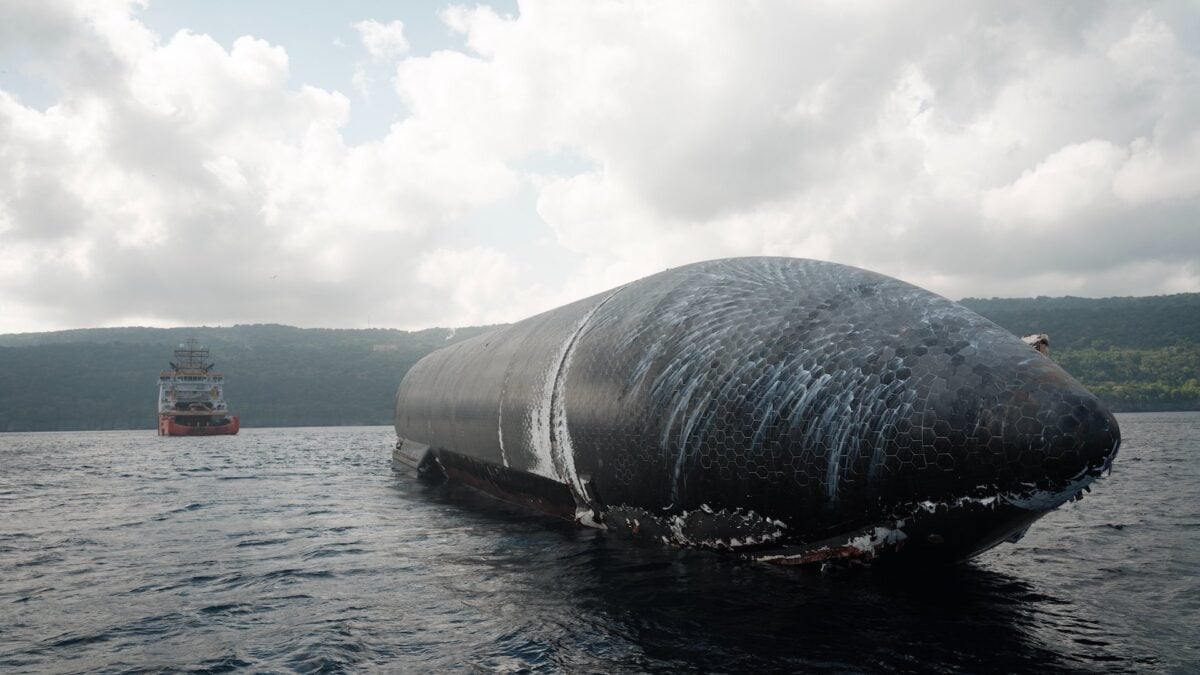
Nearly a month ago, SpaceX’s Starship splashed down in the Indian Ocean following its most recent test flight, but that wasn’t the end of the rocket’s journey. Instead, SpaceX launched a grueling mission to retrieve it, hauling it through rough waters for a closer look at the massive vehicle.
After 24 days at sea, the 171-foot-tall (52 meters) spacecraft is finally in calm waters just offshore of Christmas Island in Australia and is awaiting inspection. “A team of SpaceX engineers is on their way to conduct additional analysis on the vehicle in calmer waters before attempting to return it to Starbase,” the company announced on X.
Starship launched on July 24 from Starbase, Texas, for its 13th test flight. The Super Heavy V3 booster performed relatively well during liftoff, ascent, and stage separation before making a hard splashdown in the Gulf of Mexico due to a partial engine ignition failure.
Ship 40, the rocket’s upper stage, continued on its planned trajectory before pulling off a controlled splashdown in the Indian Ocean and remaining surprisingly intact. With Ship 40 floating in the Indian Ocean in one piece, SpaceX set out to take advantage of this golden opportunity and recover its precious hardware. Something the company wasn’t planning on doing.
“We’re sending a ship out to recover Starship,” SpaceX founder and CEO Elon Musk announced on X on July 28. Thus began the treacherous adventure to retrieve the rocket’s upper stage, and things were not looking good at first.
In a recent update on X, SpaceX wrote that its recovery team has been “overcoming challenging conditions and increasingly rough seas as they attempt to guide the 52m long spacecraft to port.”
Despite the odds, SpaceX finally succeeded in tugging Ship 40 across several hundred miles in the Indian Ocean. The spacecraft is currently at a port in Australian territory, but it’s not clear when, or how, it will make its way back to Starbase in South Texas.
Once it does, SpaceX engineers will have an opportunity to inspect the hardware to measure how it performed during its latest test flight. SpaceX uses onboard sensors and cameras to gather data about each flight, but a closer look at the rocket itself is a much better way to inform modifications for the next test.
SpaceX is targeting a late August to early September launch date for Starship Flight 14, where it will attempt the first full orbital test for Starship.
Whether your budget is $10 or $1,300, we've got tech and gear recommendations that will make the new semester more productive and entertaining.
The fresh impact crater measures at 60 feet wide and 10 feet deep.
The outlandish pay package meant to drive peak performance from Tesla's CEO may be easily within reach.
SpaceX is trying to bring a Starship upper stage back to shore for post-flight inspection, but it's not going so well.
A stray Falcon 9 rocket crashed into the Moon on Wednesday. This Korean spacecraft may have spotted the aftermath.
Tesla's controversial vehicle is replacing a tactical military transport designed to deflect landmine blasts.