
Supreme Court hands GOP major election defeat over mail-in ballots
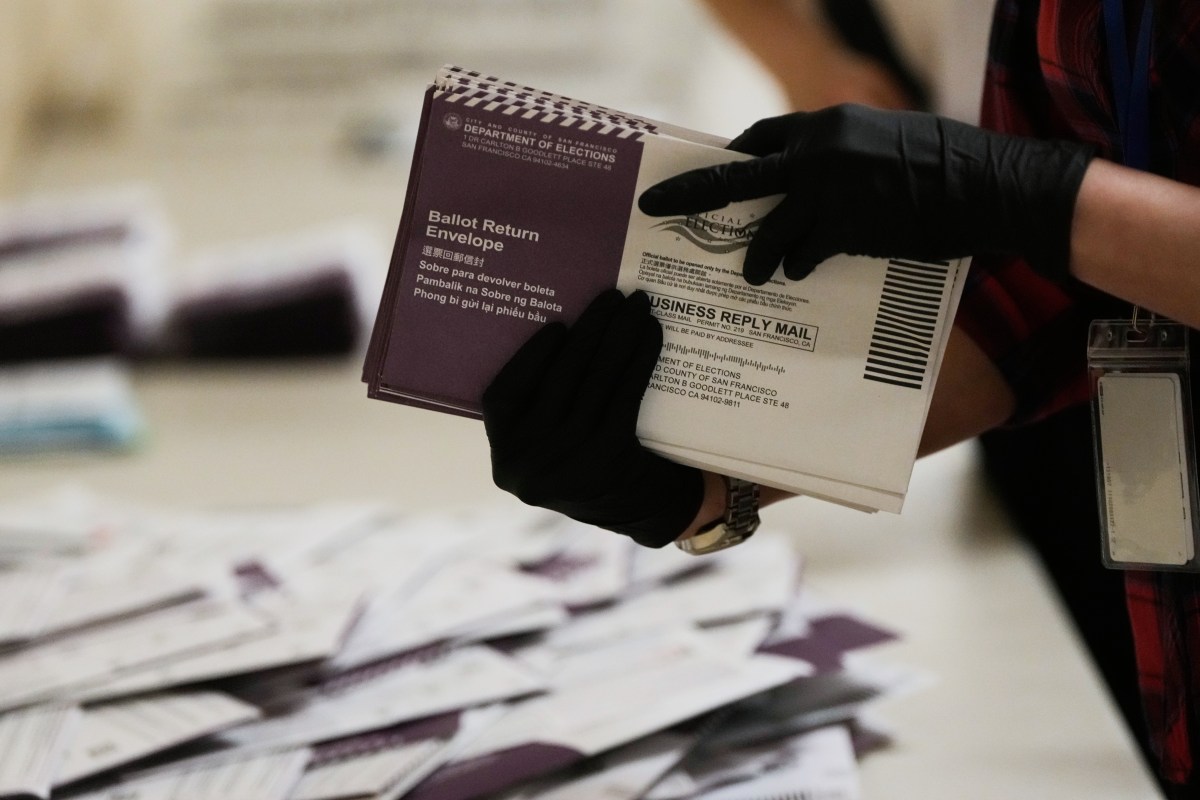
Two conservative Supreme Court justices joined their liberal colleagues Monday in a decision allowing states to carry on counting mail-in ballots after Election Day, in a blow to the Republican Party and President Donald Trump.
In a 5-4 ruling favoring the state of Mississippi, the Supreme Court upheld laws allowing late-arriving mail-in ballots to be counted up to five days after Election Day, reversing a Fifth Circuit decision which said federal law barred that practice.
Reacting to the ruling on Truth Social, Trump said it was "more important than ever" to pass his voting reform bill in Congress, known as the Save America Act.
Amy Coney Barrett, writing for the majority which included Chief Justice John Roberts, said, "nothing in the federal election-day statutes requires ballots to be received by election day."
Justices Samuel Alito, Clarence Thomas, and Neil Gorsuch dissented, with Kavanaugh joining in part.
The ruling preserves voting systems used in roughly 30 states that accept some mail ballots after Election Day, ensuring those laws remain in place heading into future elections.
Newsweek reached out to the Mississippi Secretary of State for comment Monday morning.
Barrett said the law governs when voters must cast ballots, not when election officials receive them, and emphasized that the statutes "say nothing about ballot receipt." The majority framed its decision as a narrow interpretation of federal statutes, stressing that Congress, not the courts, must decide whether to impose stricter national rules.
"The question today is not whether [an election-day receipt deadline] is a good or bad idea," Barrett wrote, but whether "the idea has made its way into the United States Code."
She added that concerns about election integrity and voter confidence "are properly directed to legislatures, not courts," signaling that any nationwide deadline for receiving ballots would need to come from Congress.
"This is a sober response from the Court. It upholds 250 years of American tradition about state versus federal power in elections and makes sense," Mitchell Brown, a professor and director at the Institute for Election Administration Research and Practice at Auburn University, told Newsweek.
"Regardless of how people feel about access and integrity, there is nothing to suggest that the safeguards in place for protecting election integrity in mail ballot states somehow threaten American democracy. Mail in states have different procedures that express the will and needs of their residents; that doesn’t make them corrupt or invalid. And ultimately, according to our constitution, states get to decide."
But in a sharply worded dissent, Alito argued that the majority’s interpretation rewrites federal law. He said an election is only complete when all ballots are collected, meaning late-arriving votes push the election beyond the legally required day.
"If ballots received after election day are added…the electorate’s choice does not occur on election day," Alito wrote.
The dissent warned that the ruling could create confusion for states and undermine trust in election results, saying it "threatens to produce lamentable consequences."
Those remarks echo sentiments put forward in recent years by Trump and others within the GOP about mail-in ballots.
Reacting to the decision, the RNC's Chairman Joe Gruters told Newsweek, "If we want fair and secure elections, Election Day should mean exactly what it says, which is why this decision makes it even more imperative that Congress pass the SAVE America Act."
Gruters said that Democrats were "inviting chaos at the ballot box" in allowing the buffer period for mail-in ballots.
"Republicans are not going to be deterred by this decision, and the RNC will keep fighting to have elections end on Election Day as Americans want," he said.
The decision directly affects states that accept mail ballots after Election Day, as long as they are postmarked on time.
A total of 14 states, as well as Washington, D.C., allow this, while the other 36 have rules requiring ballots be received by Election Day. In some other states, extra time is allowed only for military and overseas ballots, which are governed by separate federal rules.
The battleground over the future of mail-in voting centered on Watson v. Republican National Committee, a critical case argued before the Supreme Court on March 23, 2026. The legal dispute began in 2024 when the Republican National Committee (RNC), alongside state party officials, filed a federal lawsuit challenging a state rule that allowed mail-in ballots to be counted after Election Day.
The RNC argued that an 1845 federal statute establishing a uniform national Election Day—specifically the first Tuesday after the first Monday in November—means that an election is legally completed only when all votes are received. Under their interpretation, federal law preempts any state-level grace periods, meaning ballots must be both cast and received by the close of polls on Election Day.
Though a federal-district court initially dismissed the RNC's challenge, the U.S. Court of Appeals for the Fifth Circuit reversed that decision, agreeing that federal law mandates an Election Day receipt deadline. During oral arguments in March, the Supreme Court's conservative majority had appeared ready to affirm the Fifth Circuit's ruling.
Joshua Douglas, associate dean for research at the University of Kentucky Rosenberg College of Law, told Newsweek that the ruling had avoided a decision which would have upended election administration in 30 states soon before the midterms.
The RNC hoped this litigation would end in a bang, but it goes out with a whimper—as it exactly it should have," Douglas said. "The idea that states have been misinterpreting federal law and the meaning of "election" for over 150 years was absurd."
At the center of the case is a 2020 Mississippi statute designed to accommodate the logistical hurdles of the post-pandemic era. The Mississippi law states that mail-in absentee ballots are valid and must be counted so long as they are postmarked on or before Election Day and received by local election registrars within five business days after the election.
Mississippi Secretary of State Michael Watson has vigorously defended the statute, pointing out that the original 19th-century definition of an "election" refers exclusively to the voter’s act of choosing a candidate, not the administrative time frame required for mail delivery or ballot counting.
“While I oppose the practice of counting ballots received after Election Day, the principle of federalism is a core tenet of my conservatism. I deeply value the rights of states to govern themselves, including the administration of elections, so long as they do not conflict with federal law," Watson said in a statement to Newsweek Monday afternoon.
He went on to say that while policies in states like California "often undermine confidence in election integrity," the court's ruling confirmed that the decision was up to Congress or state legislatures.
Also reacting to the ruling Monday, Mississippi Attorney General Lynn Fitch told Newsweek in a statement that this was the case.
"With the bedrock constitutional principle of federalism now affirmed, I am hopeful that the Mississippi Legislature will take this opportunity to amend the law and require absentee ballots be received on the same day ballots are cast at the polling place," Fitch said. "President Trump is right to prioritize improving public trust in our elections."
In a post on Truth Social in the hours after the ruling, the president said lawmakers needed to pass the SAVE America Act in order to firm up election security, including requiring proof of citizenship to register to vote, and a widespread ban on mail-in ballots.
"There is no excuse for a politician, or otherwise, to be against the above three requirements. There is only one reason to oppose — CHEATING!" Trump posted.
The president went on to criticize Democrats and five GOP holdouts on the bill: Senators Susan Collins of Maine, Lisa Murkowski of Alaska, Thom Tillis of North Carolina, Bill Cassidy of Louisiana, and Mitch McConnell of Kentucky.
Speaking later in the Oval Office, Trump called the ruling "a little bit surprising" and said the decision gave more opportunity for people to "vote illegally."
Trump has repeatedly criticized mail-in voting over several years, often claiming, without evidence, that it leads to widespread fraud in U.S. elections.
He has frequently used blunt language to describe the practice. In recent remarks, Trump said mail-in voting is "corrupt as hell" and "rigged," while also claiming the United States is "the only country in the world" that uses it—a statement that is not accurate.
At a March 2026 event, he went further, saying: "Mail‑in voting means mail‑in cheating," as part of his argument that the system is vulnerable to abuse.
Trump has also called for major restrictions, or even an end, to the practice. In 2025, he said he would "lead a movement to get rid of MAIL‑IN BALLOTS," describing them as "Highly ‘Inaccurate,’ Very Expensive, and Seriously Controversial," in posts on Truth Social.
These comments built on his long-running claims that mail voting contributed to fraud in the 2020 election, which he has repeatedly described as "rigged," despite courts and election officials finding no evidence of widespread fraud.
At times, however, Trump’s messaging has been mixed. During the 2024 campaign, he encouraged supporters to take advantage of absentee and early voting, saying they are "all good options."
Overall, Trump’s stance has combined strong opposition to expanded mail voting with occasional tactical support for its use, particularly when encouraging voter turnout among his supporters.
Update 6/29/26, 3:14 p.m. ET: This article was updated with comment from Mississippi Secretary of State Michael Watson.