
The Biggest Known Galaxy Is 1.7 Million Light-Years, And We Can't Comprehend The Scale
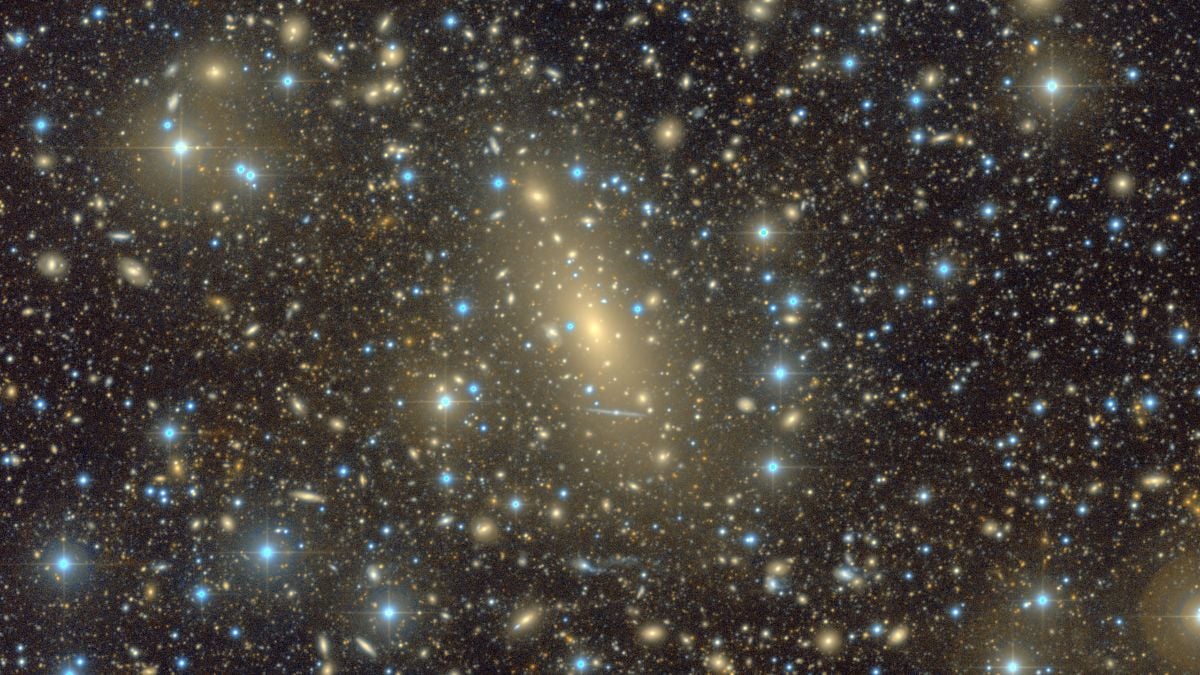
The Universe can pull some wild monkeyshines, especially when it comes to scale.
From giant black holes to massive sheet-like walls of galaxies, our reality is full of mind-boggling chonkers.
But a galaxy named IC 1101 is bonkers in a way that dramatically exceeds the upper end of normal.
Using the deepest observations yet of IC 1101, astronomers have made the strongest measurement to date of its physical extent, identifying the boundary of its main stellar body some 260 kiloparsecs from its center.
That makes it around 1.7 million light-years across – which makes it, according to a team led by astrophysicist Carlos Marrero de la Rosa of Spain's Instituto de Astrofísica de Canarias, the largest galaxy known to date.
"For comparison, the stellar disk of the Milky Way is roughly twenty times smaller in diameter," Marrero de la Rosa told ScienceAlert.
"Another way to picture its size is that, if IC 1101 were placed between the Milky Way and Andromeda, its main stellar body would almost bridge the space between the two galaxies."
IC 1101 has long been recognized as a large galaxy. It sits within a cluster of galaxies named Abell 2029 like a well-fed spider sitting in a web, glowing with the contentment that can only be expressed with trillions upon trillions of stars.
But pinning down its diameter has been something of a challenge, because the stars at the outer limits of its main body blend in with the diffuse starlight permeating the cluster around it – like the spider's legs blending in with the strands of its web, if you will.
"A galaxy does not usually have a sharp edge like a solid object. Its stars become progressively more diffuse with distance from the center," Marrero de la Rosa said.
"So the 'edge' is not the place where stars suddenly disappear, but the radius where the main body of the galaxy stops behaving as a coherent structure."
Previous observations had shown that IC 1101 was very extended, but were not able to clearly establish that edge. Because Marrero de la Rosa's PhD thesis work partly focused on the technical challenges of finding galaxy edges, the galaxy represented the perfect laboratory for testing techniques to do so.
For the new study, he and his colleagues used the 2.5-meter Isaac Newton Telescope at Spain's Roque de los Muchachos Observatory to obtain the deepest images ever taken of IC 1101.
But the hardest part came next: painstakingly removing scattered light from foreground stars and the bright concentrated light from the center of IC 1101 itself.
That part is crucial because light from bright objects can get smeared around by the telescope and atmosphere and masquerade as genuine faint material in a galaxy's outskirts.
Once they removed those effects, the team looked for changes in several properties of IC 1101 as they moved outward from its center.
At about 260 kiloparsecs, several things changed together: the distribution of light, the color of the stars, the amount of stellar mass, and even the shape and orientation of the galaxy.
Because all these independent measurements changed at roughly the same distance from the galactic center in multiple directions, the researchers interpreted this as the edge of IC 1101's main stellar body – a structure 520 kiloparsecs, or 1.7 million light-years, across.
"Once the scattered light was removed, the field became much cleaner and several very faint structures around IC 1101 became visible. Some of them are asymmetric, filamentary, or plume-like, which suggests that they may be related to past accretion events or interactions with smaller galaxies," Marrero de la Rosa explained.
"What was especially interesting was that these structures did not look like random background fluctuations. They appeared to form a complex low-surface-brightness environment around the galaxy, consistent with the idea that IC 1101 is still assembling material in its outskirts."
These structures explain why the galaxy can have a coherent edge and still be growing.
The boundary the researchers found represents the edge of the main body where most of the galaxy's stars reside.
But IC 1101's reach doesn't end at that boundary. In its diffuse outskirts, stars and debris from smaller galaxies continue to accumulate, gradually adding material to the enormous system.
And, deliciously, some of those outer structures appear to line up with vast disturbances seen in the X-ray emission around IC 1101. That emission traces hot gas that, the researchers say, may retain the fingerprint of an off-axis merger with a smaller galaxy cluster a few billion years ago.
This tells us two things. It's a strong clue about how monster galaxies like IC 1101 can reach a prodigious size – and it shows that the machinery capable of building such monsters is still at work in the Universe.
"I would be cautious about saying that IC 1101 is the absolute upper limit, because the Universe may still contain other very extended systems that have not yet been studied with comparable depth and care," Marrero de la Rosa told ScienceAlert.
"But IC 1101 is currently one of the strongest observational constraints we have on how large a galaxy can become in the present-day Universe."
If they're out there, astronomers would like to identify them – because these behemoths retain records of the most extreme galactic growth histories. They grow to such enormous sizes mainly by accreting and merging with other galaxies – and the traces of those mergers are preserved in their outskirts.
The researchers plan to use their techniques to search for these giant galaxies to try to understand if IC 1101 is truly exceptional, or part of a population of similar objects that we have just not been able to identify until now.
And if it's exceptional, it may offer a window into how the Universe will continue to evolve.
"IC 1101 is, in some sense, a galaxy of the future: as time goes on, more and more massive galaxies may grow to similar sizes," Marrero de la Rosa said.
"In IC 1101, this process appears to have happened unusually efficiently, giving us a glimpse of what the future of many massive galaxies could look like."
The findings have been accepted in Astronomy & Astrophysics and are available on arXiv.
This article was fact-checked by Fiona MacDonald and edited by Fiona MacDonald. While we pride ourselves on our process, we are only human. If you spot a mistake, please let us know.