
The ECB's new banknotes send a clear message: Cash isn't going away
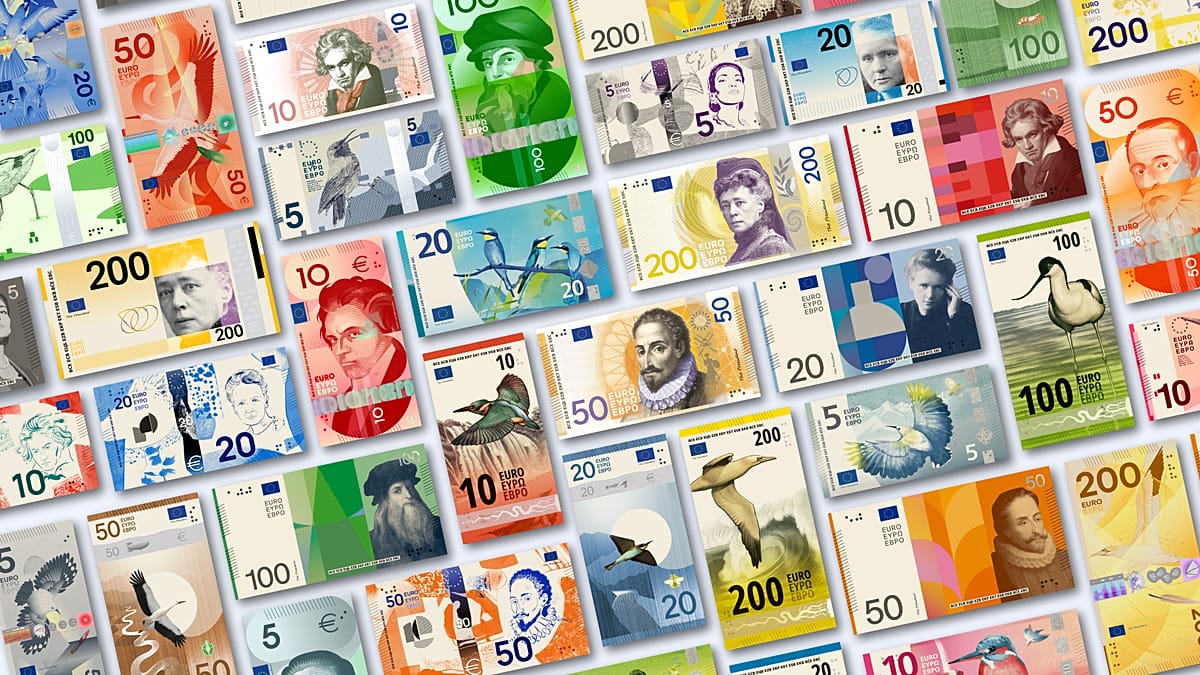
The euro is getting a facelift. Recognisable imagery in place of abstract motifs, tighter security features and a design built to feel closer to citizens — these are the hallmarks of the new euro banknotes.
The ECB put forward proposals for new banknotes in July, featuring designs that mark a clear break with those currently in circulation. It is the first time the ECB has drawn such a visible line of discontinuity in the wallets of Europeans.
"We are underway with the first complete visual overhaul of euro banknotes, with new themes, motifs and designs, with the aim of bringing the future banknotes even closer to Europeans," ECB banknotes director Doris Schneeberger told Euronews
Among the finalist proposals presented, two major themes emerged: European culture and the richness of nature.
For the first option, the ECB proposes to depict figures who have left their mark on the history of art, music, science and literature. For the other, rivers and birds.
The bank launched a public survey to let citizens choose the final option. However, entry into circulation will take some years. A source from the banking sector told Euronews that the new notes might be introduced as late as 2029.
Schneeberger told Euronews that the survey had already drawn responses from "millions of Europeans". The winner will be announced in December 2026.
"No one would renovate a house that is planned to be torn down in the near future," Schneeberger told Euronews, drawing a parallel with the new banknote designs.
As payments increasingly go cashless, the ECB is seeking to reinforce the role of banknotes as the main form of "public money" available to citizens.
Public money refers to money issued by a central bank — physical cash, such as banknotes and coins, for the public, and commercial bank reserves held at the central bank for banks. It is considered "public" because it is created and backed by a public authority.
Private money is created by commercial banks and mainly takes the form of bank deposits held in current and savings accounts, which make up most of the money used in everyday transactions, such as bank transfers and card payments.
In parallel, with the introduction of the digital euro, a new electronic form of payment with public money potentially available from 2029, the ECB wants to counter false claims spreading about the disappearance of cash in favour of the new digital currency.
"We are committed to ensuring that paying with public money is always an option, be it with cash or with a digital euro. A digital euro would complement cash and not replace it. All Europeans will continue to have the freedom of choice how to pay — be it with cash, the digital euro, or another means of payment," Schneeberger told Euronews.
Euro banknotes have changed only once since the birth of the currency, with the overall design remaining largely the same throughout.
"Since their first issuance in 2002, the theme represented by euro banknotes was 'Ages and styles,' symbolised by windows, doorways and bridges. While they received a refreshed design with the Europa series, which was first issued from 2013 to 2019, the overall visual approach stayed the similar," Schneeberger said.
Current euro banknotes depict abstract monuments that do not actually exist, Schneeberger explained. The redesign aims to move beyond this by creating notes that Europeans of all ages can identify with and feel proud to use.
"With the design proposals, we now have the opportunity to make banknotes more relatable by featuring real people, real birds and real buildings," the ECB banknotes director concluded.