
The facts of India's Gen-Z revolt
The Indian Air Force was recently drafted to execute one of the country’s most unusual operations. It was neither a military mission, nor a national security exercise. It was for a medical school entrance examination.
Ahead of the re-test of India’s fiercely competitive medical entrance examination, NEET (National Eligibility cum Entrance Test) on 21 June, the Air Force was deployed to airlift question papers to 18 designated hubs across the country. Nearly 200 flights were deployed to transport sealed, strictly surveilled examination papers to the centres.
The operation took place in the wake of one of India’s biggest scandals in recent years. In May 2026, the careers of almost 2.27 million aspiring doctors were upended by allegations surrounding a question paper leak, forcing authorities to cancel the already conducted examination and order a nationwide re-test.
“I spent the past two years preparing for NEET only to be told that the original test results would be scrapped. The student outrage is only a natural outcome,” said Nikhil Pai, a 21-year-old student from Delhi. He was relieved after taking the test, hopeful of a good score. But the ordeal of appearing for the test again gave him crippling anxiety. “After preparing for two years, I was mentally exhausted and simply did not have the emotional bandwidth to go through the examination again.” For many aspirational young people like him, the episode revealed the many loopholes of India’s testing machinery.
But what happened next was even more unexpected. This rage caught and spread, resulting in nationwide protests and one of the largest youth political movements in India. At its helm stands a unique mascot – a cockroach.
Politics isn’t supposed to be shaped by crawling insects. But, since 16 May, the Cockroach Janta Party (CJP) has emerged as a symbol of youth rebellion and resilience.
The movement started just days after the NEET scandal started to break. Investigations had revealed significant overlaps between a pre-circulated guess paper and the actual question paper, and several people associated with the autonomous body responsible for setting the question paper were arrested, leaving millions of students in limbo.
Then, on 15 May 2026, the Chief Justice of India, during a Supreme Court hearing, likened young Indians to “cockroaches”, implying their careers lacked purpose and direction.
Thirty-year-old communication professional Abhijeet Dipke voiced his outrage online. He posted on X: “What if all the cockroaches came together?” What was intended as a jibe at the government resonated with millions. Thus a political symbol was born. We are used to symbols that evoke pride – doves, flowers, lions – but a creature associated with nuisance and disgust resonated more.
The Cockroach Janta Party’s website went live within 24 hours. The satirical movement positioned itself as the voice of “the lazy and unemployed” and has so far campaigned for accountability for examination controversies and the resignation of India’s education minister, Dharmendra Pradhan. Dipke says that 1.1 million people have now registered through the party’s website, and it has amassed more than 22 million Instagram followers, far more than the ruling Bharatiya Janata Party which it satirises (9.4 million).
Speaking to me by phone, Dipke said, “It started as a harmless joke on X. But the youth of India are so disgruntled that they somehow found my joke more relatable than the prospect of their leaders’ promises ever getting realised.” Dipke points out that though the ethos of the movement is rooted in satire and internet subculture, the party is a result of longstanding frustrations. “It is not to be mistaken as a passing internet phenomenon…When political apathy is so strong, isn’t it natural that the youth would be triggered?”
The movement then took to the streets, with its first protest in Delhi on 6 June followed by more protests at Bengaluru, Amritsar, Pune, Lucknow, Nagpur, Jaipur and Hyderabad. A demonstration at Delhi’s Jantar Mantar has become an indefinite sit-in. Education reformer Sonam Wangchuk began an indefinite hunger strike on 28 June. “Many sceptics questioned if the movement would ever move beyond the digital medium,” says Dipke. “But the hundreds of young Indians, especially those frustrated by the NEET crisis, who showed up for the protests, tell a different story. They want to change the political discourse of the country.”
A striking visual at the Jantar Mantar protest site is a memorial wall with pictures of students who took their own lives after the NEET crisis. At least 12 NEET applicants died by suicide in the 37 days between the cancellation of NEET 2026 on 12 May and the 21 June retest, according to media reports. It is equally telling that despite CJP’s multiple pleas for accountability, neither prime minister Narendra Modi nor education minister Pradhan has publicly responded to the protest, student backlash or the suicides. On 26 June instead, Modi posted a birthday message on X to Pradhan, praising his “commendable efforts to make India a hub for knowledge”, a message that was viewed more than 7.6 million times.
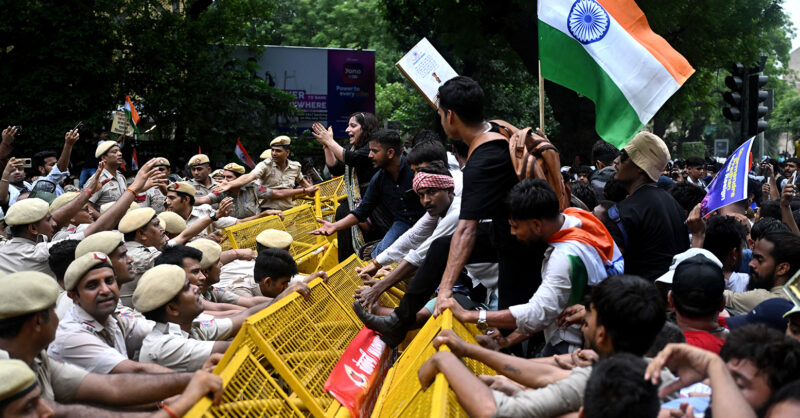
On 20 July, the nation woke up to the movement’s biggest mobilisation yet. Young Indians converged at Jantar Mantar, before marching towards parliament on the opening day of monsoon session to demand accountability. Authorities denied permission for the march, and attempted to restrict access to parliament by heavily barricading the route, suspending internet at the protest site and shutting down nearby public transportation modes. Yet, despite the restrictions, the crowd continued to grow. Delhi Police, which functions under the aegis of the central government, responded with tear gas, baton charges and mass detentions. Hundred of protestors were left severely injured, and images of blood-soaked young Indians – including women being beaten by male security personnel – surfaced on social media.
The crackdown sparked a massive national outrage, with the protest continuing through the night and the following days. It is also equally telling that many of the country’s leading politicians, industrialists, sportspersons and artists remained conspicuously silent. On 20 July, which Dipke describes as a “Black Day of Democracy”, the movement assumed a new identity: it was no longer a satirical digital phenomenon, but a youth political movement that had spilled over to the streets.
India has the largest youth population in the world, with more than 370 million people between the ages of 15 and 29. Political speeches frequently celebrate this demographic advantage, especially during election season. Yet, the country offers them few ways to deploy their energy and make careers for themselves. As per the government’s Periodic Labour Force Survey, the unemployment rate in India rose to a six-month high of 5.2 per cent in April 2026, up from 5.1 percent in March. At the same time, professional courses are highly competitive, with 2.3 million students vying for 130,000 undergraduate seats through NEET examination each year. And this isn’t the first time NEET was embroiled in a paper leak scandal; it faced similar controversies in 2021 and 2024. Students continue to face shrinking employment prospects, flawed educational governance and state neglect. Many feel that the institutions meant to honour merit and ensure transparency can no longer be trusted.
And it took one pest to unite the youth of India. Dipke believes that the metaphor hidden in the cockroach is key to understanding why the movement has amassed such a large following. “The Chief Justice assumed we would be insulted by the label. Instead, we are reclaiming it… Cockroaches survive in the most mouldering spaces. The question is not why cockroaches are emerging. It is: why is the system so mouldering?”
Aadvik Singh, a 23-year-old independent comic artist from Delhi, isn’t surprised that a satire page has captured mass attention at this scale. “Beneath all that satire is real anger,” he says. “It gave people an outlet to channel their anger at the complete lack of accountability from government institutions… People are bringing their own grievances into it. For some it’s unemployment, for others it’s exam fraud. It feels like a response to accumulated neglect.”
Sanjay Jha, author and a former national spokesperson for India’s opposition party, Indian National Congress, argues that the rise of CJP reflects the failure of traditional political institutions’ inability to keep up with an evolving society. “Many are large unwieldy and unproductive committees, with little accountability, technologically obsolete structures, little to non-existent inner-party democracy, and no ideological clarity.”
To him, examination scams expose more than a crisis of trust. “There is desperation in the air. The panic is manifesting in this spectacular deluge of support for Dipke’s innocuous post that turned into an avalanche.” Jha feels there is cynicism about India’s political ecosystem due to which a satirical movement such as CJP has suddenly occupied so much political space. “After all, 46 per cent of Indian members of parliament have criminal records.”
CJP, to young supporters such as Pai, stems from a broader sense of political exhaustion. Unlike major parties, it has largely steered clear of traditional political language around religion, mass rallies, and speeches on nationalism. Instead, it survives largely on social media. It is not registered with the Election Commission of India. Simply put, it is not a formal political party. Yet, its concerns – jobs, academic meritocracy and institutional credibility – have offered young Indians a more relatable political language.
Could online activism translate into real change? Sudhanshu Kaushik, founder of Young India Foundation, a non-profit organisation supporting young candidates in India to stand for elections, acknowledges that the biggest challenge for CJP is avoiding the perception that it is merely performative. “To compare a digital movement to a fully functioning political party that has spent years driving grassroots mobilisation would be an overstatement,” Kaushik warns. Yet he hesitates to dismiss it either. “We are so online now,” he says. “Perhaps the online medium is giving the youth an independent vehicle, filling a void in the political landscape.”
Only time will tell if CJP manages to construct grassroots networks and electoral strategies. “Movements driven by momentary outrage often fade if they don’t evolve,” says Singh. Yet, he believes it has created something meaningful. “The youth is realising that the privilege of ignoring politics doesn’t exist. When your exams are compromised, jobs are scarce, wages are low and working conditions are exploitative, you need to be involved.”
Shrinidhi RS, founder and CEO of Cherrilearn, an edtech company, believes that the deeper issue is uncertainty. “Social media may be the vehicle, but the underlying emotions are real.” Students are no longer certain that hard work, meticulous preparation and appearing for tests will guarantee academic achievement and economic prosperity, if the system continues to be flawed. “Many students feel that even after investing years (and money) into education, there is no clear roadmap connecting education to meaningful employment.”
CJP may evolve into a political party. It may live on as a pressure group. It may thrive only on Instagram, or fade as quickly as it erupted. Nonetheless, it has exposed a reality that India’s political establishment has struggled to confront. Young Indians are politically exhausted. And a cockroach gave them a way to channel that frustration.