
The Faint Hope for Peace Between India and Pakistan
Follow this section to personalize your feed and get instant alerts.
Follow this tag to personalize your feed and get instant alerts.
Follow this author to personalize your feed and get instant alerts.
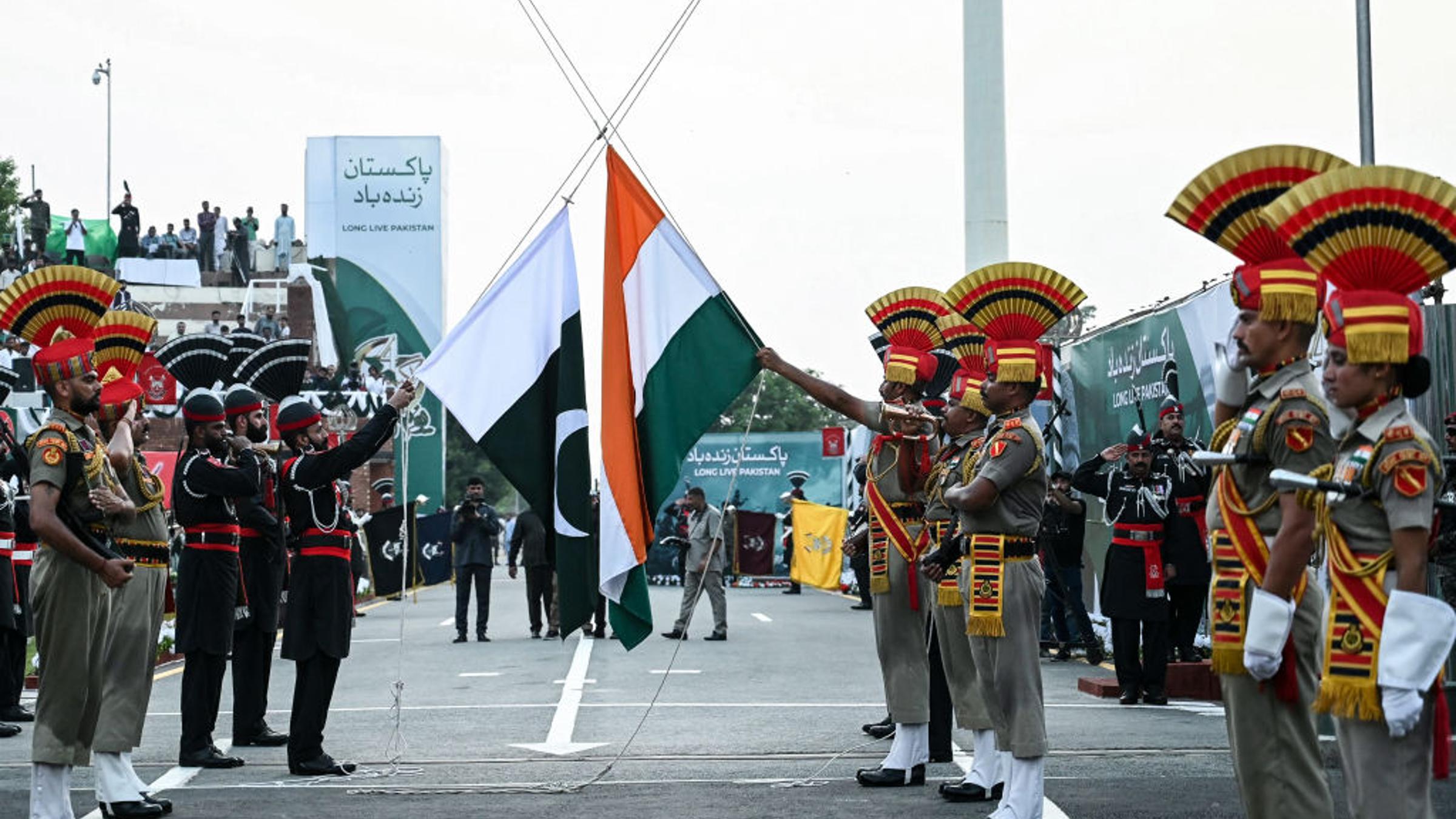
Indian Border Security Force personnel and Pakistani Rangers take part in a ceremony on the occasion of Pakistan's Independence Day and eve of India's Independence Day at the India-Pakistan Wagah border post on August 14, 2024.
Follow this author to personalize your feed and get instant alerts.
Around 14 long months have passed since India and Pakistan fought a four-day war. The brief and dangerous conflict has left relations between the nuclear-armed rivals dangerously tense. Still, a survey of historical precedents, an evaluation of contemporary geo-economics, and a growing awareness of the grim dangers of renewed escalation suggest the relationship could gradually improve. At least, until the next crisis hits.
The conflict in May 2025 was arguably the most serious between India and Pakistan since the war of 1971. Their last major military confrontation was in 1999, when they fought for nearly three months in the mountains of Kargil in the disputed region of Kashmir. But that clash was localized.
The four-day war was brief but fierce, with hostilities waged across vast geographies. Drones and missiles were fired deep into each country’s territory, and both militaries deployed weaponry and defense technologies sourced from multiple countries. Pakistan drew on Chinese and Turkish equipment; India relied on French and Israeli weapons.
In the four years before the conflict, the relationship between India and Pakistan had been relatively stable—albeit practically nonexistent, as there was little contact between the two countries. But on Apr. 22, 2025 terrorists murdered 26 Indian tourists in a meadow in the Kashmiri town of Pahalgam. There was a furious campaign in India, led by the public, the media, and politicians, demanding revenge.
New Delhi blamed Pakistan, framing its actions as a counterterrorism imperative, and it launched air strikes inside Pakistan. Islamabad, which has a long history of sponsoring terrorism against India, denied any involvement. India compounded the damage by choosing several nonmilitary punitive actions: New Delhi closed the border with Pakistan, cut off trade, and—for the first time—suspended the Indus Waters Treaty, a rare and durable bilateral achievement that ensured cooperation over shared transboundary rivers for decades.
Since the 2025 war, broader regional developments have deepened the estrangement. Pakistan has faced an intensification of attacks by Tehreek-e-Taliban Pakistan (TTP) and the Baloch Liberation Army (BLA), militant groups that Islamabad accuses New Delhi of sponsoring; India denies the charge. India’s growing ties with the Taliban government in Afghanistan, which Pakistan claims is sheltering the TTP, have fueled suspicions in Islamabad that New Delhi is colluding with the Taliban to destabilize Pakistan through sponsored violence.
Meanwhile, Pakistan’s ever-deepening defense alliance with China, India’s principal strategic competitor, has unsettled New Delhi, particularly given that Islamabad deployed Chinese weapons against Indian forces for the first time during the 2025 conflict. It would be easy to conclude that India-Pakistan relations are one trigger event away from another crisis. And yet, the prospects for a modest thaw may not be quite as remote as they seem.
History offers some reassurance. Bilateral tensions have eased after periods of conflict, often accompanied by a revival of commercial and cultural ties. In the years immediately following the Partition of the Indian subcontinent in August 1947 and the first India-Pakistan war a few months later, the two nations ramped up trade and inked new trade facilitation deals. In 1972, a year after a brutal conflict—one in which India helped with the rebirth of the eastern wing of Pakistan as Bangladesh—New Delhi and Islamabad concluded an agreement that resumed limited trade.
In January 2010, barely a year after Pakistan-backed terrorists killed 166 people in Mumbai in November 2008, The Times of India and the Jang Group, two of the biggest newspaper groups in India and Pakistan, launched a new peace initiative meant to foster cultural diplomacy. After Narendra Modi was elected as Prime Minister of India in 2014, he ushered in a new era of muscular Hindu nationalism, accompanied by an increasingly uncompromising stance toward Pakistan—a position hardened all the more after terrorists attacked an Indian air base in early 2016, just one week after Modi had made a surprise visit to Pakistan.
And yet, despite all of this, in February 2021, India and Pakistan agreed to stop cross-border firing and reaffirmed their commitment to an older cease-fire agreement—a significant step toward restraint coming less than two years after a brief conflict ignited by an attack by Pakistani militants in Indian-administered Kashmir, and India’s decision in August 2019 to revoke the semi-autonomous status of Indian-administered Kashmir. Both events had plunged ties into a deep freeze.
Today, each side has compelling reasons to avoid new escalations. Pakistan is embroiled in a limited conflict with the Taliban on its frontier with Afghanistan, and until recently it was grappling with a war across its border with Iran. India, despite having lowered tensions with China, still faces the risk of border provocations—and other major challenges—from Beijing.
More broadly, India and Pakistan are navigating a world of considerable turbulence. The economic fallout of the recent conflict in the Middle East weighs heavily on them. The Gulf states are home to several million Indian and Pakistani expatriates, and the region supplies much of the oil and gas on which both nations depend. With so many fires raging, neither India nor Pakistan can afford to ignite another.
This fraught global context and its domestic implications could be the context for recent comments about dialogue with Pakistan by Dattatreya Hosabale, a senior leader of the Rashtriya Swayamsevak Sangh, the mothership of Hindu nationalist groups in India, which birthed the ruling Bharatiya Janata Party. “The security and self-respect of a country have to be protected and the government of the day should take care of it,” Hosabale said in an interview. “But at the same time, we need not close the doors. We should always be ready to engage them in a dialogue.”
Equally telling are reports of informal meetings between retired Indian and Pakistani diplomats and military officers over the last few months, including a round of talks earlier this week in Sri Lanka and Thailand. These gestures signal a willingness to be pragmatic and to recognize the considerable costs of fresh escalations. An early indication of this sentiment came last November, when militants detonated a car near the Red Fort in New Delhi. India did not blame Pakistan, much less strike it. None of this is to understate the real risks of another conflict. From an escalation management perspective, each side appears to have drawn the wrong lessons from the 2025 war. Both benefited politically.
Pakistan’s civilian and military leadership had been battling public anger over economic stress and state repression before the conflict. The generals and the politicians recovered considerable goodwill and support through the country’s battlefield performance—which included shooting down several Indian jets—and by telling the people that Pakistan was unfairly targeted with military force for a terrorist attack it had nothing to do with. India’s government, which has long leveraged a hard line on Pakistan for domestic political advantage, enjoyed a rally-around-the-flag effect that gave it a useful boost one year after a worse-than-expected performance in national elections.
Each side has also clearly calculated that it can wage limited conventional conflict comfortably below the nuclear threshold. The last three cases of India-Pakistan hostilities—in 2016, 2019, and 2025—involved exponentially greater uses of force than those before them. Islamabad and New Delhi may well believe these precedents demonstrate their ability to manage nuclear escalation risks. But each successive confrontation has brought the two nations closer to the nuclear threshold itself.
Another India-Pakistan conflict is highly likely. And if trends over the past decade hold, it could prove even more serious than the war last year. But for now, there is at least some reason to believe that both countries are aware of this great danger, and that they want to do what they can to avoid such a scenario.