
The financial winners and losers from the World Cup
This World Cup has been bigger than any tournament before it.
More countries taking part and more matches means more eyeballs on the action - as well as more opportunities to make money.
As the planet's footballing stars create historic moments on the pitch, billions of dollars are being generated off it.
But not everyone is raking in the big bucks with financial winners and losers.
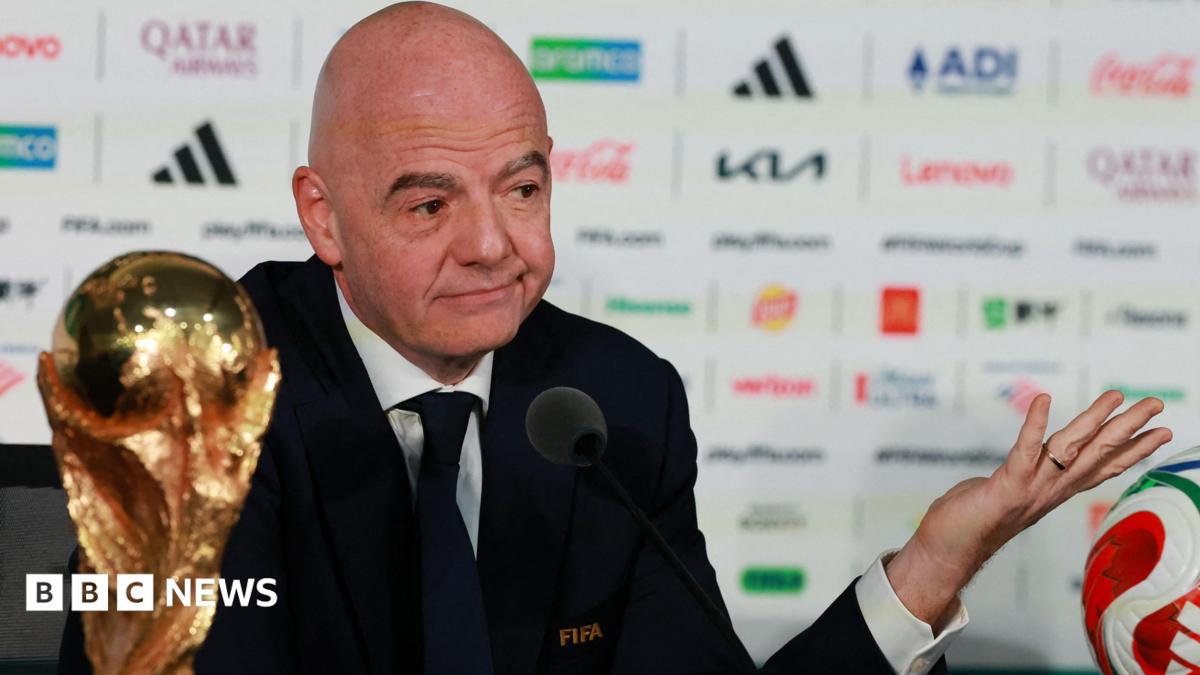
The amount of money world football's governing body Fifa makes from the World Cup is astronomical. It generated a record $7.6bn (£5.6bn) from Qatar 2022 and is expected to top that in US, Canada and Mexico 2026, especially with the expanded 48-team tournament.
Marion Laboure, senior strategist at Deutsche Bank Research, says Fifa is "without question" the main winner with its revenues over the four-year cycle period approaching $13bn.
Fifa's income comes from the sale of broadcasting, licensing and hospitality rights, sponsorship deals and ticket sales.
"Fifa also moved into the secondary market with its official resale marketplace, taking a 15% fee from both buyer and seller," adds Laboure.
We should expect more of this in tournaments to come, with Fifa considering expanding the tournament yet again to 64 teams, which could include the likes of China and India - and the billions more viewers that come with it.
While fans may have achieved lifelong dreams, financially speaking, this tournament has been tough.
The vast sums being forked out to pay for the tickets alone and criticism of Fifa's dynamic pricing strategy, which raises prices when demand is high, have been well-documented.
Even US President Donald Trump admitted he "wouldn't pay" when asked about the potential $1,000 ticket price for his country's tournament opener against Paraguay.
Tickets for the final at New Jersey's MetLife Stadium were officially offered at $32,970, while some resale tickets have been listed for more than $2m.
Fifa president Infantino defended ticket costs, arguing they were in line with other US sporting events.
Away from tickets, fans have also been squeezed through flights, food and accommodation.
One example that hit the headlines was the hike in New Jersey Transit train tickets. A 30-minute train journey to the MetLife Stadium rose to $150 for the tournament from the usual $12.90 for a return fare. A backlash led to prices being cut, but they still remained higher than normal.
While broadcasters have had to shell out big bucks to televise the tournament, the viewing figures - and sponsors wanting their brands on show - mean they are also likely to make a killing in selling advertising slots.
Fifa brought in hydration breaks for this World Cup - a move Infantino said was "purely a sporting matter" with no additional revenue for the governing body.
However, the 90 seconds for players to get fluids on board has provided a new commercial opportunity for broadcasters and sponsors wanting to show off their brand, especially in the US, where American sports fans have been long used to games effectively being played around the ad breaks.
Fox Sports, who reportedly paid $485m for the US broadcast rights, introduced the hydration intervals as "sponsored by" a brand.
According to experts, an average 30-second World Cup advertising slot on Fox costs between $200,000 and $300,000. It reached as high as $750,000 during US matches the final stages.
It means hydration break ads could net $250m in the US alone, prompting speculation that they will be here to stay.
"The hydration breaks are pure advertising inventory. I'd be extremely surprised if they disappear. The expanded format will stay because scale is now Fifa's business model," says Laboure of Deutsche Bank Research.
Fans in the UK watching games on the BBC or ITV have been shielded from hydration break adverts due to the former not using any advertising and the latter being restricted by regulator rules on the amount of commercials used in a 60-minute period.
The official sponsors of the World Cup pay eye-watering sums to associate brands with the competition, but no doubt end up benefiting financially, with the likes of Adidas and Coca-Cola plastered everywhere.
The German sportswear brand has been locked in a battle with its arch-rival Nike, spending some £50m on their "backyard legends" ad featuring Lamine Yamal, Jude Bellingham and Lionel Messi.
However, some unofficial brands have benefited from Fifa trying to make sure fans see less of them, such as the Levi's logo outside the Levi's stadium in San Francisco being covered up.
Adidas's main ad also features an AI version of Sir David Beckham - who, to be honest, might not have had time to attend filming in person.
The UK's first billionaire sportsman has been in so many adverts from Home Depot to Bank of America, you could be forgiven for forgetting what brand he is actually representing.
Despite hanging up his boots more than a decade ago, Beckham continues to be the face of US soccer, with the American club he co-owns, Inter Miami, estimated to be Major League Soccer's most valuable franchise at $1.45bn.
He may not have managed to win the World Cup on the pitch, but he's arguably won the commercial game off it.
The 16 host cities across the US, Canada and Mexico have been welcoming an influx of fans and tourists boosting hospitality, hotels and local businesses.
But while the Scots drank Boston dry and have won the heart of the city and its people, experts say the long-term economic benefits are minimal.
Fifa estimated some $41bn would be added to the global economy, of which $17bn would boost the US economy alone, with 185,000 jobs created, mostly in hospitality and accommodation.
But Alexander Budzier, a fellow in management practice at Oxford University and chief executive of project management company Oxford Global Projects, says the long-term economic benefits of hosting such a big sporting event just do not materialise.
Host cities actually typically see a big drop in visitors, he says, as many seek to avoid the tournament chaos.
And while there may be a spike in hiring, he argues it is typically only for lower-paid jobs in hospitality. "It creates jobs, but it does not create wealth," he says.
Official figures show that hiring in US pubs, bars and restaurants ramped up ahead of the tournament in May, but the boom was short-lived.
The only "worthwhile" economic benefit, Budzier argues, is the regeneration projects that can be done, such as the redevelopment and housing built in Stratford in London following the 2012 Olympic Games.
But due to much of this World Cup using existing stadia, hotels, training complexes and travel infrastructure, "there won't be any economic benefits from development".
The expected demand for hotel rooms did not materialise, with industry bodies reporting lower bookings in host cities this year than last.
The British Columbia Hotel Association says that while final booking figures are yet to be confirmed, June and July were "pacing well behind previous years", despite Vancouver hosting seven of the games in Canada.
It says tournaments "do not create 40 straight days of sold-out hotels", but rather lead to high-demand around specific dates.
For American hoteliers, the pre-tournament buzz did also not turn deliver.
The American Hotel and Lodging Association (AHLA) accused Fifa of block-booking too many rooms for its own use and creating false demand. Fifa has said it does not recognise the accusation.
Laboure of Deutsche Bank Research says the same thing happened in France in 1998 when demand did not meet expectations.
"By April, 80% of US hotel operators said bookings were tracking below their initial forecasts - two-thirds of New York hoteliers reported softer-than-expected bookings, and in Seattle nearly 80% did, with many calling the tournament a 'non-event'," she adds.
The 2026 World Cup is on track to be the biggest gambling event of all time, with an estimated $50bn placed in bets - around $500m wagered per match, according to financial services firm Macquarie, which has interests in the gambling industry.
It says this is primarily down to the expansion in teams, meaning there will be more than 100 matches played, up from 64 in 2022.
Flutter Entertainment, which owns Paddy Power, Betfair and Sky Bet, forecast the amount placed in bets would be double that of the previous tournament because of growth in the US and also Brazil.
Chad Beynon, an analyst at Macquarie, said in-play betting had taken over from the more traditional pre-match punt.
"Now it's all about reacting to what you're seeing on the field, adjusting your views. Whereas before it was kind of sit, watch, wait - you had to place your bet before the match," he says.
Sports betting in the US is still a relatively new industry. Until 2018, betting on sports was only legal in Nevada, the home of Las Vegas, but a Supreme Court ruling paved the way for many states to legalise it.
However, there are still some states where it remains illegal, including California and Texas. In those areas there has been big engagement in prediction markets - a fast-growing, billion-dollar industry popular with young men - which are not classified as gambling, meaning they can be used to place bets on sport regardless of which state someone is in.