
The late style of Anas Sarwar
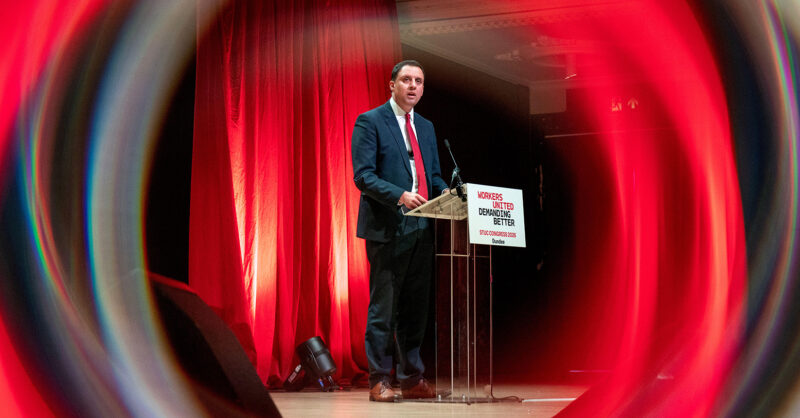
Will he stay or will he go? That’s the question Labour MSPs are asking about Anas Sarwar. Following the Scottish party’s drubbing in the recent Holyrood election, expectations are that Sarwar could step down as leader around the time of UK conference in September.
As yet, there is no firm answer. Sarwar has said he will stay on in order to “hold the party together” and continues to lead at First Minister’s Questions in his usual effervescent style. But I find it hard to believe he’s in it for the long haul or that he will stay in post until the next Holyrood election. May’s vote returned just 17 MSPs for Labour, its lowest in the history of devolution, and the same total as Reform. The SNP took 58 of the parliament’s 129 seats. The gap is simply enormous. In the recent Westminster by-elections for Aberdeen South and Broughty Ferry and Arbroath, Labour was barely an afterthought, coming fourth in both.
Sarwar puts on a show, but inside he must be gutted by how things have turned out. Another five years shouting at John Swinney from the opposition benches will have limited appeal. Sarwar was, he repeatedly told us, running to be first minister and to boot Swinney out of Bute House. The polls suggesting a comfortable SNP victory were wrong and the pundits and pollsters predicting such an outcome would be left looking foolish. He gave it everything he had but by his own metrics the outcome was a humiliation, whatever the reasons for it.
And what were those reasons? This is where it gets interesting, and where there is a split at senior levels of the party.
Everyone accepts that the deep unpopularity of Keir Starmer and his government played a, and probably the, key role in suppressing Scottish Labour’s vote. Despite having more money to spend than the other parties, an enthusiastic and experienced ground operation, and the slickest of social media outputs, Starmer proved an insurmountable obstacle. Activists talk of how conversations on the doorstep usually began with them having to defend the Prime Minister and his record. Only then, and not always, would voters be willing to discuss the SNP’s record in government and the wider Scottish issues at stake.
The intention was to make Scottish Labour an “emotionally neutral” vehicle for the anti-SNP vote, but antipathy towards UK Labour outweighed anger at the failings of the Nats over their long spell in office and the scandals that have dogged the party in recent years. Even when the SNP’s major new policy of controlling food prices in supermarkets imploded on the day it was announced, there was no impact on the polls. This has led some of the party’s analysts to conclude that policy matters a lot less than it once did and that “politics beats organisation”. The attempt to ensure this was a Scottish election fought on Scottish issues largely failed.
It undoubtedly helped the SNP that the appearance of its former chief executive Peter Murrell in court over his embezzlement of more than £400,000 from party accounts was delayed until after the election (Murrell was sentenced to five years and three months in prison this week). There has also been outrage that a Scottish government decision not to go ahead with a long-promised new hospital in Lanarkshire only emerged this week.
But others in the party believe too many mistakes were made by those running the campaign. A decision to target resources on specific seats that had been judged to offer Sarwar a route to Bute House has been criticised. So too has the party’s manifesto, which lacked surprises or eye-catching policies. The gamble that Sarwar’s obvious energy and charisma would see him preferred to Swinney by the electorate was misguided. Lord Foulkes, a former Labour minister, wrote recently that “the Scottish Labour campaign hoped that the contest would be based on the character of Scottish leaders alone and so had no really bold and attractive policy proposals in our manifesto.”
But even then, some wonder whether this, or indeed anything, would have made much of a difference. The SNP has been able to rely on a core vote of between 30 and 35 per cent which, with Reform splitting unionist support, left it cruising to victory. That stubborn loyalty to the Nats, or to the cause of independence, or both, points to an identity politics that will seemingly always remain unaffected by government failure or scandal.
Labour strategists are confronting a fresh exam question – what is the political space that a social democratic party can occupy in a political culture driven by identity politics? This is as true of the challenge posed by Reform at Westminster as it is of the SNP’s dominance in Scotland.
It’s also why Andy Burnham’s success in the Makerfield by-election is being taken as both a sign of hope and a lesson. How can populist, identity politics be beaten if policy has less purchase on the choices being made by voters? “Values and vibes” is the phrase being used to describe how Burnham saw off Reform. This reflects his ease in using social media and his ability to communicate an authenticity which cuts through.
There is belief, too, that Burnham’s northernness, even his accent, will send a signal to Scots that England is about more than Westminster and London, and that the more regionally focused approach promised by the likely next PM will challenge SNP “caricatures” of the UK. Burnham’s desire to deliver greater devolution to local communities across England could also force the SNP to confront the heavily centralised approach it has taken to governing Scotland.
We shall see. In the meantime, all eyes are on Sarwar as he weighs up his future. Alternative leaders are already being touted around, including front benchers Michael Marra, Paul Sweeney and Daniel Johnson. One can’t help wonder, though, whether being in charge of the smoking ruins of Scottish Labour is a job worth having.