
The real reason Gurgaon floods every year isn't rain
Gurgaon likes to call itself India's Millennium City — a skyline of glass towers and a financial engine for Haryana. But all it took was a few hours of rain to strip that image bare, turning the city into a swamp of stalled cars, dead power lines, and drains nobody bothered to mark. A ride home that never came I tried booking a cab from Udyog Vihar around 1pm.
First driver cancelled after five minutes — "stuck in traffic," he said. Second one never showed. By the time I gave up and started walking, my trousers were soaked to the knee and my shoes had turned into two small aquariums. Every step was a gamble, one couldn't tell if you were stepping into three inches of water or three feet, because nothing marked where the road ended and the open drain began.
That's not an exaggeration — it's the new normal. MCG's decision to open drain covers across the city ahead of the monsoon, without any visible barricading or warning markers, has quietly turned footpaths and roadsides into hazards.In several sectors, drain contracts have been left half-finished, with excavated stretches simply abandoned mid-project on sidewalks.
Residents now navigate not just flooded roads but invisible pits. The gridlock, by the numbers Gurgaon logged 115mm of rain over 33 hours this week — 83mm on Tuesday, another 32mm on Wednesday — enough to collapse a drainage system that authorities insist they've been upgrading for years. Waterlogging swallowed Sectors 31, 39, 40, 44, 45, 46, 56, 57, Sheetla Mata Mandir Road, Sohna Road, Basai Road, Kadipur and the Delhi-Jaipur Highway service lane near Narsinghpur — a list so long it reads like most of the city's map.
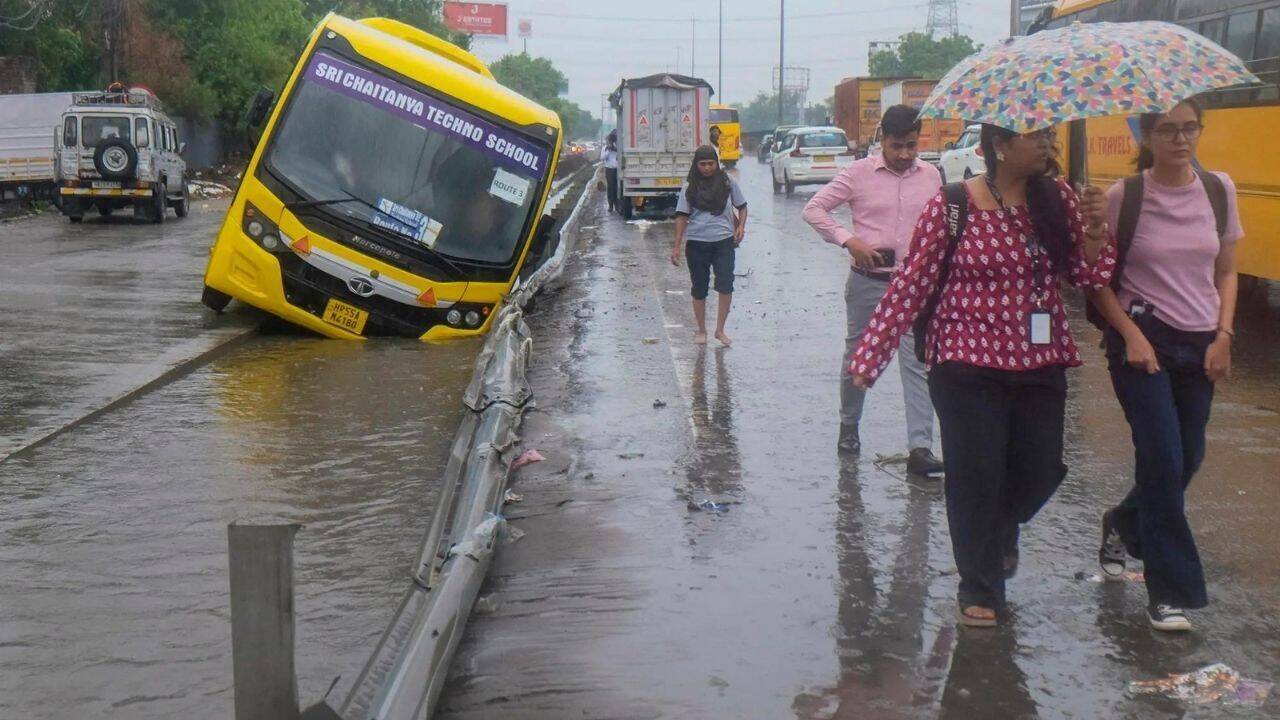
A cyclist fell into an open sewer pit in Feroze Gandhi Colony. A cow slipped into another. A school bus got stuck in a dug-up stretch in Rajendra Park. Children on multiple routes were trapped for four to five hours, sharing biscuits and half-eaten parathas as buses crawled through Mor Chowk, Jharsa, Narsinghpur and Subhash Chowk — some kids so hungry and dehydrated by the time they got home that parents reported headaches and fatigue setting in.
Premium roads, same fate This isn't a poor-infrastructure-only problem. Even NH-48 — the expressway connecting Delhi to Jaipur — caved in near Narsinghpur, a 10-foot-long crater opening up right where GMDA was laying stormwater pipes using trenchless technology. Two lanes shut, tailbacks stretched from Hero Honda Chowk to Kherki Daula Toll Plaza, and commuters who normally cross the stretch in 20 minutes were stuck for over hours on Tuesday.
Garbage floated alongside stalled SUVs on roads that cut through some of the country's most expensive real estate — DLF Cyber City included.Today, a section of a first-floor balcony collapsed at the luxury Imperia Esfera complex in Sector 37D, cracking a supporting pillar. Residents there had already protested the builder's neglect of basic amenities just a month before.
Money, it turns out, buys glass facades — not structural safety.No power, eitherWhile roads drowned, the electricity grid buckled under its own weight. Gurgaon accounted for nearly 40% of all power complaints logged across DHBVN's south Haryana operations in a single day — over 6,400 complaints from two circles alone, out of roughly 16,000 recorded statewide.More than 250 feeder trippings and three dozen prolonged breakdowns left pockets of the city dark for hours; one agricultural feeder in Bhora Kalan stayed down for over five hours after a cable failure.
Paying to escape the mess For those who could still try to leave, the exit came at a price. A ride that normally costs around Rs 600 from Udyog Vihar to Sector 90 was quoted upward of Rs 1,300 as surge pricing kicked in — some premium categories crossing Rs 1,400.Even bike taxis, usually the budget escape route, nearly doubled in fare.
Drivers say the surge isn't pure profit either — longer trip times, wasted fuel from idling, and battered suspensions from potholed, submerged roads eat into any extra earnings. Why Gurgaon actually floodsThe reasons are structural, not seasonal. A city built in a bowlGurgaon is ringed by the Aravalis on all sides but one.
Gwal Pahari in the east sits at 290 metres above sea level; Najafgarh in the west, the city's lowest point, sits at 200 metres — a 90-metre drop, taller than most of the city's own high-rises. Every monsoon, that gradient sends water rushing down from the hills straight into the low-lying sectors below.
The dams that vanishedThe British had built roughly 100 small check dams and bunds — at Ghata, Jharsa, Wazirabad and Chakkarpur — specifically to slow that flow and let ponds absorb the excess before it reached the city. Most have been encroached upon or built over. Ghata bund alone has shrunk from around 370 acres to just 2, replaced by high-end residential towers.
Jharsa bund is still under litigation at the National Green Tribunal over encroachment. With the ponds gone, there's nothing left to break the water's speed before it hits the streets. A concrete city that can't breatheUnder the 2031 master plan, more than 60% of Gurgaon will eventually be concretised, and green cover already sits below 5 square metres per person — a fraction of what's needed.
Officials estimate that in a well-functioning city, 60% of rainwater should percolate into the ground; in Gurgaon, only 20% does, while 80% runs straight into stormwater drains never designed to carry that volume. Making it worse, several major roads — including Golf Course Road — were built directly along natural water channels, so when it rains, the water simply reclaims its old path.
Drains that don't add upOf the city's seven major drains, five converge at a single choke point near Khandsa before draining into the Badshahpur Drain. The stretch between Ghata and Khandsa needs a capacity of 2,300 cusecs; at Khandsa, that capacity drops to just 500 cusecs. Widening work has pushed it up to 1,400 cusecs so far, with the rest still incomplete years after the project began.
At Vatika Chowk, the same drain receives around 1,900 cusecs against a capacity of only 1,150. On top of this, most residential rainwater harvesting pits — mandatory on paper — are built purely to secure occupation certificates and don't actually function. Money spent, little to showMCG has spent Rs 503 crore on the city's drainage infrastructure over nine years, including Rs 256 crore on sewer line repairs and Rs 222 crore on new drainage systems — yet residents describe the exact same flooding patterns as 2016's infamous "Gurujam." A Rs 280-crore comprehensive drainage project — proposing 20 check dams in the Aravalis and 200 recharge wells — was approved back in 2019-20 and still hasn't broken ground.
A separate sump-well project in Sushant Lok-1, started ten months ago, remains half-built after the contractor allegedly went missing, even as the city cycled through multiple MCG commissioners and engineers in the same period. And the hills keep shrinking tooHaryana lost 30 hectares of natural forest in 2025 alone, part of a longer slide that has cost the state 450 hectares of tree cover since 2001.
The state already has India's lowest forest cover at 3.6% of its geographical area. Much of the Aravali range functions ecologically as forest but still has no legal protection — leaving it open to further clearing for the very construction that's driving the flooding in the first place. The goose that lays the golden egg — and drowns every monsoon Perhaps the cruellest irony is what Gurgaon actually pays into the system it can't rely on.
In 2024-25, the Municipal Corporation of Gurugram generated Rs 1,077 crore in revenue — 32% of Haryana's entire municipal income of Rs 3,383.2 crore, dwarfing Faridabad's Rs 413.6 crore and Manesar's Rs 221 crore combined. The trend has held into this year too: in the first quarter of 2025-26 alone, Gurgaon delivered Rs 224.9 crore, or 33.5% of the state's municipal revenue, against Faridabad's Rs 100 crore and Manesar's Rs 44 crore.
It doesn't stop at property tax and civic fees. Gurgaon alone contributes an estimated 35-40% of Haryana's excise revenue and a similar 35-40% share of the state's GST collections — driven by the city's dense concentration of corporate offices, bars, restaurants and liquor licences. A single liquor vend in the city was once auctioned for nearly Rs 98 crore, roughly matching the entire annual revenue of a district like Mahendergarh.
Yet none of that financial weight appears to translate into proportionate investment on the ground. Gurgaon resident and former joint secretary, cabinet secretariat, Kundan Lal Sharma said, "The torrential rain in the city has belied all claims of civic agencies about flood control. As the MCG contract for drain cleaning is yet to be finalised, all internal roads of Sector 21 are having five to six inches of water.
The road from Sector 21 market to Ayappa pocket is submerged in 10 to 12 inches of water. About a dozen houses in Dundahera village are drowned in water as the Dundahera drain built at a cost of around Rs 2 crore has not benefited the area.""Overall, the efforts of all agencies are suboptimal. MCG has shown no will to address the concerns.
Across the city, apathy toward stormwater planning and water body preservation has led to civic systems being overwhelmed and natural ecosystems being erased. This is no longer just poor planning: it is a slow-burning environmental disaster. The time to act is now; otherwise, it will be too late," Sharma added.Making Model Gurugram convener Gauri Sarin said, "My biggest disappointment was the follow-up on a sump in Sushant Lok 1 for which the process started 10 months ago, but the contractor is absconding after completing only half the work.
This shows dereliction of duty of a very high order. During this time, however, several transfers happened — from MCG commissioner to chief engineer to executive engineer to junior engineer. What a shameless way to treat Gurgaon, after it has voted BJP for the third time, sans performance? The govt agencies should stop fooling people.
This is a fractured system: both natural and infrastructural.""The timing of the ULB meeting raises concerns about its scheduling during such a critical period. Questions persist regarding the involvement of various agencies. There are concerns about the significant delays in issuing work orders, particularly when a new MCG commissioner was expected to enhance operational efficiency.
It remains unclear why the repeatedly submitted flooding list to the govt continues to remain unaddressed," she added. The verdict Money spent on paper, dams erased from the map, drains that can't cope, and forest cover thinning year on year — Gurgaon's floods are the sum of every shortcut the city has taken in the name of growth.
For a city that pays roughly a third of Haryana's municipal revenue and a similar share of its excise and GST collections, that gap between what it puts in and what it gets back is the real story of every monsoon here. The skyscrapers keep rising, the hills keep emptying out, the drains keep failing — and residents keep wading home, one flooded sector at a time.You Can Also Check: Gold Rate in Gurgaon | Silver Rate in Gurgaon | Bank Holidays in Gurgaon | Public Holidays in Gurgaon | Gurgaon AQI | Weather in Gurgaon | Petrol Price in Gurgaon | Diesel Price in Gurgaon | CNG Price in Gurgaon | LPG Price in GurgaonStay updated with the latest Gurgaon news.
Download the TOI App.