
There May Be Three Times as Many Insect Species Than We Knew
Follow this section to personalize your feed and get instant alerts.
Follow this tag to personalize your feed and get instant alerts.
Follow this author to personalize your feed and get instant alerts.
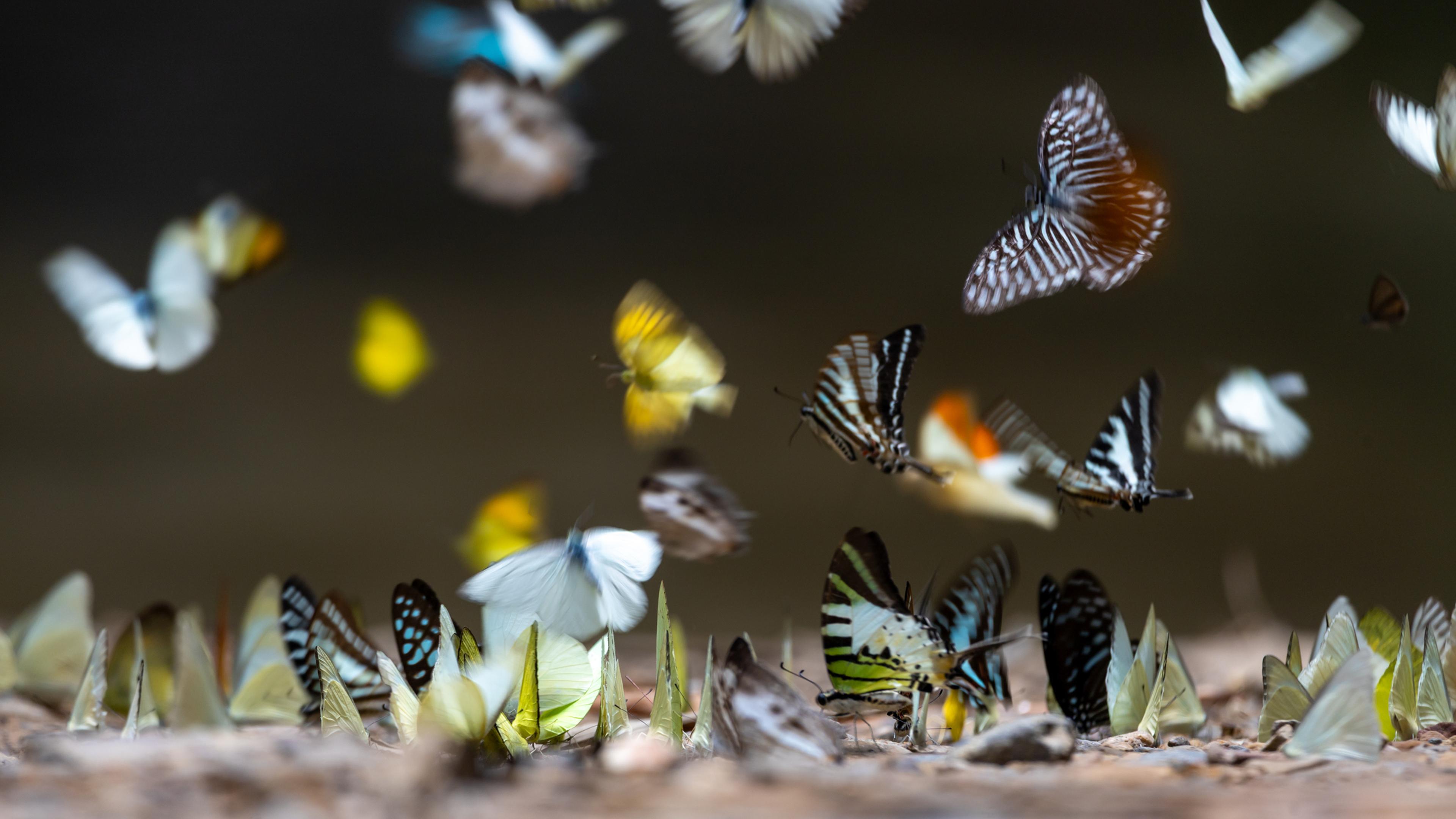
A macro wildlife photograph capturing butterfly resting on the ground.
Follow this author to personalize your feed and get instant alerts.
Think your back yard can get buggy in the summer—with mosquitoes, flies, moths, wasps, bees, lightning bugs, crickets, and more swarming, buzzing, and chirping everywhere? That’s nothing compared to the great global yard that is the Earth. According to the Smithsonian Institution, there are about 10 quintillion—or 10 with 18 zeroes—insects alive in the world at any given moment, representing the largest biomass of all terrestrial animals.
That huge group is also a diverse group. The generally accepted figure for the number of insect species on the planet is about six million. Or at least that was the number. According to a new study in the Proceedings of the National Academy of Sciences, however, that head count is also likely an undercount, with the actual number of insect species topping out at anywhere from 14 million to 20 million—or more than three times the current estimate. Within that census there are still local collapses: populations of pollinators like bees and monarch butterflies are declining precipitously, and climate change and habitat loss are claiming other insect species, disrupting the food chain, which is built in part on those tiny creatures at the bottom. The tripling of the overall known species count has implications not only for basic entomological research, but for efforts at conservation as a whole.
“If we don't even know that a species of insect exists, and we don't even have a name or anything for it, we could be losing a lot of species [without knowing it],” says Laura Melissa Guzman, assistant professor in the Department of entomology at Cornell University, and one of the co-authors of the paper. “Our study gives us a baseline of how much work there is to do. Can we find ways to speed up this process to be able to catalog biodiversity before we lose it?”
The researchers involved in the study did their work in Costa Rica’s Área de Conservación Guanacaste (ACG), a 418,000-acre wilderness area stretching from the Pacific Ocean to the Caribbean Basin. The ACG is home to uncounted species and families of insects, but the scientists were interested in one in particular: the Microgastrinae, a group of small, parasitic wasps. Microgastrinae adults lay their eggs inside unlucky caterpillars. When the larvae hatch, they consume the insides of their host and emerge as fledgling wasps. The researchers chose the Microgastrinae because they are a well-sampled subfamily of insects, with many of their species already typed and catalogued. Their population could be used as a yardstick for the populations of all species across the ACG.
Studying the Microgastrinae required setting up so-called Malaise traps—curtain-like nets topped by a canopy net that catches insects on the fly. In an attempt to escape, the insects fly upward and blunder into a bottle filled with ethanol, which kills them and preserves their remains. Three arrays of Malaise traps—one core array and two secondary arrays—resulted in the collection of more than 1.6 million insect specimens, all of which were shipped to a lab where a high-speed, robotically controlled system sequenced a part of their genome and produced a sort of barcode for each. That barcode identified the samples by species. A total of 54,000 species were detected among the 1.6 million insects. Of those, 388 were Microgastrinae caught in the core array and 1,414 in all three arrays. Those are big numbers—but they’re also incomplete numbers.
“Remember that not every species gets caught in a Malaise trap, and they were only in three different parts of the forest,” says Guzman. To extrapolate up from those numbers to the total population of insect species in the ACG in general and Microgastrinae species in particular, the researchers relied on statistical models that used an “undersampling ratio” to compare what was collected in the nets to what was likely still flying free in the near half-million-acre wilderness. That method yielded an estimate of 2,400 Microgastrinae species in the ACG and a whopping 333,000 insect species overall.
The next step was to use similar methods to estimate the total number of insect species in the world at large. That, in part, involved modeling other life forms, including trees—with 1,500 species in the ACG compared to 73,000 across the planet—as well as mammals, amphibians, and Saturniidae moths. The result, the researchers concluded, was the new 20-million estimate for the number of insect species that call Earth home.
“This calculation gave us the proportion of the richness and species that we have an ACG versus the entire world,” says Guzman.
Those figures won’t hold. As Guzman observes, as habitats are lost, their inhabitants go with them. It’s humans—a single species against the millions-strong insects—who are largely responsible for that damage. We’re doing a better job than ever of counting the species with which we share the planet; we could do an equally good job of protecting them.