
Trump Administration Moves to Block Chinese-Owned Solar Firms From Tax Credits, Prompting Corporate Restructuring
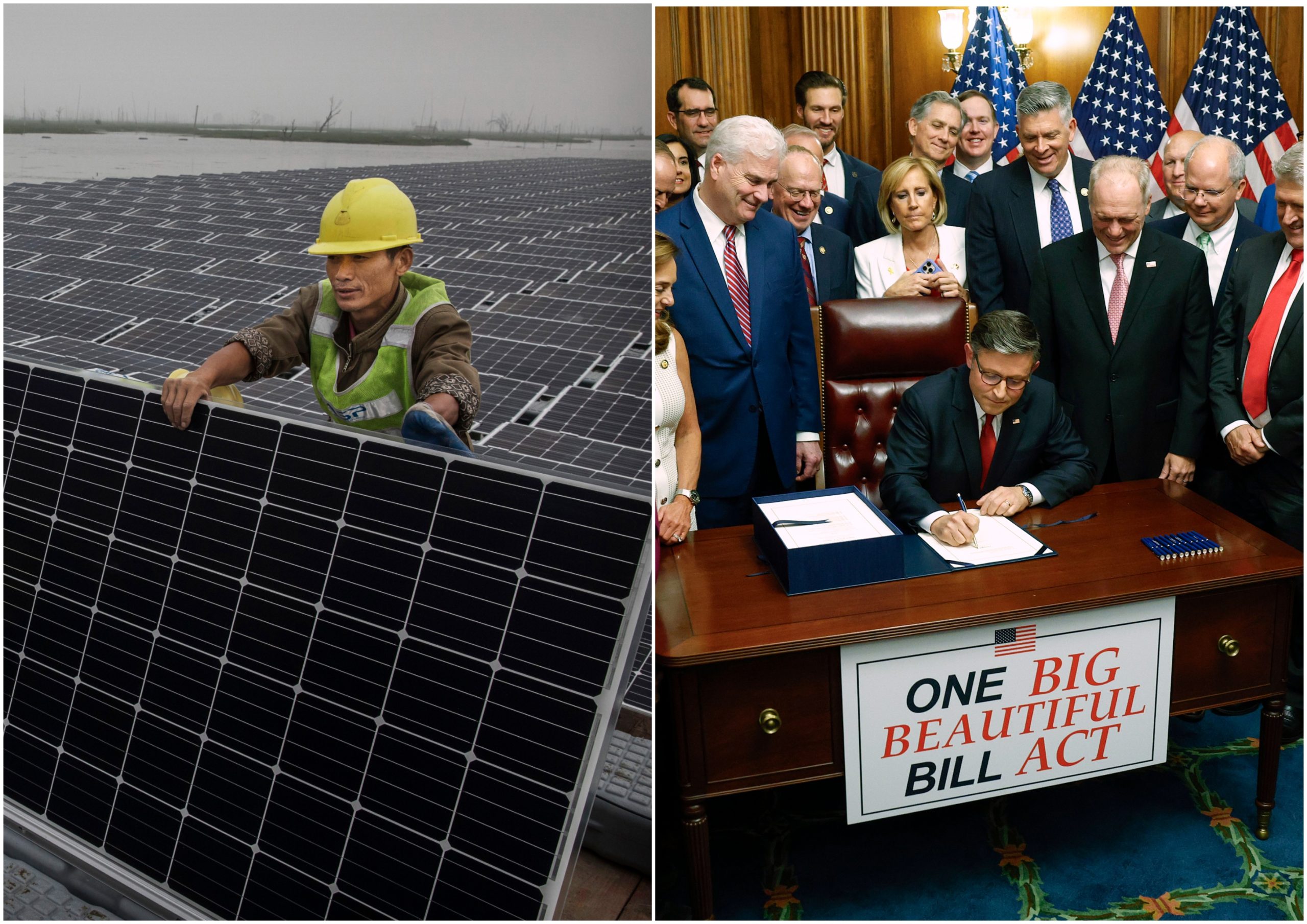
The Trump administration is finalizing rules to exclude companies with significant Chinese ownership from receiving federal green energy tax credits, prompting a wave of corporate restructuring among solar firms with ties to Beijing. The Treasury Department's guidance, tied to Trump's One Big Beautiful Bill Act, stipulates that entities with 25 percent or more Chinese ownership are ineligible for subsidies, a threshold several companies are now racing to circumvent.
Canadian Solar, a global panel maker headquartered in Ontario, exemplifies the trend. Though the company recently announced a joint venture to resume direct oversight of its U.S. operations, internal documents reveal its Chinese subsidiary, CSI Solar, retains a 24.9-percent stake, just below the disqualifying threshold. Founder and CEO **Xiaohua Qu**, a member of China's Communist Party-controlled advisory body, has openly prioritized the Chinese market, calling economies outside the country "foreign markets" in a 2012 interview with state-run China Daily.
Financial statements show the majority of Canadian Solar's assets and employees remain in China, where six subsidiaries benefit from preferential tax rates as "high and new technology enterprises." Similar structures appear across the industry. **T1 Energy**, a Texas-based firm touting an "integrated U.S. supply chain," was formed after purchasing an Austin facility from **Trina Solar**, a Chinese giant now holding a 17-percent stake. Trina also placed director **Mingxing Lin** on T1's board and secured technology licensing agreements, which T1 now routes through a Singapore intermediary to avoid violating rules.
**SEG Solar**, which brands itself as a "robust American solar company," maintained contracts with former affiliate **Jiangsu Seraphim** (now **Century New Energy Technology**) until late 2024. President **Jun Zhuge** previously chaired the Chinese entity, and the company continues procuring components from its former parent via ongoing supply agreements.
Analysts warn such maneuvers reflect broader efforts by Chinese firms to maintain dominance in the solar supply chain. "China's strategy is clear: if they can't undercut U.S. producers through cheap imports, they'll infiltrate the market directly," said **Nick Iacovella** of the **Coalition for a Prosperous America**. "This isn't just ownership, it's about control over technology, production, and decision-making."
**Horizon Advisory** cofounder **Nathan Picarsic** emphasized that ownership thresholds alone may not address Beijing's influence. "Chinese entities often exert control through supply chain dominance, regulatory leverage, or technological dependencies, not just equity stakes," he said. "These cases prove the need for stricter scrutiny beyond simple percentage ownership."
Other firms under scrutiny include **Illuminate USA**, a joint venture involving Chinese behemoth **LONGi**, and **Sinotec Solar**, led by CEO **Guangming Jin**, who sits on the board of a **China Power International Development** subsidiary in Nigeria. None of the companies responded to requests for comment.