
Trump Lashes Out at ‘Meaningless’ Senate Rebuke Over Iran War
Follow this section to personalize your feed and get instant alerts.
Follow this tag to personalize your feed and get instant alerts.
Follow this author to personalize your feed and get instant alerts.
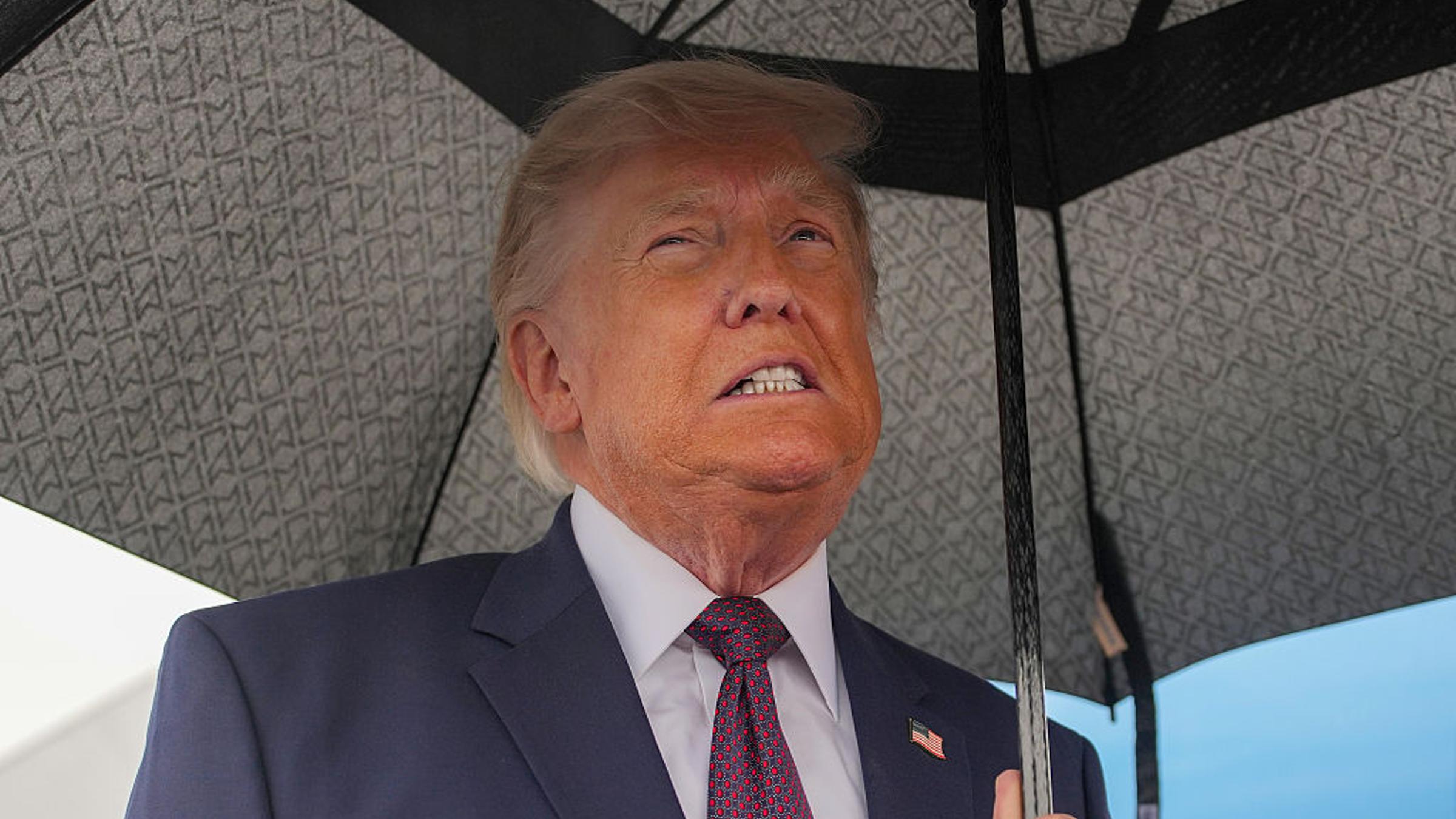
U.S. President Donald Trump stops to speak to reporters after landing at Reading Regional Airport in Reading, Pa., on June 23, 2026.
Follow this author to personalize your feed and get instant alerts.
Donald Trump lashed out on Truth Social on Tuesday night at “Four Republican Losers” and the “Dumocrats” who voted in the Senate to pass a war powers resolution that directs the President to end the ongoing war with Iran or get Congress’ authorization to continue it.
Trump called the vote “poorly timed and meaningless” and said it “just made my job more difficult,” as the Administration continues to try to negotiate a peace deal, which he said he will still get done “one way or the other, because I always get it done!”
The resolution—which passed 50-48 thanks to GOP Sens. Bill Cassidy of Louisiana, Susan Collins of Maine, Lisa Murkowski of Alaska, and Rand Paul of Kentucky breaking ranks and joining all Democrats except for Sen. John Fetterman of Pennsylvania—may, however, end up being largely a symbolic rebuke. The Senate adopted the resolution that the House passed earlier this month.
Two Republican Senators, Mitch McConnell of Kentucky and Dave McCormick of Pennsylvania, missed the vote. They have historically voted against reining in Trump on Iran, and their absence facilitated the resolution’s passage. (McConnell’s office previously said that he won’t be voting this week after his recent hospitalization.)
Congress’ rebuke comes as many GOP lawmakers grow increasingly concerned over the Administration’s handling of the war, which has had profound economic impacts and remains unpopular among Americans. Republicans hold a slim majority in both chambers of Congress but could lose power after the midterm elections in November.
Tuesday’s Senate vote marks the first time both legislative chambers have passed a concurrent resolution to limit Trump’s Iran war powers, but what happens next is still being debated.
Concurrent resolutions do not require the President’s signature but also do not have the force of law. Such resolutions are used usually to make or amend rules applying to both houses or to express the sentiments of the two chambers.
The War Powers Resolution of 1973, which was passed in the wake of the Vietnam War to limit unilateral military action by the President, states that the President must withdraw U.S. forces from hostilities “if the Congress so directs by concurrent resolution.”
But in 1983, the Supreme Court cast the validity of concurrent resolutions for such use in doubt when it ruled in a case that legislative actions must largely be passed by both chambers and be signed by the President.
“Whatever happens with this, it’s going to have no effect,” Sen. Jim Risch, (R, Idaho), said on the Senate floor Tuesday, referencing the Supreme Court’s ruling.
Trump claims that his war on Iran doesn’t need congressional approval because a cease-fire that took effect on April 8 effectively ended it. His Administration also argues that the 1973 law is “unconstitutional” and that the Administration only complies with parts of it to maintain good relations with the legislative branch.
Others, however, argue that Congress’ authority over declarations of war allows for the method. Rep. Gregory Meeks (D, N.Y.), the ranking member of the House Foreign Affairs Committee who sponsored the House war powers resolution, said in a statement that he will make sure that the Administration adheres to it: “Regardless of what President Trump says, this measure is binding under the War Powers Resolution, and I will explore all legal avenues to ensure the Executive complies with the will of Congress.”
Sen. Tim Kaine (D, Va.), who has led Democrats’ efforts to curb the President’s war powers, said that while Trump is not expected to follow the House resolution, he would be politically wise to. “Because he’s looking for an off-ramp,” Kaine said in a video posted on social media after the vote. “And we’ve just given him an off-ramp.”
The Senate vote also comes as the Trump Administration seeks congressional approval for billions of dollars of Iran-related expenses, funding that has drawn scrutiny as many Americans continue to reel from the high costs of living raised by the war.
Defense Secretary Pete Hegseth is seeking roughly $80 billion in additional funding for defense supplies and other non-war related costs, which lawmakers are expected to balk at.
While the Pentagon had initially estimated the war to only cost around $11 billion during its first week, the war may have already cost about $40 billion, according to the D.C.-based thinktank Center for Strategic and International Studies.
“We shouldn’t spend another dime of taxpayer dollars on Operation Epic Failure,” House Minority Leader Hakeem Jeffries (D, N.Y.) said Tuesday.
But the Trump Administration’s peace negotiations with the Iranian government have also drawn skepticism from Congress, including some Republicans, who have argued that it gives Iranians an advantage. The terms of the two countries’ “memorandum of understanding” included waiving sanctions on Iranian oil and working toward setting up a $300 billion fund to rebuild Iran.