
Trump unveils new name for White House ballroom
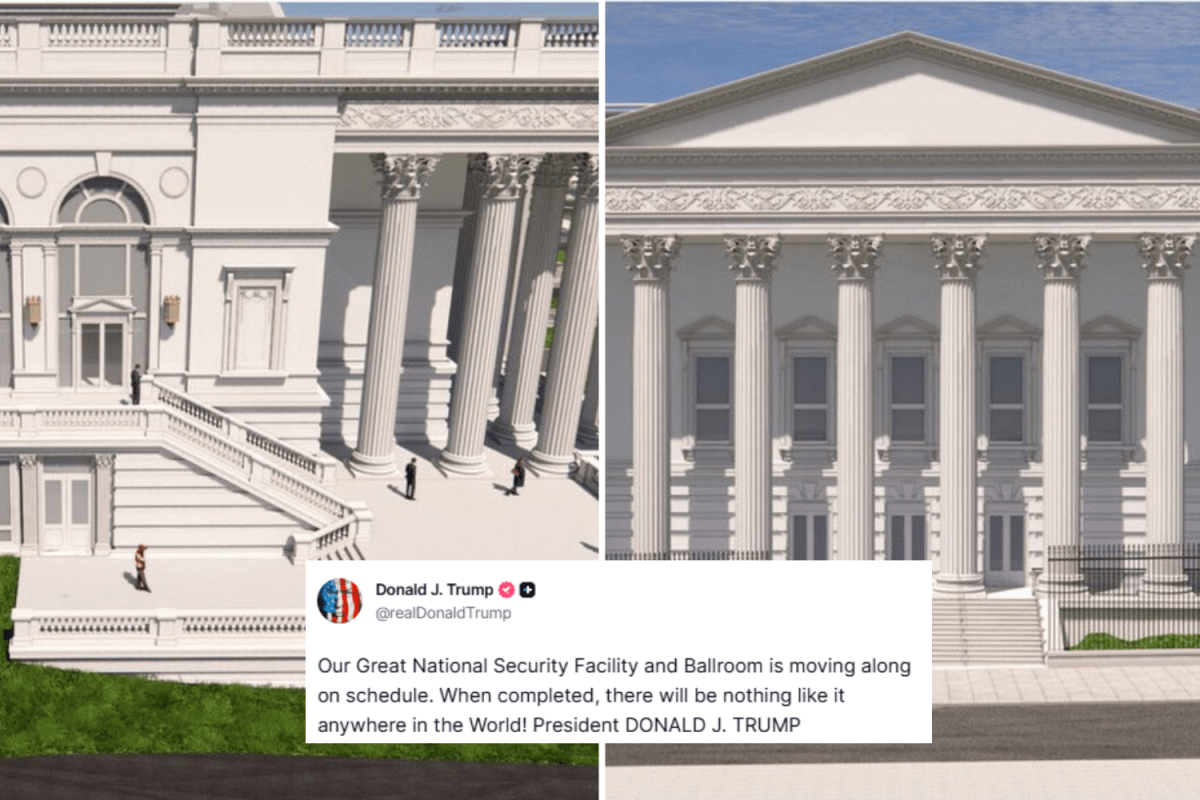
President Donald Trump has released new images of his planned White House ballroom, describing the project as a “Great National Security Facility and Ballroom”—the clearest example yet framing the development as security infrastructure rather than simply an event space.
The White House shared the images on X on June 28, alongside Trump’s statement which he repeated on Truth Social, saying the project was unlike anything “anywhere in the World.”
Newsweek reached out to the White House via email for comment.
The new render images show a large neoclassical-style building with columns, raised steps and a formal façade attached to the White House complex.
“Our Great National Security Facility and Ballroom is moving along on schedule,” Trump wrote on Truth Social. “When completed, there will be nothing like it anywhere in the World!”
The wording effectively merges two strands of messaging that had previously been separate: the ballroom as a venue for large events, and the security-focused infrastructure planned beneath and around it.
Trump and his allies have described the project using terms such as "secure" and "top secret." But the latest post goes further by putting “National Security Facility” first—casting the ballroom as part of a wider defensive complex.
This comes as the project faces a legal challenge from the National Trust for Historic Preservation, which is contesting that justification. The group argues that plans to demolish or significantly alter parts of the East Wing site require explicit congressional approval, and that proceeding without it would violate federal law governing historic and federal properties. This claim sits at the center of the ongoing court battle over the project’s scope and legality.
The security dimension became explicit in late March, when Trump told reporters on board Air Force One that “the military is building a massive complex under the ballroom.”
He described the building as effectively sitting over that structure, which he said would include drone-proofing and other defensive features. He also said the ballroom would use bulletproof glass and hardened materials.
In early April, a federal judge blocked parts of the ballroom construction but allowed work tied to security to continue. The ruling came in response to the legal challenge brought by the National Trust for Historic Preservation, and brought the underground facility into focus.
Court filings from the White House argued the project was “vital” to the safety of the president and warned that halting construction would “imperil” national security.
Those filings listed features such as bomb shelters, blast-resistant materials and secure facilities.
However, the judge later rejected the argument that the entire above-ground ballroom could be justified on national security grounds, stating that “national security is not a blank check” to proceed with otherwise unlawful construction.
An appeals court stayed the ruling within two days, allowing construction on the ballroom to continue while the legal challenge moved forward.
In May, Trump described the project in military terms during a site tour where he said the structure would extend “about six stories deep” and include a military hospital, research facilities and a drone‑capable roof.
He also described hardened construction materials, including “impenetrable” steel and thick protective glass.
At the same time, Republican lawmakers proposed up to $1 billion in federal funding for security upgrades tied to the project.
The proposal quickly ran into resistance on Capitol Hill, with some Republicans questioning the cost and others objecting to linking the ballroom to broader spending legislation.
In June, officials reiterated security justifications in court filings, citing threats such as drone attacks and mass-casualty incidents.
That argument has been complicated by as publicly available documents revealed around $352 million originally allocated to the U.S. Secret Service was had been redirected “White House security measures,” with indications it could support construction linked to the ballroom project. Lawmakers from both parties have raised concerns the shift could amount to taxpayer funding, despite Trump’s repeated insistence the ballroom is being paid for privately.
Trump also highlighted plans for a rooftop “DronePort,” describing it as a system that could help protect Washington, D.C. On June 28, White House officials and Trump refer to the project as the "Great National Security Facility and Ballroom" for the first time.
Reporting and court filings indicate the project includes a significant underground component beneath the former East Wing site, which has been compared to the Presidential Emergency Operations Center (PEOC), constructed during World War II.
The facility came into sharp public focus on September 11, 2001, when then–Vice President Dick Cheney was taken to the PEOC and coordinated with President George W. Bush and national security officials as the attacks unfolded. Trump was also taken to the PEOC in 2020 during George Floyd protests.
The security features themselves are not new; what has changed is how they are being framed.
By calling it a “Great National Security Facility and Ballroom,” Trump appears to be redefining the project as a core piece of national security infrastructure—rather than a controversial White House expansion justified by security concerns.
That shift comes as the project remains under legal scrutiny and political debate over its cost, scope and authorization.
Contact Newsweek editors on this story: Rebecca Flood and Emma Lee-Sang.