
U.S. and Iranian attacks continue as tensions mount on a key waterway in the Red Sea
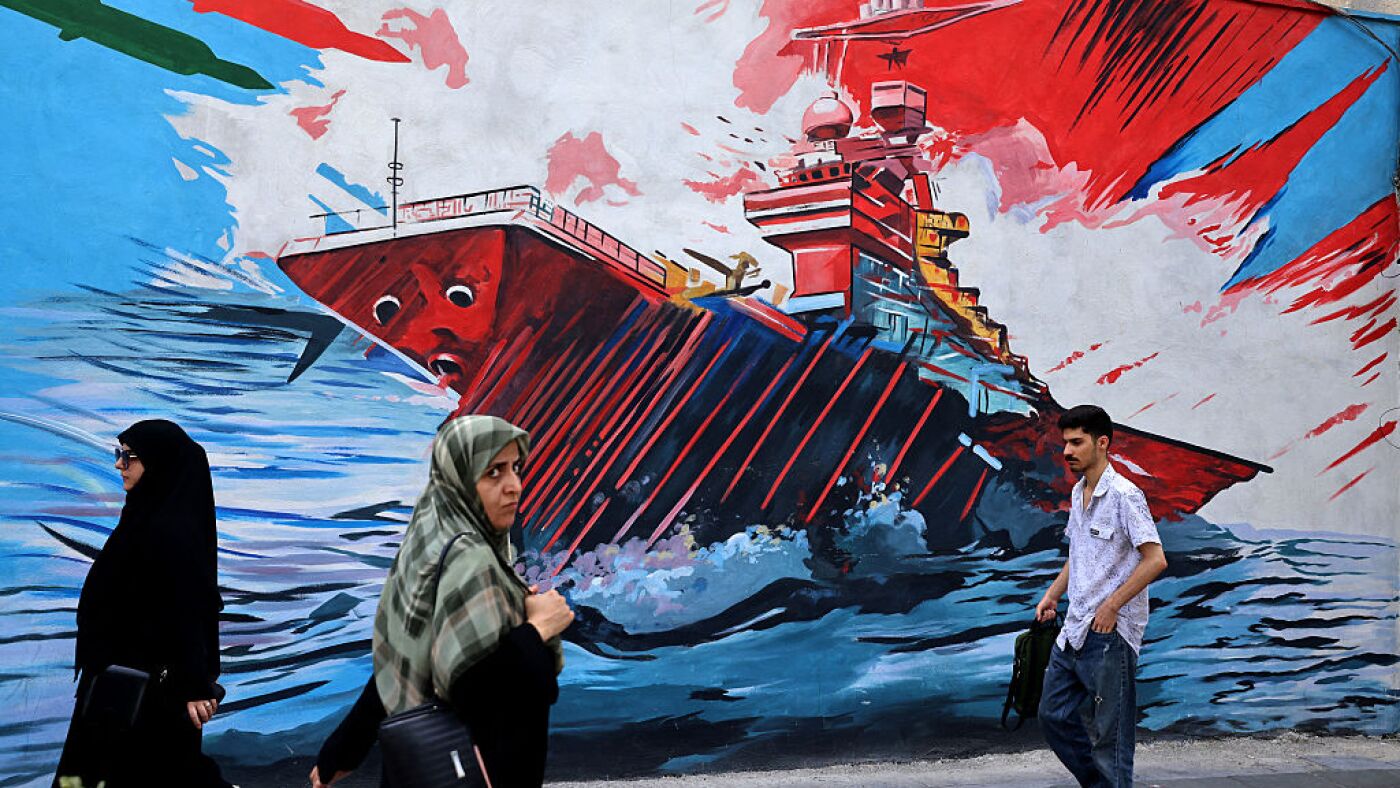
Commuters walk past a wall mural along the street in Tehran on July 21, 2026. Atta Kenare/AFP via Getty Images hide caption
The U.S. military launched more airstrikes on Iran early Wednesday as Iran hit back against U.S. military targets in the Gulf and Jordan.
The attacks overshadowed diplomatic efforts in Pakistan, one of the conflict's mediators, where Iranian Interior Minister Eskander Momeni visited for talks potentially aimed at reviving a collapsed ceasefire between the United States and Iran.
U.S. Central Command said it targeted Iranian military operations centers, maritime capabilities, aircraft hangars, drone storage facilities, and military logistics infrastructure in its 11th consecutive night of attacks. It said the attacks were aimed at degrading Iran's control over the Strait of Hormuz – a vital shipping channel.
Iranian state media reported explosions in seven Iranian provinces and said attacks included a strike on an electrical installation close to a nuclear power plant in Bushehr province.
Oil prices rose again Wednesday in the opening of Asian markets, topping more than $92 per barrel for benchmark crude after Iran attacked a tanker in the Strait of Hormuz.
The British military maritime operations center said a tanker was attacked Tuesday in the disputed area. The Strait of Hormuz is a narrow channel in Iranian and Omani territorial waters but open under international law to freedom of navigation. It has been effectively closed by Iran since the start of the war.
Contributing to market nervousness over global oil and gas supplies, Yemen's Houthi rebels, backed by Iran, declared that Bab el-Mandab, a Red Sea waterway crucial to Saudi Arabia's exports, would be off limits to that country. The group also warned international shipping companies to avoid this waterway. It connects the Red Sea to the Gulf of Aden and the Indian Ocean, and to the Suez canal and the Mediterranean Sea.
The Houthis' Ansar Allah (Partisans of God) military and political movement controls the north and center of Yemen, including the capital Sanaa. An internationally recognized Yemeni government, supported by Saudi Arabia, controls the south.
The Shia Muslim Houthis are backed by Iran and a key part of Iran's "axis of resistance," which has joined in attacks on U.S. and Israeli targets.
The Houthi-run news agency said six ships in the Red Sea turned course on Tuesday after it issued the warning. Commercial shipping trackers said several tankers loaded with Saudi oil backed out of the waterway to avoid attack.
The latest round of strikes came after President Trump told reporters Tuesday that the U.S. was planning to target a fortified underground site near one of Iran's main uranium enrichment facilities. Iranian state media said Iran would consider any attack on nuclear or "other sensitive facilities" a major escalation.
Trump also said that the Iranians "want to meet desperately to try and end it because they are getting decimated." He added, "until they're ready to meet in a meaningful way, we have no interest."
Meanwhile, Iran has said that while it is potentially open to negotiations if they safeguard Iran's national interests, it does not trust the United States.
Iran said Wednesday it again targeted an air base in eastern Jordan where three U.S. military personnel were killed in an attack last week. Iran also hit the Sheikh Isa air base in Bahrain, a logistical hub for the U.S. Navy's Fifth Fleet.
The Pentagon identified on Tuesday the third service member who was killed in Jordan as Sgt. Angel S. Rampersad, 28, of Ozone Park, N.Y., bringing the number of U.S. casualties killed during the Iran war to 18. She had been reported as missing after the direct missile hit on Friday.
Iran's government says about 3,000 people in Iran, many of them civilians, have been killed in the war.
Iranian media reported that body fragments of 32 victims of a bombing on an Iranian elementary girls' school nearly five months ago, identified after DNA tests, were laid to rest Wednesday. Iranian state-run Press TV said they were buried in the Minab cemetery.
Iran says 168 students and teachers were killed in a U.S. missile strike on the school in southern Iran on Feb. 28. The U.S. military says it is investigating the attack.
Jordan said it intercepted six Iranian missiles on Wednesday, with two of them falling in remote, uninhabited areas.
The Israeli military said it detected an attack Wednesday on Aqaba, the Red Sea resort in Jordan, immediately next to the Israeli city of Eilat, but did not intervene as the missile did not threaten Israel.
Iran attacked U.S. military targets at the Aqaba airport earlier this week.
Trump in remarks Tuesday appeared to blame Jordan – a small kingdom which is a U.S. security ally – for the deaths of U.S. personnel at the remote Muwafaq al-Salti air base in north-eastern Jordan.
"They did slip something through in Jordan," he said, referring to Iranian missiles. "And if we had other operators, you know, would not have happened unfortunately."
The U.S. operates its own air defenses within the Jordanian base, backed by the Jordanian air force. It was not clear what Trump was referring to.