
UK announces billions for drones and touts European defence projects
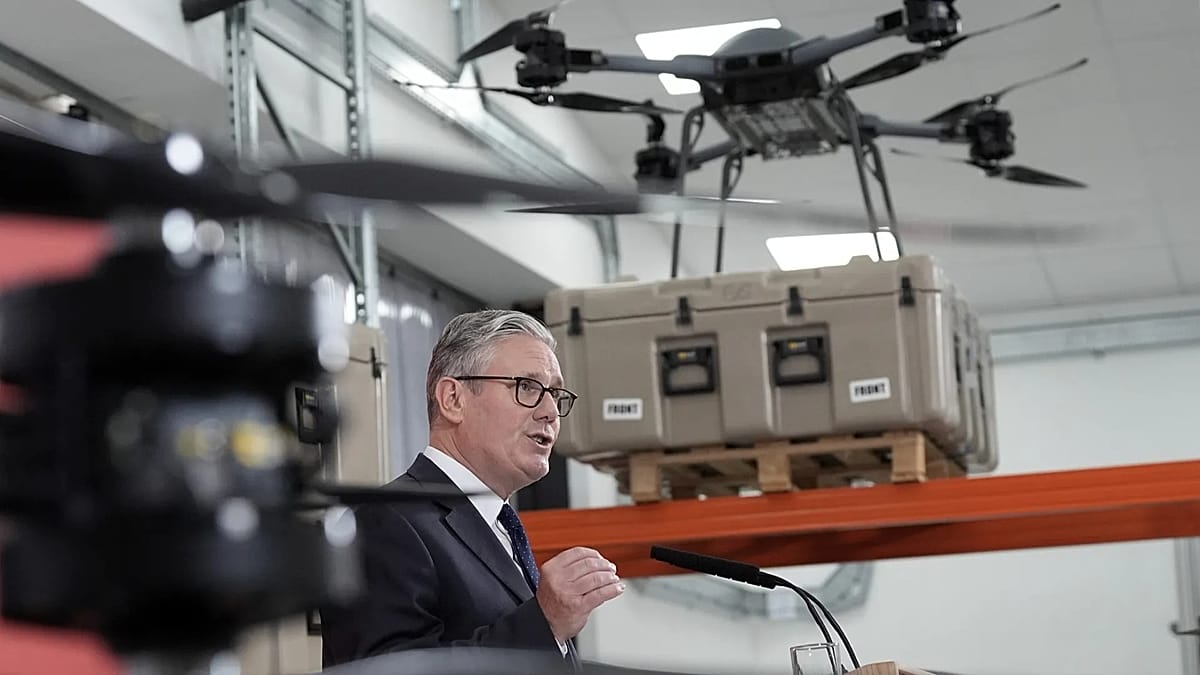
British Prime Minister Keir Starmer has at last presented his government's Defence Investment Plan, a spending programme that aims to ensure Britain’s military future by raising defence investments to £80 billion (€92.8 billion) a year by 2029.
Building and buying stealth fighter jets, submarines and warheads are all on the menu, with £5 billion (€5.8 million) allocated solely for the development of drones, a move Starmer hailed as “the largest ever UK investment in this technology”.
“We will build an army that is ten times more lethal, with attack drones flying alongside our Apache helicopters, a new fleet of surveillance drones collecting intelligence and finding targets and a surge in low-cost one-way attack drones which have proved so effective in Ukraine,” he said at a press conference on Tuesday.
The new spending will emphasise autonomous vehicles, such as a “hybrid” Royal Navy vessels utilising artificial intelligence and smaller autonomous aircraft flying alongside RAF Typhoon combat planes that are “invisible” to radar systems.
Drones will also be tested at the “Uncrewed Systems Centre” — a 50,632 square metre facility touted as Europe’s largest drone testing facility.
Starmer used his speech to directly point the finger at Russia, a country identified by various intelligence services as preparing to mount an attack on a NATO ally by 2030.
He reiterated that if Russia continues its full-scale invasion of Ukraine, and pushes past the war-torn country’s border, Europe may be in the Kremlin’s line of sight.
“If Russia were to win in Ukraine, Putin would not stop there but turn his gaze to other allies, bringing even greater instability to our continent, even greater impacts on our security and the cost of living and an even greater need to mobilise yet more resources for our defence,” Starmer said.
In April, the UK's then-Defence Secretary John Healey warned that three Russian submarines had conducted a clandestine operation over pipelines and cables in waters just north of the UK, mirroring similar cable-cutting incidents across Europe, particularly in the Baltic Sea. Britain and Norway are already developing frigates to hunt Russian submarines that enter European waters.
In a stunning turn of events, Healey resigned two weeks before the defence plan was announced by Starmer over concerns that not enough money was being allocated to support the country’s security and meet the new NATO commitment of 3.5 percent of GDP to be spent annually on defence by 2035.
In his resignation letter, Healey wrote that the original defence sum in the blueprint fell “well short” of what is required “at this dangerous time”.
The prime minister reiterated on Tuesday his view the investment plan is sufficient to support both Britain and Europe more broadly.
“(We are) maintaining our role in guaranteeing British and European security and leaving our country in a much better and much stronger state than we found it,” he said.
But speaking in Parliament on Tuesday after the plan was unveiled, Healey repeated that the spending programme does not go far enough, warning that the UK needs "to develop a clear, credible funding plan" before it faces a Russian attack.
Starmer said the plan aims to bolster European defence decision-making and will have input from the Europeans, such as the development of “deep precision strike weapons” in partnership with Germany.
The plan comes as the US is signalling it will review its defence posture within Europe, prompting allies to step up to the plate.
Euronews asked the Ministry of Defence whether the EU will have any involvement with the plan through the development or testing of capabilities. In response, a spokesperson pointed to comments Starmer had made earlier in the day without providing specifics.
The UK's new plan is being made public just before the 2026 NATO summit in Ankara on 7-8 July. NATO Secretary General Mark Rutte said that the first day of the summit will be an opportunity for the alliance’s 32 members to sign “massive amounts of new contracts, MOUs (and) letters of intent” to meet defence spending goals.