
UK 'ready to defend itself' after Iran says bases are 'legitimate targets'
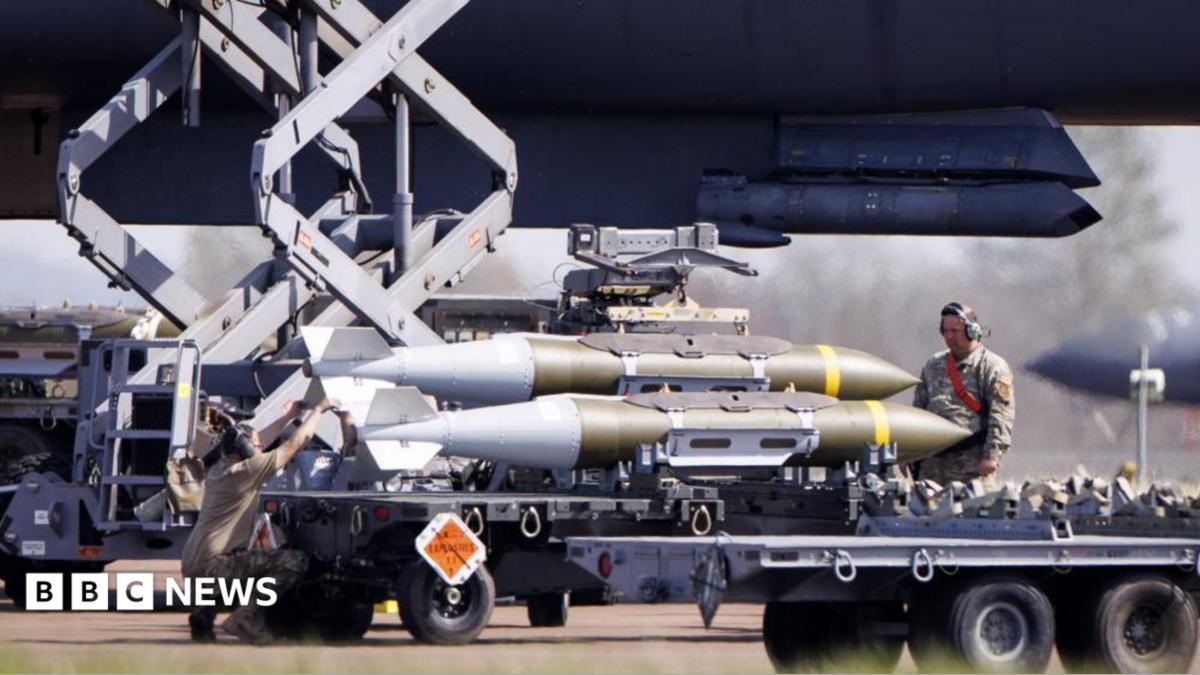
The British government has said it "stands ready 24/7 to defend itself" after Iran said UK bases used by the US were considered "legitimate targets".
The UK has allowed the US to launch "defensive" operations from British bases hosting American personnel and aircraft, while refusing to cooperate in offensive operations against Iran.
Iran's foreign ministry said the UK was an "accomplice" in the US war, while the powerful Islamic Revolution Guards Corps (IRGC) military wing said any country which supports the US militarily "will be responsible for the consequences and repercussions".
It came after the US carried out a 12th consecutive night of strikes against targets in Iran.
While US President Donald Trump has repeatedly criticised the British government and former Prime Minister Sir Keir Starmer for what he has deemed a lack of support for his war, Iran's comments on 23 July sought to paint the UK as a party to the campaign.
In March, days into the US-Israel led war, permission was given to the US for it to use British bases including RAF Fairford in Gloucestershire and Diego Garcia in the Indian Ocean to target Iranian military infrastructure used to attack Gulf countries and vessels in the Strait of Hormuz.
That policy has not been altered by new Prime Minister Andy Burnham, who was notified last week that a decision had been taken to extend the agreement with the US.
In a statement published on the IRGC-linked Tasnim News Agency on 23 July, the group said American bombing missions had been launched from RAF Fairford two days earlier.
The UK Ministry of Defence has not commented on whether the base was used by the US for operations against Iran this week.
Responding to the Iranian threats, a UK government spokesperson said: "Our Armed Forces are ready to keep the United Kingdom safe from any kind of attacks, whether it's on our soil or from abroad. The UK stands ready 24/7 to defend itself.
"This includes through operating a layered approach to air and missile defence, provided by Royal Navy, British Army and Royal Air Force assets equipped with a range of advanced capabilities, working closely with our Nato allies.
"The UK's approach to the conflict remains the same - we are committed to defending our people, our interests and our allies, acting in accordance with international law and not getting drawn into the wider conflict."
Days after the war began on 28 February, Iran's ambassador to London, Seyed Ali Mousavi, said Iran would have the "right to self-defence" if the UK joined the war, and said it should be "very careful" about taking part.
On 19 March, Iran fired two ballistic missiles at the UK's Diego Garcia base in the Chagos Islands. One reportedly failed mid-flight, with the other shot down by a US airship.
There were doubts then over whether Iran had missiles which were capable of reaching the archipelago, which is about 2,360 miles (3,600km) from Iran.
The same month, Israel claimed Iran possessed missiles that could reach up to 4,000km (2,485 miles), which would theoretically mean they could reach the UK and mainland European countries.
However, then Housing Secretary Steve Reed told BBC News at the time there was "no specific assessment that the Iranians are targeting the UK - or even could if they wanted to".
Analysts have also raised doubts over the reliability and accuracy of Iran's missile arsenal, which the US says has been severely degraded by its strikes.
Iran has launched strikes against several countries in the Gulf which house US military bases in recent months, while attacks against civilian vessels in the Strait of Hormuz have effectively closed the vital shipping route.