
Ukraine hits major oil terminal in Russia's St Petersburg
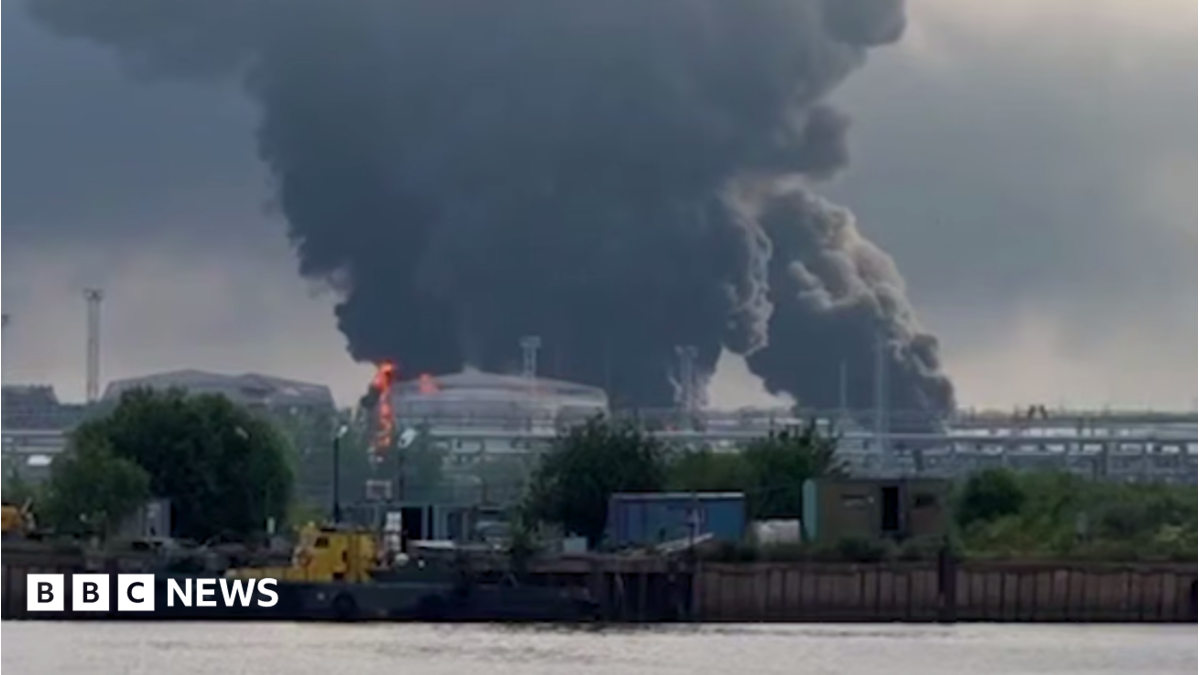
A major oil terminal in Russia's second city of St Petersburg in the north-west was struck overnight by Ukraine, President Volodymyr Zelensky has said.
He described it as key "infrastructure that generates revenue for Russia's war". Ukraine also said a major Russian naval base in the region was hit.
St Petersburg Governor Aleksandr Beglov said the city was under a "massive" drone attack, admitting the oil terminal was hit. He reported no casualties.
Ukraine has recently intensified its long-range drone attacks on Russia's critical energy infrastructure, causing widespread fuel shortages. Kyiv says nearly 43% of Russia's oil refining capacity has been "disabled" as a result.
The claim has not been independently verified.
Ukraine says Russian oil and gas facilities are legitimate targets as Moscow relies heavily on fossil fuel exports to continue its war effort.
Russian President Vladimir Putin - who last week made a rare admission of fuel shortages caused by Ukrainian attacks - on Saturday signed into law a bill aimed at boosting supplies to the domestic fuel market.
Putin launched a full-scale invasion of Ukraine in February 2022.
Zelensky said on Saturday morning that the targets hit in St Petersburg and the surrounding region were about 850km (528 miles) from Ukraine's border.
The extent of the damage was not immediately clear, but a video posted by the Ukrainian president showed a drone flying towards a target and a huge column of black smoke billowing from the area after the strike.
The BBC later verified that St Petersburg's oil terminal was hit.
Ukraine's military described the terminal as "one of the largest" in Russia, capable of producing 12.5 million tonnes of petroleum products per year.
The military also said a key naval base of the Russian Baltic Fleet in Kronstadt was hit.
Russia has not publicly commented on the claim.
Governor Beglov said that 72 Ukrainian drones were shot down over St Petersburg and the wider Leningrad region.
He urged city residents to stay indoors until the drone threat was lifted. Mobile internet services might also be disrupted, he warned.
More than five million people live in St Petersburg.
In a separate development on Saturday, Ukraine's military denied that the key eastern Ukrainian town of Kostyantynivka was now under full Russian control.
Military spokesman Maj Andriy Kovalyov told the BBC that "Kostyantynivka remains under the control of the Defence Forces of Ukraine".
He admitted that there were "cases of infiltration by small infantry groups deep into the combat formations of our forces", but added that those groups were being identified and destroyed.
His comments came a day after Putin said that Russian control had been established over the town of Kostyantynivka in June.
The Kremlin leader provided no evidence to back his claim.
Later on Saturday, Zelensky wrote on Telegram: "If Kostyantynivka is now under Russian control, then Putin will probably have no problem meeting me there and finding diplomatic solutions to finally end the war. But still, he will not cross the front line: the truth is very different from Putin's words."
Kostyantynivka is one of several heavily-fortified towns that make up Ukraine's "fortress belt" in the Donetsk region, most of which is occupied by Russia.
In its latest operational bulletin on Saturday afternoon, the Russian defence ministry said it had shot down more than 500 Ukrainian drones and missiles launched overnight and in the morning.
It described the Ukrainian attacks as an attempt by Zelensky to "distract the attention" of Ukrainians and "foreign sponsors" from the consequences of one of the biggest and deadliest Russian strikes on Ukraine's capital Kyiv on 2 July and also a "catastrophic failure" of Ukrainian forces in Kostyantynivka.
Ukrainian attacks on Russian civilian facilities "will not go unanswered", the ministry said.