
US-Africa health deals: Why some nations are turning down Trump's money
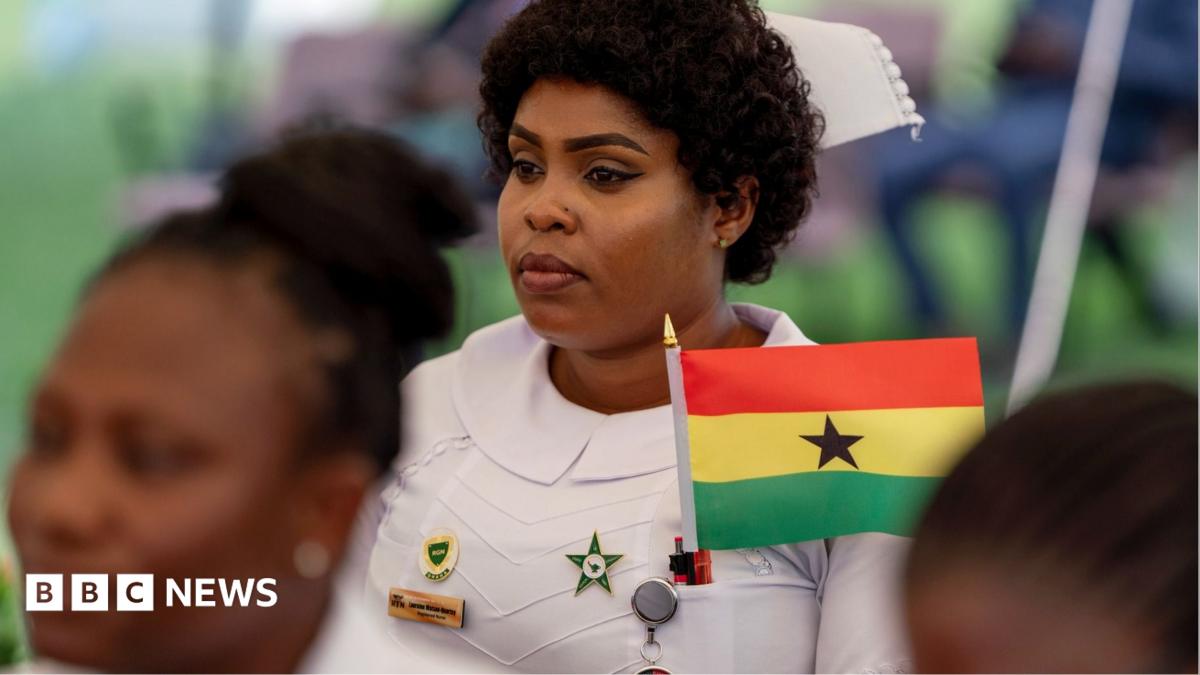
After dismantling the main US body for delivering foreign assistance last year, the Trump administration is again offering hundreds of millions of dollars to African countries to support their healthcare structures and help fight disease.
But the new deals come with conditions attached and as a result, face resistance from some governments.
When the initial agreement was signed by Kenya's President William Ruto in Washington last December, US Secretary of State Marco Rubio said he hoped it would be the first of many.
"We hope to sign, I don't know, 30, 40, how many? Fifty? Well, this is number one. We'll always remember this one… and we think we've picked the perfect partner," Rubio declared.
But even this landmark deal with Kenya, worth $2.5bn (£1.9bn), has been delayed by activists who went to court to block it, although cabinet ministers did finally approve it last month.
Shortly after taking office, President Donald Trump ordered the closure of the US Agency for International Development (USAID) amid accusations of wastefulness, in the process decimating health programmes in some African countries that relied on American funding.
The State Department's new global health strategy requires recipient governments to share responsibility by increasing their own health spending, with the goal of building durable systems that can eventually be self-reliant. It is, for example, contributing $1.6bn to the overall deal with Kenya, external - with the East African nation pledging $850m over five years.
The Trump administration hopes that partnering with national leaderships will improve on traditional donor-NGO relationships which it says created dependency, led to parallel delivery arrangements and sucked up aid dollars in overhead costs.
The deal signed by Kenya's President William Ruto and Secretary of State Marco Rubio sees the US contributing $1.6bn and Kenya $850m over five years
"Our aid to those countries will not just be dollars distributed to an NGO who then will go into the country and impose programmes," Rubio told a congressional committee last month.
"Not only are we treating the acute situations on the ground of people that are sick, we are helping them build the capacity and the capability to do this for themselves."
But the result is a shift away from a model of global cooperation anchored in the World Health Organization (WHO), to direct agreements with individual governments that are tied to US strategic and commercial interests.
The US withdrew from the WHO early this year saying it was unfair that Washington provided so much more funding than other countries and alleging that the organisation mismanaged the Covid-19 crisis, lacked transparency, and was susceptible to political influence.
Controversially, the American bilateral deals come with an explicit promise to prioritise US pharmaceuticals and medical firms to develop and deliver treatments.
"Our global health foreign assistance programme is not just aid - it is a strategic mechanism to further our bilateral interests around the world," says the policy document.
Thirty-two countries had accepted the health Memorandums of Understanding (MOU) by mid-May, in Latin America, the Caribbean and at least 20 in Africa. But some - such as Ghana, Zimbabwe and Zambia - have resisted signing up, citing different reasons.
In Zambia, Foreign Minister Mulambo Haimbe criticised what he described as an American effort to link health funding to US economic interests by connecting the deal to a separate agreement giving Washington access to critical minerals.
"Our [US] colleagues looked at it from the perspective that [the two deals] must be taken as a package to be negotiated and concluded at one particular time," he told the BBC, saying the Zambian government wanted to discuss them separately on their own merits.
"The US felt that there is need for there to be a preferential treatment in the use of critical minerals. And the framework was to reflect that," he added.
The State Department stopped short of explicitly linking the two when questioned by the BBC but offered a robust "America First" response.
"The Trump administration has made clear, US foreign assistance is not charity - rather it is strategic capital to be wisely invested to advance US interests - and we expect all of our allies and recipient nations to take seriously American strategic and commercial priorities," a department spokesperson said.
Last month provided further evidence of this readiness to tie health financing to American priorities - with the announcement that the US would withdraw completely from funding HIV/Aids programmes in South Africa.
An administration official connected the move to Pretoria's "failure to make demonstrable progress on policy requests", including apparently the treatment of the white-minority Afrikaner community. US claims that a "white genocide" is taking place in South Africa have been widely discredited.
For some African countries who were negotiating the bilateral MOUs, it was concerns over US access to health data which set alarm bells ringing. This included patients' information as well as biological resources known as pathogens - organisms that cause disease such as viruses, bacteria and parasites.
At the time the US-Zimbabwe deal fell through, the US ambassador said 1.2 million Zimbabweans were receiving HIV treatment through programmes it supported
A Kenyan court initially suspended the country's deal after legal challenges demanding protection of patient privacy.
Arnold Kavaarpuo, executive director of Ghana's Data Protection Commission, told the BBC the government in Accra had objected to the deal it was offered for similar reasons.
"We had concerns around the scope and breadth of data that was being required," he said.
"It was us generating data and passing it on to the US authorities, and there were no real reciprocal measures when it comes to the protection of Ghanaian data and Ghanaian sovereignty.
"And so from our perspective," he added, "once the data left the Ghanaian borders, we had no control over what becomes of it."
Zimbabwe also cited concerns about requests for medical data, presumably to be shared with US pharmaceutical companies, as the reason it rejected a deal.
There were no guarantees that drugs or vaccines developed from the pathogens would be available to its people, a government spokesman said, pointing out that the WHO already had a system for members to share data and benefit from any treatments in future pandemics.
African countries have previously passed on medical information through existing schemes including USAID and Pepfar, America's main programme to tackle HIV and Aids.
The US insists the sharing of data and specimens is key to continuing scientific development and mutual co-operation.
And a State Department spokesperson said the material requested was the same aggregated and de-identified data which has been used for years in the fight against infectious diseases.
What has changed is the context, says Nelson Aghogho Evaborhene, a PhD fellow in global health governance at Roskilde University in Denmark.
"It was an unequal relationship, but it was quite tolerable politically," he says, "because you could sell it to the domestic population as an altruistic need to improve health service.
"But now it has changed significantly, because it's more about very transactional leverage."
Many African nations have also drawn lessons from Covid, as the race to find a vaccine proved the value of pathogen data but left the continent struggling to get doses for its people.
"I think one of our biggest opportunities as Africa," says Aggrey Aluso, the executive director of Resilience Action Network Africa (Rana), "is the fact that we have important information that can help build the global health security ecosystem."
Rana joined more than 50 civil society groups in signing an open letter warning African leaders that US terms were not guided by African national or regional interests, a view shared by South Africa.
"Frankly speaking, no nation on Earth that respects itself should accede to [two requests]," South Africa's Health Minister Dr Aaron Motsoaledi told the BBC.
"That [the US] will get their pathogen if there's any pandemic or epidemic in their area.
"And they'll also provide them with a genome for life. But the US is going to give them money for five years."
The debate over health diplomacy has been thrown into sharper relief in recent weeks following the spread of a new outbreak of Ebola in the Democratic Republic of Congo.
DR Congo was one of the first countries to accept the new American health deals - and the US says the agreement is helping co-ordinate Kinshasa's response to the crisis.
But, according to humanitarian workers and former US health officials, sweeping US aid cuts to DR Congo and to the WHO seriously weakened the front-line response.
Amadou Bocoum, the DR Congo country director for the international humanitarian organisation Care, says he had to lay off 36 workers - a third of his staff - after USAID cuts, including those responsible for community mobilisation, health education and Ebola prevention.
"When this new Ebola came, the staffing was not there, and the emergency stock that we also used to have was also not there," he says.
"With proper funding, we would have had prepositioned stock and begun distributing critical supplies like PPE from day one, but instead, we started with nothing and lost 10 days."
Critics describe the dismantling of the USAID as a blow to the speed of detecting the Ebola outbreak and the scale of response, emphasising that the humanitarian agency was crucial to organising logistics, supplies and local outreach.
"I just cannot imagine that if you still had the full slate of health partners that the US government was funding in Congo up until [the cuts] shut most of that down, that no-one would have seen that an unidentified viral haemorrhagic fever was spreading," adds Jeremy Konyndyk, who led the USAID response to the 2014 Ebola epidemic in West Africa.
The US denies its cuts have harmed efforts this time, arguing that they are more "aligned and effective" under the new arrangement and pointing to the $270m it has donated to tackle the epidemic.
Underpinning the US deals is the administration's desire to encourage national governments to spend more of their own money on their health services - observers say there is a poor record of this in Africa, despite a continental commitment to do so in 2001.
But others warn that the Ebola outbreak has highlighted the risks of a bilateral approach to global health.
"Bilateral relationships ignore collective challenges," says Dr Kevin DeCock, a former director at the US Centers for Disease Control (CDC) who worked for many years at the forefront of battling infectious disease.
"Global health, by definition, is transnational, crosses borders, does not concern just one country. Global health problems require global approaches, and no country can go it alone."
Some health and foreign policy analysts have made a case for giving the administration's new strategy a chance.
In an article for conservative think-tank the American Enterprise Institute, Brett Schaefer and Roger Bate acknowledge the risk of stepping away from the multilateral system, especially the withdrawal from the WHO.
But this "is not the end of American leadership in global health", they write. "It is the start of a test - of whether influence is better exercised through conditional engagement, parallel institutions and results-driven partnerships than through deference to an organisation that has struggled to learn from failure."
Evidence so far is that months on from Rubio's excited signing of the first MOU, adoption of the bilateral agreements in Africa remains patchy and controversial.
Tanzania has just signed up to the partnership, yet with several African nations saying thanks but no thanks, it remains to be seen how far the reshaping of America's global health strategy will go.
Go to BBCAfrica.com, external for more news from the African continent.