
US sends more aid in final critical hours of Venezuela rescues
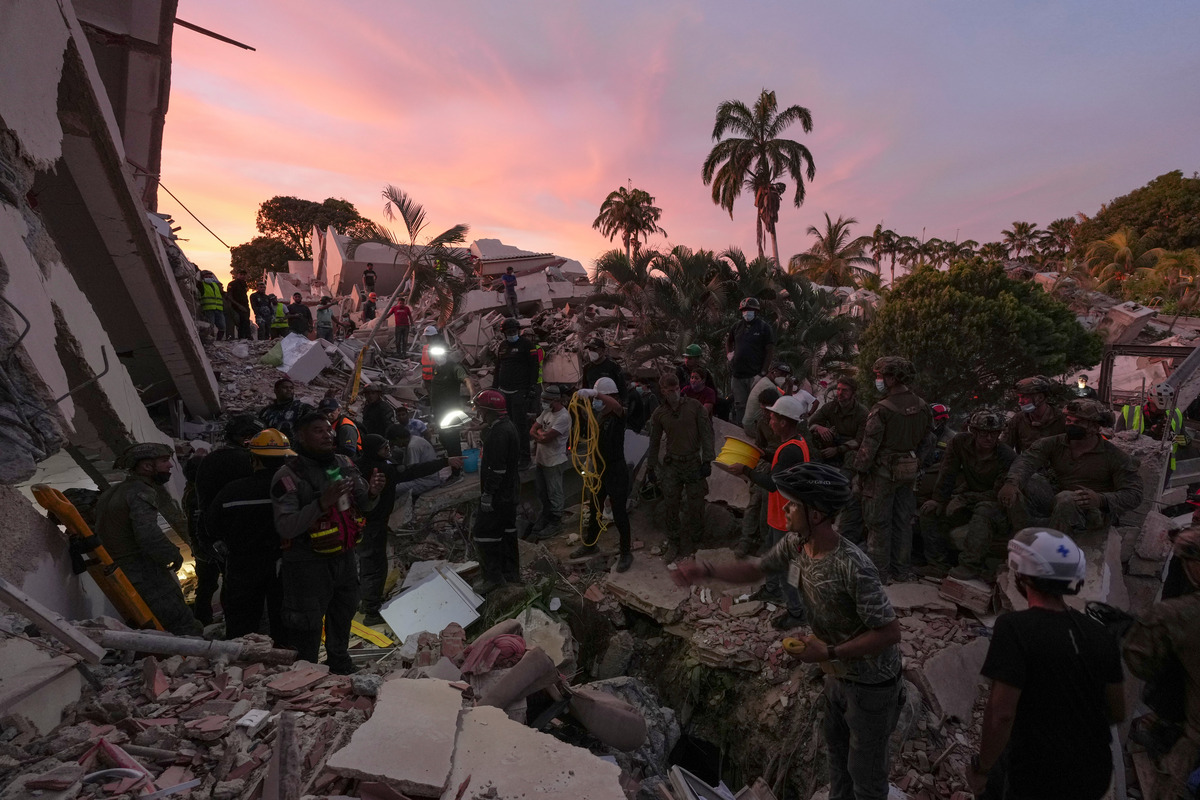
Hopes of finding more survivors buried in the rubble of northern Venezuela are fading fast, five days after two powerful earthquakes struck the South American country and killed at least 1,450 people.
Families have reported at least 68,900 people unaccounted for following the twin magnitude 7.2 and 7.5 earthquakes that struck northern Venezuela on June 24. Modeling from the U.S. Geological Survey suggests the final death toll could be several thousand.
Local volunteers and international teams, including additional American emergency responders who arrived on Sunday, are working around and against the clock to locate anyone still breathing. More U.S. personnel are expected to arrive in the devastated country on Monday.
But anger is growing toward acting Venezuelan president Delcy Rodríguez and her government over the state's response to the disaster, particularly in La Guaira—the area hit hardest by the twin quakes on Wednesday evening, just north of the capital, Caracas.
Rodríguez took over as interim Venezuelan leader shortly after U.S. forces swept into Caracas and captured former president Nicolás Maduro in January.
But Maduro's ex-deputy is contending with powerful U.S. influence in the country, rising disappointment over a lack of change from the socialist regime and a still-shuddering economy, on top of the humanitarian fallout from the most devastating earthquakes in more than a century.
Much of Venezuela's infrastructure, including its hospitals and roads, had already atrophied after years of underinvestment and aftershocks have run through the country in the days after the twin quakes.
Meanwhile, time is running out in the search for any remaining survivors trapped in the bones of collapsed buildings, even as those surveying the damage along Venezuela's coastline, or throwing bricks to the side with their bare hands, say the grim conditions are becoming overwhelming.
Emergency responders often talk about a "72-hour window" after a natural disaster, because it's much less likely people will survive beyond three days if they haven't had access to water, medical help or food.
But flickers of hope remain, even more than a day past this unofficial cut-off. El Salvador's president, Nayib Bukele, said on Monday a 21-year-old, named as Aaron Levi Cantillo Vargas, had been rescued alive by Venezuelan, Mexican and Salvadoran teams working "tirelessly" in La Guaira.
Hours earlier, he had been located and fed fluids by a doctor, and was quickly given specialist medical care, Bukele said. The body of a deceased victim lay between Cantillo and his rescuers, making it harder to reach him, Bukele added.
On Sunday, a man and his son were pulled to safety as Rodríguez committed to plugging away with rescue operations.
"We always maintain hope," Rodríguez said in a televised address.
A day earlier, the U.S. said American teams pulled an infant from the debris, sharing a clip showing a young child wrapped in a blanket surrounded by hard hat-clad rescuers wearing U.S. flags on their uniform and local firefighters.
"Against impossible odds, hope endures," the U.S. State Department said.
Dayana Patino, a resident of La Guaira who was stuck in the remains of her destroyed home with her 18-day-old baby, said in an interview by the BBC after she was rescued that she had been determined to stay alive for her son. She sustained injuries to her legs, but newborn Juan David escaped largely unscathed. Footage of her rescue was shared on social media.
The U.S. quickly pledged to send search and rescue teams, as well as medical supplies and unspecified humanitarian assistance to Venezuela in the hours after the earthquakes struck.
Several different branches of the U.S. military have been involved in American relief efforts, as well as teams from the U.S. State Department working alongside international organizations, delegations from other countries and local authorities.
But some experts say the U.S. response would have been faster and more effective if President Donald Trump's administration hadn't shuttered the doors of the U.S. Agency for International Development (USAID), which had been the biggest funding agency for humanitarian and development assistance across the world before it was officially closed 17 months ago.
While USAID workers would have arrived in Venezuela within hours of the earthquakes, there's no longer any coordinated way for the U.S. to respond quickly in these situations, Christopher Sabatini, the director of the Latin America program at the influential Chatham House think tank who formerly worked at USAID, told Newsweek last week.
Newsweek has contacted the White House via email for comment.
The U.S. Space Force has provided satellite imagery of the areas most impacted, and the U.S. Southern Command—which oversees all U.S. military activity in Latin America and the Caribbean—said on Sunday another 100 U.S. personnel from the U.S. Air Force's rapid reaction team, known as the Contingency Response Element (CRE), had arrived to help Venezuela's authorities get supplies in and out of the country's main international transport hub.
The Simón Bolívar International Airport was shut down shortly after the earthquakes hit, footage quickly emerging of ceiling panels tumbling toward panicked travelers.
The U.S. military said in a statement on Sunday another five C-17 Globemaster cargo aircraft were en route to Venezuela, while other cargo aircraft and helicopters able to carry large amounts of aid and personnel are already at work. C-17s usually carry troops, tanks and armored vehicles, but can carry vast quantities of life-saving supplies in an emergency.
U.S. sailors aboard the USS Fort Lauderdale, a warship designed to quickly get U.S. Marines onto foreign shores in military operations, delivered aid to La Guaira's port on Sunday by traveling to the coast on a smaller landing craft, the U.S. military said. Marine helicopters are also dropping off State Department personnel working on relief efforts.
Another 130 Marines are expected to arrive in La Guaira's port on Monday to make sure new aid can reach Venezuela's most impacted areas by sea routes, the military said. The U.S. has also sent Army helicopters and soldiers with Joint Task Force-Bravo, a specialist task force trained for quick-reaction operations in Latin America.
Update 6/29/2026 at 11 a.m. ET: This article was updated with additional information.