
Uzbek refugees flee Kyrgyzstan violence
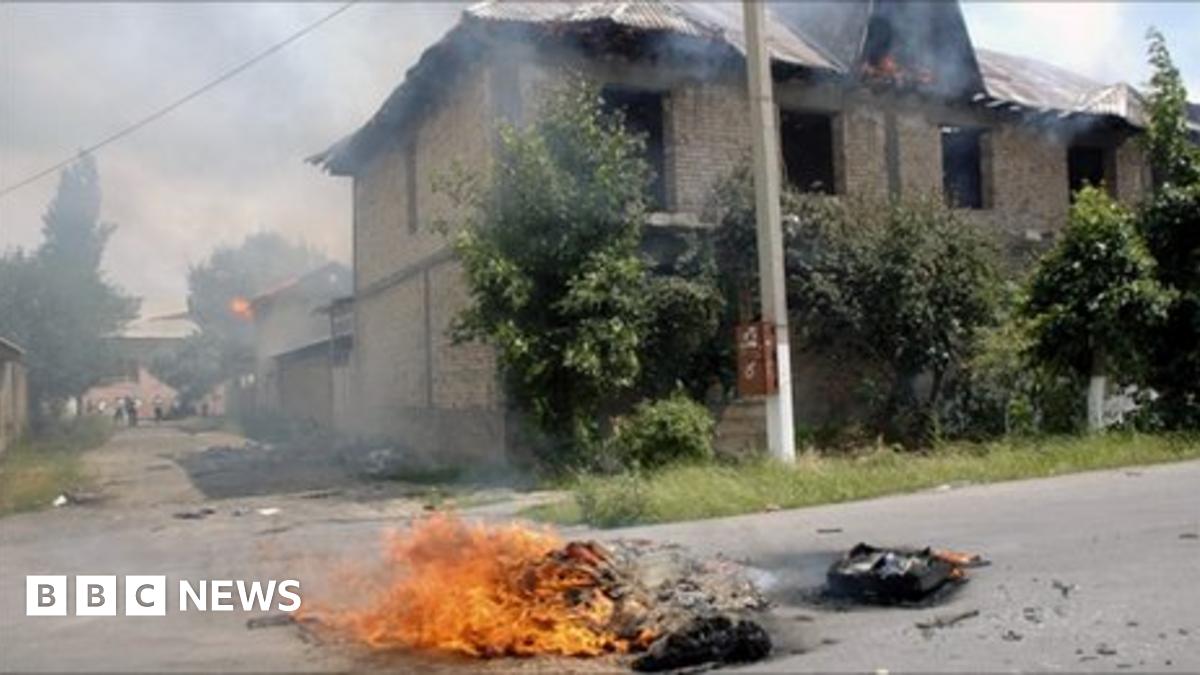
Thousands of ethnic Uzbeks have massed at the Uzbekistan border in an attempt to escape violence in Kyrgyzstan which has left at least 138 dead.
Reports suggest that Uzbekistan is considering closing its borders as the build-up continues, despite requests by the UN to keep it open.
The United States has called for a "co-ordinated international response" to the violence.
At least 1,761 people have been injured in four days of clashes.
The unrest - which broke out overnight Thursday between Kyrgyz and minority Uzbeks in the southern cities of Osh and Jalalabad - is the worst ethnic violence in Kyrgyzstan in 20 years.
The south of Kyrgyzstan, an ex-Soviet Central Asian state of 5.5 million people, is home to an ethnic Uzbek minority of almost one million.
It is unclear what has sparked the violence, which comes two months after ex-President Kurmanbek Bakiyev was ousted in a violent uprising.
Kyrgyzstan has appealed to Russia for military support, and the UN Security Council is also being briefed on the situation, according to officials.
British authorities have meanwhile arrested Mr Bakiyev's son, who is wanted by the Kyrgyz interim government for alleged corruption.
The International Committee for the Red Cross (ICRC) earlier said that an estimated 80,000 Uzbeks have crossed into Uzbekistan from Kyrgyzstan, while about 15,000 are waiting on the border.
Camps have been set up in Uzbekistan to cope with the influx of refugees.
Most were women, children and the elderly, many of whom reportedly had gunshot wounds.
The UN refugee agency says it is providing aid to about 75,000 people.
Earlier on Monday, the Collective Security Treaty Organisation (CSTO), a regional grouping of former Soviet states, reached an outline agreement on measures to take as a response to the crisis.
No details have been released of the plans, but a Russian official has told the BBC that Moscow would not rule out sending peacekeeping troops.
Kyrgyzstan has asked Russia for troops, but it has so far refused. Correspondents say Moscow is reluctant to act unilaterally, although it has sent at least 150 paratroopers to protect its military facilities in the north of Kyrgyzstan.
Both the US and Russia have military bases in the north of Kyrgyzstan, and the country is also an important transit point for Nato troops en route to Afghanistan.
Mr Bakiyev, who was ousted in April, has called on the CSTO to send forces, claiming that Kyrgyzstan's interim government had been ineffective.
Separately, the ousted president's son, Maxim Bakiyev, has reportedly been arrested in the UK on an Interpol warrant, the AFP news agency cited Kyrgyz officials as saying.
Keneshbek Duyichebayev, the chief of Kyrgyzstan national security council, told local TV that Maxim Bakiyev was detained on his arrival at Farnborough airport.
The Home Office in London has declined to comment.
In Kyrgyzstan, sporadic attacks continued on Monday in the southern cities of Osh and Jalalabad, amid further accusations that Kyrgyzstan troops in some areas had supported anti-Uzbek mobs over the weekend.
Several planes containing medical supplies from the World Health Organisation have begun to arrive at Osh's airport.
The BBC's Rayhan Demytrie in Osh says that many ethnic Uzbeks in the city are trapped in their homes - fearing attacks from mobs on the streets if they leave - and are in urgent need of food and supplies.
There were reports of bodies lying in the streets and in smouldering buildings, and of mass burials being carried out. Whole streets had been burned down.
Osh Police Chief Kursan Asanov said that 950 foreigners - mostly Russians, Pakistanis, Indians and Africans - had been evacuated, according to AP news agency.
UN Human Rights Commissioner Navi Pillay has called on the Kyrgyz authorities to end the fighting, adding that there was evidence of indiscriminate killings - including of children - and of rapes.
Uzbek refugees allege that, during the clashes, armoured vehicles in Osh drove through Uzbek streets shooting at civilians and clearing the way for gangs following behind.
Pascale Meige Wagner, from the International Committee for the Red Cross, said the death toll was an underestimate.
"We hear about bodies not being recovered in Osh and Jalalabad. We do believe that once the situation is bit quieter in those two towns we'll have a better idea of the dimension of this crisis," she said.
Mr Bakiyev, living in exile in Belarus, still has supporters in the south of the country, and there have been concerns that his overthrow might have exacerbated historical tensions between the ethnic groups.
Kubatbek Baibolov, commandant in Jalalabad, said the unrest was "nothing other than an attempt by Bakiyev's supporters and relatives to seize power".
The interim government said a "well-known person" was arrested in Jalalabad on Monday on suspicion of being behind the unrest, Reuters reported. No further details on the alleged arrest were available.