
Venezuela earthquake: Two boys pulled from rubble among 33 people rescued
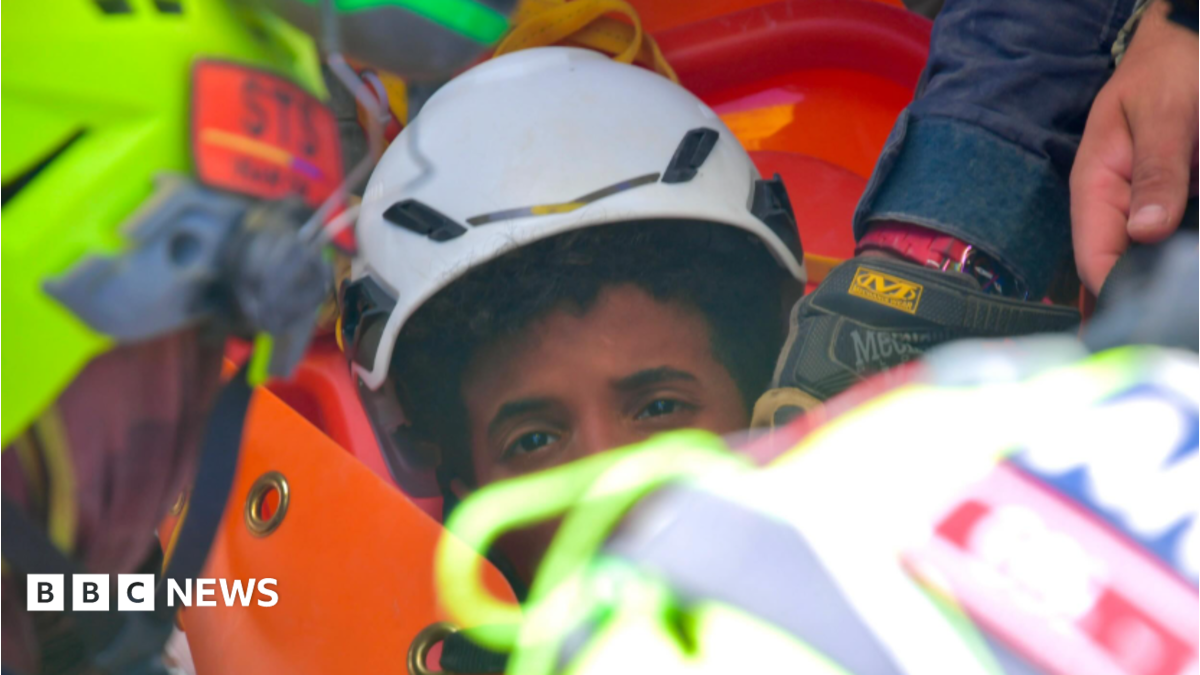
More stories of miraculous rescue have emerged from Venezuela on Sunday, days after two powerful earthquakes struck the country.
Interim President Delcy Rodríguez said 33 people had been pulled from debris alive over the weekend. Among them were two 11-year-old boys, who were separately rescued from collapsed buildings within hours of each other on Sunday.
However, with tens of thousands of people still missing, hopes of finding more survivors are fading by the hour.
Aid agencies say the first 48 to 72 hours after a disaster are crucial for finding people alive. Relatives of the missing are facing a fifth night waiting for news of their loved ones.
As of Sunday, at least 1,450 people have been killed in what Rodríguez said was the "most brutal natural catastrophe" in Venezuela's history. But the search to find survivors is not over.
Desperate families have been digging through the debris – some by hand – trying to find loved ones.
Some have told the BBC that they can hear people under the rubble, but cannot move the heavy slabs of concrete, and are waiting anxiously for heavy machinery.
The magnitude 7.2 and 7.5 quakes on Wednesday struck within 39 seconds and caused almost 800 buildings to collapse, leaving many people trapped inside.
Though the crucial 72-hour window has now passed, rescuers have said people could still be found alive, especially if they had access to food and water.
Over the weekend, Colombia's National Unit for Disaster Risk Management (UNGRD) pulled an 11-year-old boy, named as Moises from under about 3m (9.8ft) of debris.
Reuters reported that a rescuer was overheard on a walkie-talkie saying the young boy was found near his sister and mother, who had both died.
Hours later, interim President Delcy Rodríguez posted a video on X, purportedly showing the rescue of a second 11-year-old boy in the town of Caraballeda.
Frustration is growing among the hundreds of thousands of Venezuelans who have been affected by the quake, with many accusing the state of a slow and uncoordinated response.
Families have been pleading for heavy machinery to assist them in their efforts to pull loved ones from the rubble, with many using their bare hands to try and dig people out of the wreckage.
A firefighter working in Caraballeda told the BBC there are dozens of buildings yet to be searched.
"There aren't enough hands," he said. "And it is very, very likely that there are still people trapped."
In Catia La Mar, La Guaira - one of the worst-affected areas - people told the BBC that in the wake of a hesitant and mismanaged reaction from the government, it has been the people themselves who have pulled together relief efforts.
One man, Wilber, cried as he said he had lost eight of his relatives, with five of them still entombed in their homes.
He said that far from being a help, the state was actually a hindrance.
"The government decided to close the streets," he said, adding it was "making it harder to bring help".
"Yesterday we waited from 6am to 4pm to get a special permission to come here. We wasted hours," he said.
A civilian-run missing persons site puts the number of people missing in the tens of thousands, reporting more than 46,000 people who have been unreachable by family members.
Rescuers' efforts have also been hampered by aftershocks, which are in turn terrifying residents.
"To be honest, it makes you feel kind of nervous. Any little noise... horrible," Jesús Andueza, a 64-year-old bus driver told BBC Mundo.
Thousands of people are living in their cars or camping at places like the airport and golf course, away from buildings that could collapse.
The golf course in Caraballeda has become an epicentre for the emergency response.
Its green lawn, which used to be perfectly manicured, is now a makeshift hospital and donation centre, where residents who have lost everything are sifting through piles of donated clothing and boxes of humanitarian aid.
Milagros González, who lives in Caribe, told BBC Mundo that her building was one of the few that didn't collapse, and she fled as soon as she could to take refuge at the golf course.
"I left with my two young daughters and my two elderly relatives. But thank God we got out alive. The building can't be lived in. But we're alive, which is what matters," she said.
Rodríquez said the José María Vargas sports complex in La Guaira was also serving as an emergency response centre.
Pointing out that the armed forces were sorting clothes, medicine and food, Rodríguez said "everything is functioning as well as possible during these terrible moments, these terrible hours, that our people are enduring".
"Let them know that no one here is alone, not a single family or individual need [to] feel alone. Our people and our state are here, the social protection system is here, and international solidarity is here."
In recent days, international rescue teams from Mexico, Spain, Qatar, the US, and the UK have arrived to reinforce the search efforts.
The UN's Tom Fletcher said on Saturday that 39 search and rescue teams had been deployed from all over the world, with each consisting of 50-100 people.
"You're looking at almost 2,000 people surging in, 111 dogs, medical teams as well. We go in with these micro drones, they call them cockroach drones, that help us find people in the buildings."