
Venezuela earthquakes fatalities rise over 1,700: What has made it so deadly
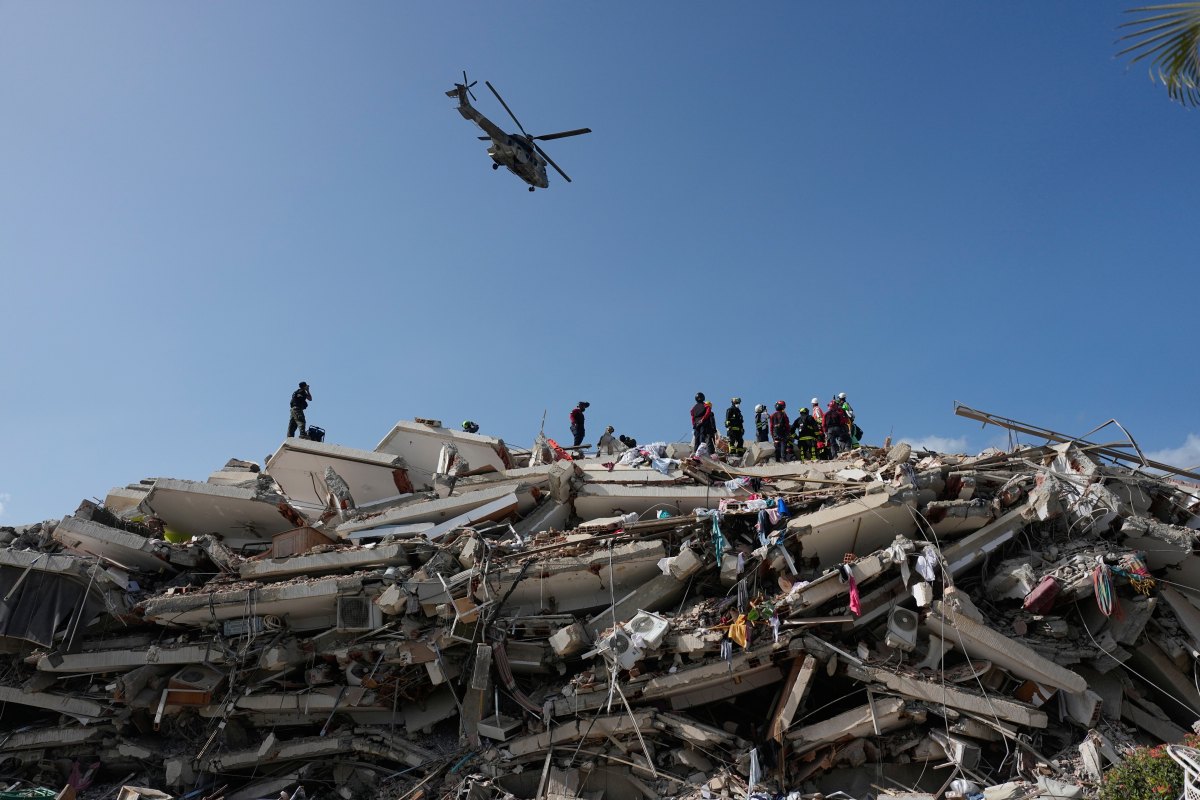
The death toll from the Venezuelan earthquakes has reached over 1,700 on Monday, with nearly 16,000 displaced, five days after 7.2- and 7.5-magnitude earthquakes hit the South American nation.
According to Jorge Rodríguez, the leader of Venezuela's National Assembly, the death toll has now reached 1,719, while 5,034 people have been injured and 15,866 displaced, The New York Times reports. Rodriguez made the announcement during a televised speech on Monday.
Venezuelans have been looking for loved ones in the wreckage with shovels, heavy equipment, ropes and even their bare hands, while a number of international rescue teams have also stepped in to assist. Estimates by the U.S. Geological Survey (USGS) suggest the death toll could eventually hit the tens of thousands.
Tensions have been mounting in the country, as many locals feel the government's response to the natural disaster has been inadequate, and that soldiers, firefighters and police were all underprepared for the scope of the tragedy.
The first 48 to 72 hours after an earthquake are considered crucial for finding missing people, though that can be extended if they have access to food and water. This means that, as it is now past that 72-hour window, many are worrying they are running out of time to be reunited with their loved ones.
Venezuelan officials said 17 flights carrying more than 1,600 rescue team members had touched down by Saturday, and more than 14,000 members of the military and police are patrolling the area, but locals in some affected zones have reported seeing little governmental support so far.
Some locals, angered by the government's response, blocked an excavator leaving the rubble in one site, pulling the operator out from the cabin after state workers were seen taking selfies in front of crumpled buildings and leaving without helping.
Venezuela was hit by an earthquake of magnitude 7.2, and 39 seconds later by one of magnitude 7.5, a rare event known as a "doublet."
A doublet is when two quakes of a similar magnitude happen in close succession, amplifying the damage caused by a single earthquake. They are rare, but Venezuela has experienced them before, with 6.2- and 6.3-magnitude earthquakes hitting in September 2025.
Judith Hubbard, an earthquake scientist at Cornell University who analyzed the recent seismic activity on Substack, wrote that a 7.2-magnitude earthquake in northern Venezuela "is already an emergency," but a 7.5-magnitude earthquake "releases about three times as much energy."
Scientists are still trying to untangle what happened in Venezuela. Hubbard wrote that "two large earthquakes one after the other might also be considered two pulses of a single large rupture, with a total moment release equivalent to ~M7.6."
A number of smaller aftershocks have also been recorded in Venezuela; a total of 11 quakes have happened in the country in the last 30 days, according to earthquaketoday.org.
The USGS has also reported that between June 19 and 26, 93 earthquakes occurred worldwide with magnitudes of 4.5 or stronger, indicating a week of heightened global seismic activity that included Venezuela's earthquake. Shortly after the major quakes in Venezuela, another was recorded in Japan and California, although scientists currently believe they are unrelated.
Buildings have collapsed across northern Venezuela. In Caracas and nearby coastal areas, at least eight hospitals, the Venezuelan Red Cross headquarters, and the French Embassy were among the buildings reported badly damaged.
William Barnhart, a geophysicist at the USGS, told NPR that part of the reason so many buildings in Caracas crumbled is that they are older and more vulnerable to strong shaking.
Chris Goldfinger, a paleoseismologist at Oregon State University, also told NPR that many of these buildings were built before the science of plate tectonics had advanced, meaning their engineering has not kept pace with evolving earthquake science.
Earthquakes typically occur at the boundaries of Earth's tectonic plates, which make up the crust and move slowly, sometimes sliding past one another. As they move past each other, they can stick, and pressure can build until they fracture and slip, releasing energy as seismic waves.
Venezuela's northern coast follows "a long right-lateral strike-slip fault," earthquake scientist Hubbard wrote on Substack. There is the Oca-Ancón fault west, and the El Pilar fault east, and then, at that junction between these two faults, is the Boconó fault, which goes southwest. Essentially, Venezuela sits on the boundary between the South American plate and the Caribbean plate.
The earthquakes happened right at this juncture, Hubbard wrote. "At this time, the earthquake focal mechanisms all point to rupture of the main east-west fault," she added.
As the death toll in Venezuela continues to rise, with estimates that it could reach the tens of thousands, whether it will become the deadliest earthquake in the last decade is unclear.
The most deadly this decade were the 2023 Turkey-Syria earthquakes, a doublet involving 7.8 and 7.7 magnitude quakes, causing more than 59,000 deaths and catastrophic damage across two countries.
Japan’s 9.0–9.1 magnitude Tohoku earthquake in 2011 was also deadly, though it was the subsequent tsunami, not the shaking, that caused most of the nearly 20,000 deaths and the Fukushima nuclear disaster.
In 2010, Haiti’s 7.0 magnitude quake remains one of the deadliest of the century, killing an estimated 100,000–160,000 people.
Chile’s 8.8 magnitude quake in 2010 triggered a destructive tsunami and caused 525 deaths, but the country’s strict building codes and dense seismic monitoring network prevented far greater losses.
Contact Newsweek editors on this story: Toby Meyjes, Edward Pearcey, and Sam Wilson.