
Victims or Volunteers? The Gray Zone of Foreigner Soldiers Fighting for Putin
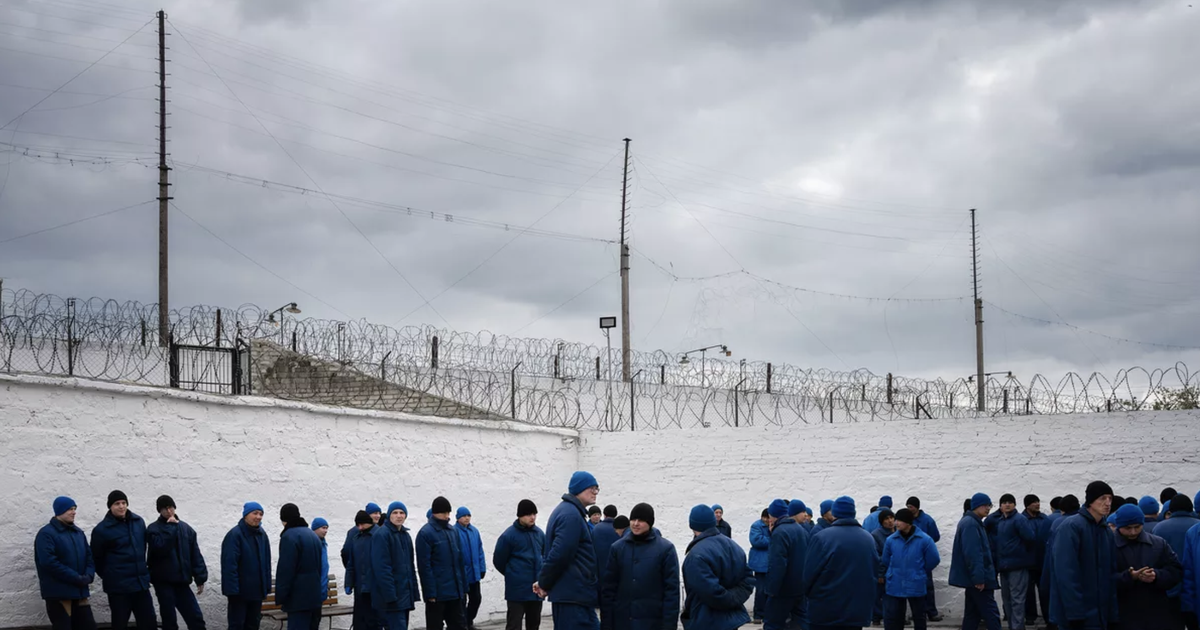
Blue-clad figures wander in front of white walls topped with barbed wire. About a hundred of them stare at the journalists—some amused, others avoiding eye contact—who have been invited by the Ukrainian authorities to visit this prisoner-of-war (POW) camp located in the Lviv region in western Ukraine.
Most are Russians captured on the front line. But many others are foreign nationals. “We have more than 30 nationalities in the various camps set up across the country,” explains Petro Yatsenko, the Ukrainian spokesperson responsible for coordinating the treatment of prisoners of war. “The most represented countries are Tajikistan, Uzbekistan, Belarus, Kazakhstan, Azerbaijan and Kyrgyzstan.”
Alongside this predominance of nationals from Central Asian countries, former Soviet republics, there are also a number of Nepalese, as well as others from several African countries. “They were sent to the front as cannon fodder, with very rudimentary training, without understanding the language and completely helpless,” Yatsenko continues. “They were promised a safe place, but in reality they were thrown onto the front line. If they have an opportunity to surrender, it is a real miracle. These men are therefore very lucky to still be alive.”
We meet Pierre, who did not want to give us his real first name but wanted to tell us his story. Like the other French-speaking Black prisoners of war with whom we were able to talk without jailers or guards nearby, Pierre is angry with media outlets that published articles claiming Russia had deceived them into going to the front. “That’s completely false. I’m a volunteer. And so are the others,” says the man who, unlike the others, claims to have been born on Russian territory. “A lot of them say they were tricked by Russia when they get captured by the Ukrainians so they won’t be executed immediately. I’ve never lied.”
Pierre was already living in Russia when the invasion began in February 2022. Why did he want to join this war and risk dying for a country that is not his own? “Because Russia is on Africa’s side!” he exclaims. “Europe impoverishes Africa. But that’s something you in the media never talk about.”
As for conditions at the front, Pierre chooses honesty: “It’s hard. Very hard. And the Russians lose enormous numbers of men every day. More than the Ukrainians, I think.”
Another prisoner tells us he chose to enlist in order to move to the country and earn money. All hope to return to Russia one day, either at the end of the war or through the prisoner exchanges organized between Kyiv and Moscow.
Denis, who also prefers to give us a false name, explains that he came to Russia to work, start a family, and hopes to see his loved ones again someday. “But we don’t understand why we’re not part of the prisoner exchanges,” he admits, refusing to believe that Moscow prefers to recover Russian nationals first. “No, I don’t believe that. Maybe it’s because the Ukrainians love us so much they don’t want to let us go,” Pierre jokes, echoing Denis’s remarks.
Denis, moreover, had still not received his passport at the time of his capture—nor all of his pay, for that matter. He is convinced both will be waiting for him when he returns to Russia.
The involvement of African fighters in Russia’s ranks is not new. Rumors began a few months after the February 2022 invasion with the case of Lemekhani Nathan Nyirenda. The 23-year-old Zambian died at the front in Ukraine on September 22, 2022, while fighting for Moscow. The foreign ministry of the southern African country then demanded answers from its Russian counterpart. At the time, it was the late Yevgeny Prigozhin, head of the Wagner paramilitary group, who said he had recruited Nyirenda and maintained that the young man had wanted to enlist despite the risks.
“You Russians helped us Africans gain independence,” the Zambian reportedly argued, according to Prigozhin, before adding: “It’s the least I can do to repay our debt.”
The Kremlin ultimately accepted responsibility for Nyirenda’s death a few weeks later.
The practice of offering sentence reductions to prisoners is not exclusive to Russia. Ukraine itself, to address its own conscription and desertion problems, passed a law allowing a similar process, although it has so far refused to allow foreign nationals to benefit from it.
At the beginning of 2024, investigations and reports multiplied, revealing that Moscow was not merely recruiting convicted foreigners but was allegedly seeking them directly in more than 20 countries. Russia would thus lure young Africans by promising ordinary civilian jobs, attractive salaries, and residence permits, only to incorporate them into the military and deploy them directly to the front after only a few weeks of rudimentary training, and with little equipment.
On social media, images circulate illustrating these practices. One viral video shows a Black man with an anti-personnel mine strapped to his chest and ordered, at gunpoint, to attack Ukrainian positions.
On February 18 of this year, Kenya’s National Assembly cited a damning report exposing a trafficking network that had sent more than 1,000 Kenyans to fight alongside the Russian army in Ukraine. Recruiters reportedly target former soldiers and police officers, offering salaries of around €2,500 per month and bonuses reaching €10,000. The promise of obtaining Russian citizenship is also said to be part of the deal.
At the center of the operation, these agencies use two Kenyan medical centers for preliminary examinations. The provisional toll for the country: “Thirty-nin are hospitalized, 30 have been repatriated, 28 are missing, 35 are deployed in camps or bases, 89 are on the front line, one is detained, and one has completed his contract,” a Kenyan lawmaker commented during the presentation of the report.
The phenomenon is not confined to Kenya. Across the continent, a multitude of short-lived companies have been created to recruit these men using contracts written in Russian. These firms often present themselves as travel agencies or employment agencies and advertise on WhatsApp or Telegram.
Kenya, Tanzania, and Zambia, but also South Africa, Nigeria, Togo, Mali, and Botswana: all of these governments have reported cases of men recruited into the Russian army on the basis of misleading information.
Questioned on the matter, Russian Foreign Minister Sergei Lavrov stated last March that “like citizens of many other countries who have signed contracts to participate in this special military operation, the Kenyans joined voluntarily.” He added: “Like any citizen, a Kenyan can suspend his participation during the contract period for various reasons.”
While acknowledging the importance of the issue for Kenya, Lavrov also recalled during that statement that his Kenyan counterpart did not wish “for this issue to dominate Russian-Kenyan relations, which have a long history of a common struggle for justice,” adding that “the two countries are on the same side, on the right side of history.”
Far from the Ukrainian front and the prisoner camps, another war is being fought—quieter, but no less significant: the war for Russian influence in Africa.