
Why BlackRock, Nvidia, and Temasek are betting billions on quantum computing | Fortune
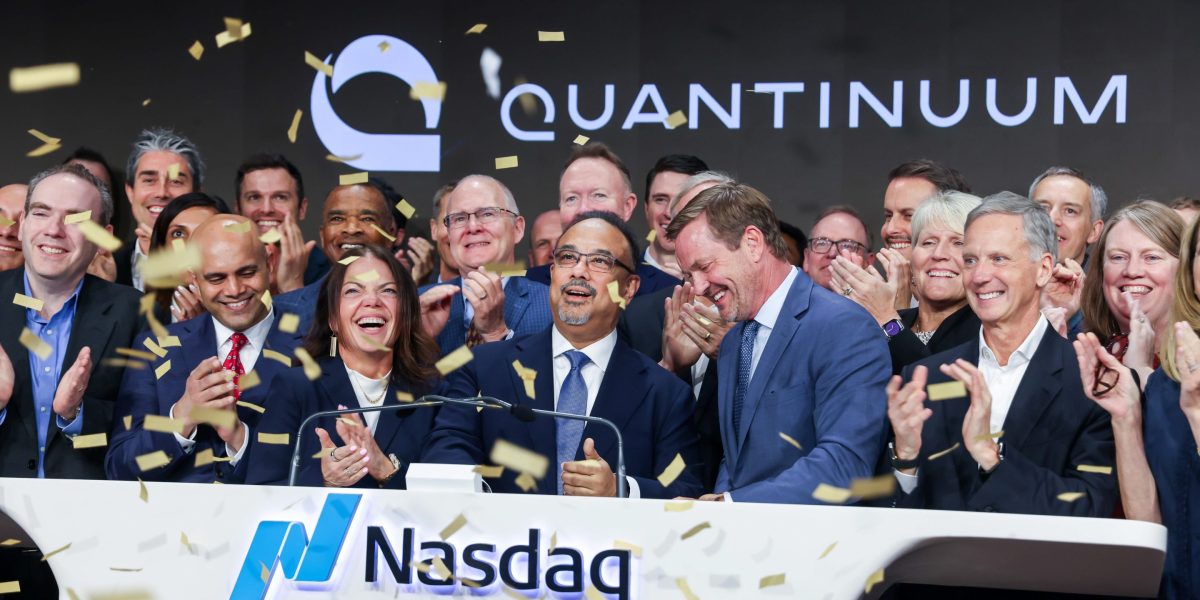
For four decades, quantum computing was all about theory. Now it’s all about term sheets.
VC investment in quantum computing hit $3.9 billion across 125 deals in 2025—the highest annual total ever recorded, per a new PitchBook report. Q3 2025 alone clocked $1.6 billion—more than any full year before 2021. And early 2026 is keeping pace: $1.2 billion landed in Q1 before the usual post-megadeal digestion.
The more telling story in the data is who is writing the checks. The top investors by capital deployed are no longer specialist quantum VCs. They’re BlackRock ($1.7 billion), Nvidia ($1.6 billion), Baillie Gifford, Ripple Impact Investments, and Temasek. The venture growth tier went from capturing roughly 1% of quantum deal value in 2024 to 30.4% in 2025 (the largest single-year stage shift in the dataset).
PitchBook senior AI analyst Dimitri Zabelin told Fortune that companies like Nvidia aren’t deploying capital carelessly. “They’re very aware the market watches them, and they’re aware of the impact if they pick a certain direction of an investment vehicle or theme,” he said.
Global data science and AI company Quantinuum serves as a strong capstone. Quantinuum raised a $838.9 million Series B at a $10 billion pre-money valuation last November. Quantinuum’s Nasdaq IPO in June raised $1.68 billion at $60 a share and debuted at $68 a share. PsiQuantum isn’t far behind, having closed a $1 billion Series E in September at a $7 billion valuation, led by BlackRock, Temasek, and Baillie Gifford.
The geopolitical overlay is impossible to ignore. Cumulative government commitments to quantum globally now exceed $60 billion, according to PitchBook. China’s 15th Five-Year Plan—adopted in early 2026—ranked quantum as its top future industry, ahead of both AI and semiconductors, backed by an estimated $17.5 billion National Guidance Venture Fund. The U.S., European Union, and Japan are all responding, but at different speeds.
On whether this is a Sputnik moment, Zabelin was pointed: “The Soviets launched Sputnik, but they still lost the race. The U.S. shouldn’t be as worried as Europe. If I were Europe, I would be much more worried. They have a tendency to regulate first and innovate later.”
Quant’s long frozen exit window also finally cracked. Four deals in Q1 2026—Xanadu, Infleqtion, Quantum Circuits, and Horizon Quantum Holdings—totaled $5.7 billion, roughly 15 times the combined exit value of the prior three years.
Still, most quantum companies have gone public via SPAC-style reverse mergers rather than traditional IPOs. And companies are still years from delivering on the big promises—breaking encryption, accelerating drug discovery, modeling molecules that classical computers can’t touch. Most insiders don’t expect a commercially useful quantum computer until the end of the decade. The median deal in 2025 was still just $9 million, against an average of $50.4 million. So, a handful of platform bets are capturing nearly all the capital while the broader early-stage pipeline stays quiet.
There’s also a talent bottleneck that money alone can’t fix. “Quantum physicists aren’t just hanging out in a bar—you can’t just pick one up and bring them to your startup,” Zabelin said.
Above all, he emphasized, “dollars invested does not always equal innovation breakthroughs. The future of quantum isn’t going to be its own system—it’s going to be working in conjunction with AI.”
The dollars are there, but whether this vintage will produce generational returns is the question only the next decade can answer.
- Quantfind, a Palo Alto, Calif.-based risk intelligence company, raised $200 million in funding. Summit Partners led the round and was joined by existing investors Citi Ventures, S&P Global, Deloitte, and Stephens Group.
- Aseon Labs, a Redwood City, Calif.-based developer of a network of robotic pit stops for autonomous vehicle fleets, raised $10 million in seed funding. Crane Venture Partners led the round and was joined by Y Combinator, Expa, and others.
- Kotoba Technologies, a San Francisco and Tokyo, Japan-based voice AI company, raised $10 million in funding. Kindred Ventures led the round and was joined by Salesforce Ventures and Sony Innovation Fund.
- An investor group led by J.C. Flowers acquired Republic Finance, a Plano, Texas-based consumer loan provider, from CVC Capital Partners. Financial terms were not disclosed.
- Warburg Pincus agreed to acquire Network Plus, a Manchester, U.K.-based utility and infrastructure service provider, from OMERS Private Equity. Financial terms were not disclosed.
- Sinda, a Guanajuato, Mexico-based silver mining company, raised $213 million in an offering of 17.8 million shares priced at $12 on the New York Stock Exchange.
- Reformation, a Vernon, Calif.-based women’s clothing brand, filed to go public on the New York Stock Exchange. Permira and the Aflalo Family Trust back the company.
Lily Mae Lazarus is a news reporter at Fortune.