
Why did Andy Burnham pick John Healey?
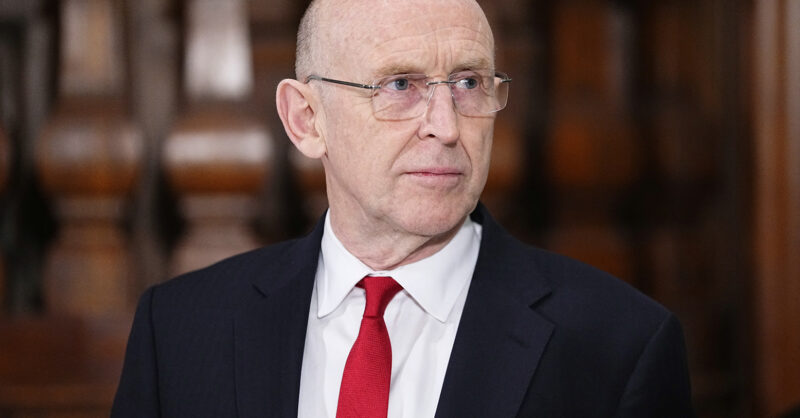
In an early sign of how leak-proof the Andy Burnham operation has been so far, journalists were confounded yesterday (20 July) when John Healey was announced as the new Chancellor of the Exchequer.
The race for the job had been reported as a head-to-head between Ed Miliband and Shabana Mahmood, with the latter in the lead. Instead, the former defence secretary got the job, with Mahmood remaining at the Home Office to pursue her immigration agenda, and Miliband moving from the energy brief to the Foreign Office (where he can still promote his net zero policies on the world stage through emissions trading schemes, global climate targets and the like).
Why Healey? One realisation that dawned in the run up to the cabinet appointments was that both Miliband and Mahmood were as divisive as each other for the Parliamentary Labour Party and the wider Labour movement, Miliband because of his net zero agenda and Mahmood because of her hawkishness on borders. Healey emerged as a more conventional choice. One minister close to Burnham said the case for Healey rested on his Treasury experience (he served as a minister in the department under Gordon Brown from 2002 to 2007), his understanding of industry (reindustrialisation is so key for Burnham that he name-checked it on the steps of No 10) and his strong relationships across the Labour “family” from left to right.
But he remains a somewhat mysterious appointment: his team has a low profile, and little of his thinking on economics is publicly available. Other staffers have noted wryly that after two years of Labour government, one of Healey’s top special advisers is not a member of the large Spads WhatsApp group. (To get a better sense of the man, check out this profile by our political editor Ailbhe Rea.) So what about his politics? Healey is usually classified as coming from the Old Right of the party, but has taken an ecumenical approach in his career, serving in both the New Labour governments and the shadow cabinet of Jeremy Corbyn. In fact, viewing this appointment through the lens of left-right internal Labour politics may be wrong entirely.
What Burnham actually wants, according to sources close to him, is a malleable chancellor who will take orders from a beefed up No 10 economics team. That is the natural endpoint of having a prime minister with a very clear vision of how he wants to restructure the economy. As one Burnham adviser puts it: “Anyone who worked with Keir will have a big gear shift. They might be quite shocked at how many strong views Andy has in a range of areas and how involved he will want to be in decisions. It will be night and day.”
An example of that is the fact that the first big announcement of the new government, a VAT cut on energy bills, was decided before Healey knew he would be tasked with the job of finding money to pay for it. There will be more of that to come, with a plan of summer announcements, also leak-proof, already drafted before the cabinet was appointed. The desire for No 10 control over economic policy is serious. As one source close to Burnham said to me: “There’s this idea now that you can never change your chancellor. But you need that threat. If Andy wants to be in control, he needs to be able to sack the chancellor.”
Healey’s apparent malleability is not a positive for all Burnhamites, however. Among those who had hoped for a Miliband chancellorship – in part because of his long experience as a Treasury adviser to Gordon Brown and his consequent ability to “master” the Treasury – there are fears that while Healey was a competent defence secretary, he was quickly “captured” by the Ministry of Defence mindset. This “capture”, for critics, was exemplified by his resignation last month over demands for more military spending.
It depends how you interpret his resignation. Was it the resignation of a minister who was more aligned with vested interests than his own government, or of a minister who was boldly challenging the Treasury orthodoxy of Rachel Reeves in an attempt to face up to the real threats to Britain he had identified? The latter, the more generous interpretation, clearly won out when Burnham was making his cabinet picks. Indeed, to follow through on the Manchesterism agenda in any sustained and meaningful way, the new chancellor will have to confront and triumph over Treasury orthodoxy and vested interests. Burnham’s big bet is that Healey will be the man to do it for him.